
Why Solar Gravity Bends Light: Gravitational Lensing, Einstein’s Theory of Relativity, and How the Sun Warps Space-Time
Discover why solar gravity bends light, how Einstein’s theory of general relativity predicts gravitational lensing, and what this reveals about space, stars, and the universe.

Introduction: When Light Does the Unexpected 🌌
Imagine staring at a distant star during a total solar eclipse. The Moon blocks the Sun’s bright glare, revealing stars that should not be visible in that exact position. Yet they appear slightly shifted—moved from where they “should” be.
For centuries, light was believed to travel in perfectly straight lines unless it hit something physical. Gravity, after all, was thought to pull only on objects with mass.
But in the early 20th century, science revealed something astonishing:
Gravity can bend light.
And the Sun is massive enough to do exactly that.
This discovery changed our understanding of space, time, and the structure of the universe itself. To understand why solar gravity bends light, we must explore one of the most important scientific ideas ever developed.
________________________________________
The Foundation: Einstein’s Theory of General Relativity 🧠
The reason solar gravity bends light comes from Albert Einstein’s theory of general relativity.
Before Einstein, gravity was described by Newton as a force between masses. But Einstein proposed something deeper.
He suggested that gravity is not just a force—it is the curvature of space and time.
According to general relativity:
• Massive objects warp space-time.
• Objects move along the curved paths created by that warping.
• Light follows the curvature of space.
This means that when light passes near a massive object like the Sun, it does not travel in a perfectly straight geometric line. Instead, it follows the curved structure of space-time itself.
The Sun’s mass is so large that it significantly warps the space around it.
________________________________________
How Mass Warps Space-Time ☀️
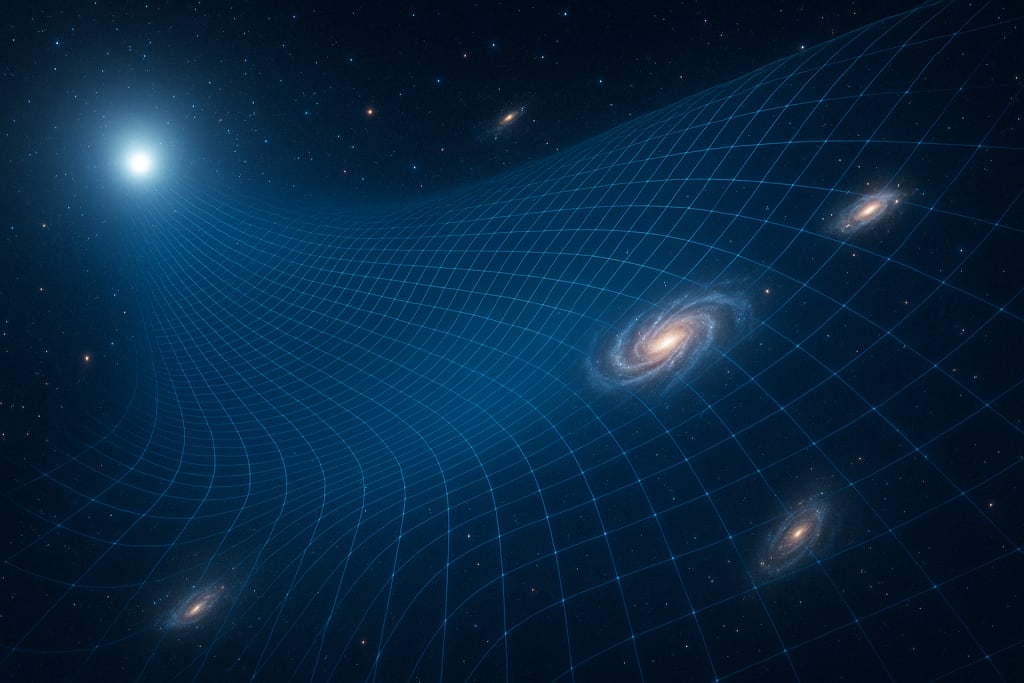
To understand this, imagine space-time as a stretched fabric.
If you place a heavy object on that fabric, it creates a dip.
The more massive the object, the deeper the curve.
The Sun is extremely massive—about 333,000 times the mass of Earth. Because of this, it creates a noticeable curvature in the surrounding space-time.
Light passing near the Sun must travel through this curved region.
Since light always follows the shortest possible path (called a geodesic) in space-time, it bends along the curvature.
This bending is not because light has mass in the traditional sense. Instead, it is because space itself is curved.
________________________________________
Why Light Is Affected Even Though It Has No Mass 💡
Light consists of photons, which have no rest mass.
However, photons still follow the geometry of space-time.
In general relativity, gravity affects:
• Matter
• Energy
• Light
Because light carries energy, it responds to gravitational curvature.
This is why solar gravity bends light—even though light is not a massive object.
The Sun’s gravitational field changes the structure of space around it, and light follows that structure.
________________________________________
The First Proof: The 1919 Solar Eclipse 🌒
One of the most famous confirmations of this idea happened during a total solar eclipse in 1919.
During the eclipse, astronomers measured the positions of stars near the Sun.
They discovered that the stars appeared slightly shifted from their normal positions.
The Sun’s gravity had bent their light.
This observation matched Einstein’s predictions from general relativity.
The experiment became one of the most important scientific confirmations in history and helped establish Einstein’s theory as a major breakthrough in physics.
________________________________________
What Is Gravitational Lensing? 🔭
When light bends around a massive object like the Sun, the effect is called gravitational lensing.
In simple terms, the massive object acts like a lens.
There are different types of gravitational lensing:
• Weak lensing: Slight bending of light, causing small distortions.
• Strong lensing: Noticeable arcs or multiple images of distant objects.
• Microlensing: Small temporary brightening due to alignment.
The Sun produces weak gravitational lensing compared to galaxies or black holes, but the effect is measurable.
Gravitational lensing is now one of the most powerful tools in modern astronomy.
________________________________________
How Much Does the Sun Bend Light? 📐
The Sun bends light by a very small but measurable amount.
The deflection angle depends on how close the light passes to the Sun.
Light passing near the edge of the Sun’s surface bends by a tiny fraction of a degree.
Although this sounds extremely small, it is enough for astronomers to detect with precise instruments.
This bending confirms the relationship between mass and space-time curvature predicted by Einstein.
________________________________________
Why the Effect Is Stronger Near Massive Objects 🪐
The more massive an object is, the more it warps space-time.
The Sun bends light slightly. But much more massive objects—such as neutron stars or black holes—bend light dramatically.
In extreme cases:
• Light can form rings around objects (called Einstein rings).
• Multiple images of the same galaxy can appear.
• Light can orbit a black hole.
The Sun’s effect is modest compared to these extreme cases, but it is still scientifically significant.
________________________________________
Does the Sun’s Gravity Change the Color of Light? 🌈
Gravity affects the path of light, but it can also influence its energy.
When light moves through a gravitational field, it experiences a phenomenon known as gravitational redshift.
However, the primary effect of solar gravity on light passing nearby is deflection—not color change.
The bending of light is the most visible and historically important consequence.
________________________________________
Why This Matters for Modern Astronomy 🚀
Gravitational lensing is not just a theoretical idea.
It helps scientists:
• Study distant galaxies
• Detect dark matter
• Observe exoplanets
• Measure cosmic expansion
Even the Sun plays a role in understanding these effects.
By studying how solar gravity bends light, scientists refine measurements of space-time curvature and test Einstein’s predictions with high precision.
________________________________________
Space-Time Is Not Empty
One of the most important lessons from this discovery is that space is not just empty background.
Space-time has structure.
Mass changes that structure.
The Sun continuously shapes the geometry of the solar system through its gravitational influence.
Every planet, asteroid, and beam of light moving nearby is affected by this curvature.
________________________________________
The Sun as a Cosmic Lens 🔆
Although we usually think of lenses as glass objects, gravity can also act like a lens.
The Sun bends light slightly, making it a natural gravitational lens.
In some rare alignments, the Sun’s gravity can even focus light from distant objects, enhancing their brightness.
This principle is used on much larger scales in astronomy, where galaxies and galaxy clusters create powerful lensing effects.
________________________________________
A Revolutionary Idea About Reality 🌠
Before Einstein, gravity was seen as a force acting across distance.
After general relativity, gravity became understood as geometry.
The Sun does not “pull” light in the traditional sense.
Instead, it reshapes the fabric of space-time.
Light follows that reshaped fabric.
This idea fundamentally changed physics and remains one of the most tested scientific theories in history.
________________________________________
Conclusion: The Sun’s Invisible Influence ☀️
The reason solar gravity bends light is rooted in the nature of space-time itself.
The Sun’s enormous mass curves space around it. Light traveling through that curved region follows the geometry of space-time, resulting in measurable bending.
This phenomenon—gravitational lensing—was one of the first major confirmations of Einstein’s general relativity and remains a cornerstone of modern astrophysics.
From solar eclipses to distant galaxies, the bending of light reveals the deep connection between mass, space, and time.
The Sun does more than illuminate our world.
It warps the very structure of space around it—quietly shaping the paths of light across the universe. 🌌
Introduction: When Light Does the Unexpected 🌌
Imagine staring at a distant star during a total solar eclipse. The Moon blocks the Sun’s bright glare, revealing stars that should not be visible in that exact position. Yet they appear slightly shifted—moved from where they “should” be.
For centuries, light was believed to travel in perfectly straight lines unless it hit something physical. Gravity, after all, was thought to pull only on objects with mass.
But in the early 20th century, science revealed something astonishing:
Gravity can bend light.
And the Sun is massive enough to do exactly that.
This discovery changed our understanding of space, time, and the structure of the universe itself. To understand why solar gravity bends light, we must explore one of the most important scientific ideas ever developed.
________________________________________
The Foundation: Einstein’s Theory of General Relativity 🧠
The reason solar gravity bends light comes from Albert Einstein’s theory of general relativity.
Before Einstein, gravity was described by Newton as a force between masses. But Einstein proposed something deeper.
He suggested that gravity is not just a force—it is the curvature of space and time.
According to general relativity:
• Massive objects warp space-time.
• Objects move along the curved paths created by that warping.
• Light follows the curvature of space.
This means that when light passes near a massive object like the Sun, it does not travel in a perfectly straight geometric line. Instead, it follows the curved structure of space-time itself.
The Sun’s mass is so large that it significantly warps the space around it.
________________________________________
How Mass Warps Space-Time ☀️
To understand this, imagine space-time as a stretched fabric.
If you place a heavy object on that fabric, it creates a dip.
The more massive the object, the deeper the curve.
The Sun is extremely massive—about 333,000 times the mass of Earth. Because of this, it creates a noticeable curvature in the surrounding space-time.
Light passing near the Sun must travel through this curved region.
Since light always follows the shortest possible path (called a geodesic) in space-time, it bends along the curvature.
This bending is not because light has mass in the traditional sense. Instead, it is because space itself is curved.
________________________________________
Why Light Is Affected Even Though It Has No Mass 💡
Light consists of photons, which have no rest mass.
However, photons still follow the geometry of space-time.
In general relativity, gravity affects:
• Matter
• Energy
• Light
Because light carries energy, it responds to gravitational curvature.
This is why solar gravity bends light—even though light is not a massive object.
The Sun’s gravitational field changes the structure of space around it, and light follows that structure.
________________________________________
The First Proof: The 1919 Solar Eclipse 🌒
One of the most famous confirmations of this idea happened during a total solar eclipse in 1919.
During the eclipse, astronomers measured the positions of stars near the Sun.
They discovered that the stars appeared slightly shifted from their normal positions.
The Sun’s gravity had bent their light.
This observation matched Einstein’s predictions from general relativity.
The experiment became one of the most important scientific confirmations in history and helped establish Einstein’s theory as a major breakthrough in physics.
________________________________________
What Is Gravitational Lensing? 🔭
When light bends around a massive object like the Sun, the effect is called gravitational lensing.
In simple terms, the massive object acts like a lens.
There are different types of gravitational lensing:
• Weak lensing: Slight bending of light, causing small distortions.
• Strong lensing: Noticeable arcs or multiple images of distant objects.
• Microlensing: Small temporary brightening due to alignment.
The Sun produces weak gravitational lensing compared to galaxies or black holes, but the effect is measurable.
Gravitational lensing is now one of the most powerful tools in modern astronomy.
________________________________________
How Much Does the Sun Bend Light? 📐
The Sun bends light by a very small but measurable amount.
The deflection angle depends on how close the light passes to the Sun.
Light passing near the edge of the Sun’s surface bends by a tiny fraction of a degree.
Although this sounds extremely small, it is enough for astronomers to detect with precise instruments.
This bending confirms the relationship between mass and space-time curvature predicted by Einstein.
________________________________________
Why the Effect Is Stronger Near Massive Objects 🪐
The more massive an object is, the more it warps space-time.
The Sun bends light slightly. But much more massive objects—such as neutron stars or black holes—bend light dramatically.
In extreme cases:
• Light can form rings around objects (called Einstein rings).
• Multiple images of the same galaxy can appear.
• Light can orbit a black hole.
The Sun’s effect is modest compared to these extreme cases, but it is still scientifically significant.
________________________________________
Does the Sun’s Gravity Change the Color of Light? 🌈
Gravity affects the path of light, but it can also influence its energy.
When light moves through a gravitational field, it experiences a phenomenon known as gravitational redshift.
However, the primary effect of solar gravity on light passing nearby is deflection—not color change.
The bending of light is the most visible and historically important consequence.
________________________________________
Why This Matters for Modern Astronomy 🚀
Gravitational lensing is not just a theoretical idea.
It helps scientists:
• Study distant galaxies
• Detect dark matter
• Observe exoplanets
• Measure cosmic expansion
Even the Sun plays a role in understanding these effects.
By studying how solar gravity bends light, scientists refine measurements of space-time curvature and test Einstein’s predictions with high precision.
________________________________________
Space-Time Is Not Empty
One of the most important lessons from this discovery is that space is not just empty background.
Space-time has structure.
Mass changes that structure.
The Sun continuously shapes the geometry of the solar system through its gravitational influence.
Every planet, asteroid, and beam of light moving nearby is affected by this curvature.
________________________________________
The Sun as a Cosmic Lens 🔆
Although we usually think of lenses as glass objects, gravity can also act like a lens.
The Sun bends light slightly, making it a natural gravitational lens.
In some rare alignments, the Sun’s gravity can even focus light from distant objects, enhancing their brightness.
This principle is used on much larger scales in astronomy, where galaxies and galaxy clusters create powerful lensing effects.
________________________________________
A Revolutionary Idea About Reality 🌠
Before Einstein, gravity was seen as a force acting across distance.
After general relativity, gravity became understood as geometry.
The Sun does not “pull” light in the traditional sense.
Instead, it reshapes the fabric of space-time.
Light follows that reshaped fabric.
This idea fundamentally changed physics and remains one of the most tested scientific theories in history.
________________________________________
Conclusion: The Sun’s Invisible Influence ☀️
The reason solar gravity bends light is rooted in the nature of space-time itself.
The Sun’s enormous mass curves space around it. Light traveling through that curved region follows the geometry of space-time, resulting in measurable bending.
This phenomenon—gravitational lensing—was one of the first major confirmations of Einstein’s general relativity and remains a cornerstone of modern astrophysics.
From solar eclipses to distant galaxies, the bending of light reveals the deep connection between mass, space, and time.
The Sun does more than illuminate our world.
It warps the very structure of space around it—quietly shaping the paths of light across the universe.
About the Creator
Keep reading
More stories from shahkar jalal and writers in Education and other communities.
How the Sun Affects Asteroid Paths: Gravity, Radiation Pressure, and Orbital Changes Explained
Introduction: The Silent Influence of the Sun ☀️ Every night, thousands of asteroids quietly move through space. Most of them orbit harmlessly between Mars and Jupiter in the asteroid belt. Others travel closer to Earth, following paths shaped by invisible forces.
By shahkar jalalabout 11 hours ago in Education
Atlas Aluminum Corp Parts Catalog: Aerospace Manufacturing, Aviation Hardware, and Industrial Aluminum Components
Introduction: My Research Into Atlas Aluminum Corp Parts Catalog While exploring aerospace hardware suppliers and industrial component manufacturers, I came across the Atlas Aluminum Corp Parts Catalog listed on the NSN platform. What fascinated me most was how manufacturers like Atlas contribute to the broader ecosystem of aerospace engineering, aviation structures, and industrial aluminum components.
By Beckett Dowhan6 days ago in Education
Millions Have ADHD — Here's What That Means
ADHD is a neurodevelopmental condition that manifests with symptoms of inattention, hyperactivity, and impulsivity, often interfering with various aspects of daily life. It is most commonly diagnosed in childhood but can persist into adulthood, affecting how people function at work, in school, and in personal relationships.
By Madhuri Janviabout 20 hours ago in Education


Comments
There are no comments for this story
Be the first to respond and start the conversation.