
Beyond the One-Size-Fits-All Classroom: How Personalized Learning is Redefining Education for Real Kids
From Stagnant Standardization to Thriving Individuality: How Personalized Learning is Writing a New Story for Today’s Students
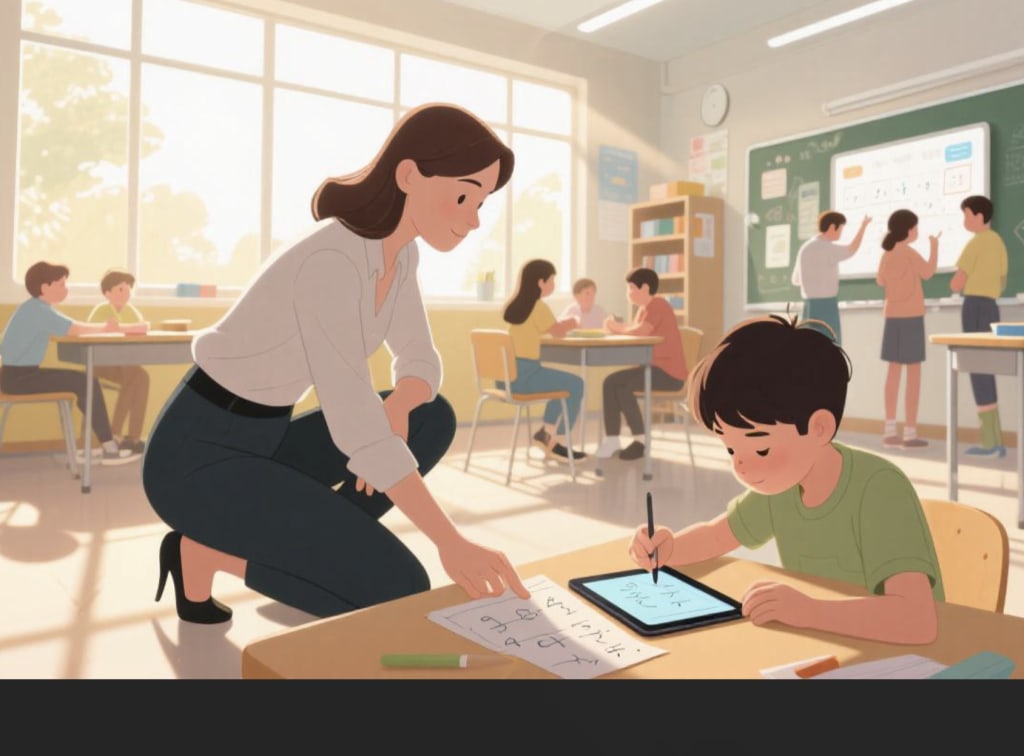
Let me tell you a story. Last month, I sat in on a 7th-grade math class at Maplewood Middle School in Austin, Texas. Ms. Carter, the teacher, wasn’t lecturing from a textbook. Instead, she was kneeling beside a student named Liam, who was stuck on fractions, while across the room, Maria—already acing the basics—was dissecting a real-world budgeting problem on her tablet. No two students were doing the same thing. And guess what? The energy in that classroom felt alive.
This isn’t a scene from a futuristic movie. It’s happening right now, in schools across the U.S.—and it’s called personalized learning. But here’s the thing: it’s not just a buzzword. It’s a lifeline for kids like Liam, who’ve been told for too long to “keep up or fall behind,” and a game-changer for educators drowning in one-size-fits-all lesson plans.
The Problem with “Standardization”
Let’s be honest: traditional education was built for factory workers, not future innovators. Think about it: we group 25+ kids by age, teach them the same material at the same pace, and test them on the same day. But here’s the reality—no two brains learn the same way. A 2024 study by the National Center for Education Statistics found that 68% of 9th graders say they’ve “zoned out” in class because the material felt either too easy or too hard. Worse, 40% of teachers admit they spend more time “managing the middle” than supporting struggling students or challenging advanced ones.
I saw this firsthand as a 5th-grade teacher. Emma, a shy student with dyslexia, would shut down during reading groups. Meanwhile, Ethan, a voracious reader, would finish assigned books in an hour and beg for more. Both were bright, but our system treated them like cogs in a machine. That’s not education—it’s compliance.
Enter Personalized Learning: Education That Fits
Personalized learning flips the script. At its core, it’s about tailoring instruction to each student’s strengths, needs, and interests. But how does that actually work in practice? Let’s break it down:
1. Data-Driven Insights (Without the Spreadsheets)
Teachers no longer guess—they use tools like Classcraft (www.classcraft.com), a platform that tracks student progress, identifies learning gaps, and even suggests personalized “quests” (think: mini-projects) to keep kids engaged. In Ms. Carter’s class, Classcraft flags when a student like Liam struggles with fractions, prompting her to pull a small-group lesson on visual models—just for him.
2. Student-Led Pacing
Gone are the days of “finish Chapter 3 by Friday.” Platforms like Khan Academy (www.khanacademy.org) let students move ahead if they master a concept or revisit basics if they need time. For Maria, this meant diving into algebra early—while still getting support in geometry during office hours. Her confidence? Through the roof.
3. Passion-Driven Projects
Personalized learning isn’t just about academics—it’s about ownership. At Washington High School in Oregon, students in a “Genius Hour” program spend 90 minutes a week on projects they care about. Last year, a sophomore named Javi designed a solar-powered water filter for his community, using math, science, and public speaking skills he’d learned in class. When kids connect learning to their lives, they don’t just study—they create.
The Human Side of Tech: Why Tools Matter (But Teachers Still Rule)
Critics worry personalized learning means replacing teachers with algorithms. Nothing could be further from the truth. In fact, tech amplifies what great teachers do best: connect, inspire, and adapt.
Take Nearpod (www.nearpod.com), a tool that lets teachers create interactive lessons with quizzes, polls, and virtual reality field trips—all in real time. During a history unit on the Civil Rights Movement, Ms. Carter used Nearpod to send students on a VR tour of the Selma March. Then, she split them into groups: some analyzed primary sources, others wrote letters to historical figures, and a few designed protest posters. The result? Deeper engagement, critical thinking, and a classroom full of voices—all heard.
So, Where Do We Go From Here?
The shift to personalized learning isn’t about ditching textbooks or “tech-ing up” classrooms. It’s about rethinking our definition of “school.” It’s about asking, “What does this child need to thrive?” instead of “What does this curriculum require this child to do?”
To the teachers reading this: You’re already the heart of this movement. Start small—try a flipped classroom, use a peer-tutoring app, or let students choose their next research topic. To parents: Ask your school board about personalized learning initiatives. And to students: Speak up. Your curiosity matters.
Education isn’t one-size-fits-all. It never was. And thanks to tools that empower teachers and students, we’re finally building classrooms where every kid can shine.
Got questions about personalized learning tools? Drop them in the comments—I’ll share my top 5 picks for 2025 (and how to use them without breaking the bank).
---
[Your Name] is a former 5th-grade teacher turned education advocate, sharing actionable insights on making learning human again. Follow her on X @EdReimagined for daily tips.
P.S. If you’re a teacher looking for free, classroom-tested resources, check out https://www.teacherspayteachers.com/—a community of educators sharing lesson plans, activities, and tech hacks. (Full disclosure: I contribute there, but it’s 100% teacher-approved!)
About the Creator
Keep reading
More stories from liang ming and writers in Education and other communities.
Beyond the Textbook: How Personalized Learning is Rewriting the Rules of Education
Let me start with a memory. Three years ago, I sat in a crowded 9th-grade math classroom, watching my friend Mia—bright, curious, but perpetually stuck—raise her hand yet again. “I just don’t get quadratic equations,” she whispered, her voice cracking. The teacher, juggling 30 students, nodded empathetically but moved on. By the end of the term, Mia had barely passed, and I wondered: Is this really the best we can do for kids?
By liang ming6 months ago in Education
Earning Money Online Through Freelancing
Earning Money Online Through Freelancing In today’s digital world, earning money online has become easier than ever before. One of the most popular and trusted ways to make money online is through freelancing. Freelancing allows people to work independently, use their skills, and earn income without being tied to a traditional office job. With just a computer, an internet connection, and useful skills, anyone can start freelancing from anywhere in the world.
By Bilal Mohammadi2 days ago in Education
Adding Tech to Ed
Technology is reshaping education in ways that were unimaginable just a generation ago. While access to quality learning was once limited by geography, income, language, or physical ability, digital innovation is steadily removing many of those barriers. Today, technology is not simply enhancing classrooms—it is expanding who education is for, when it happens, and how it is experienced. By increasing flexibility, personalization, and inclusion, technology is making education more accessible to learners of all ages and backgrounds.
By Dennis Muizers Lovejoy2 days ago in Education


Comments
There are no comments for this story
Be the first to respond and start the conversation.