
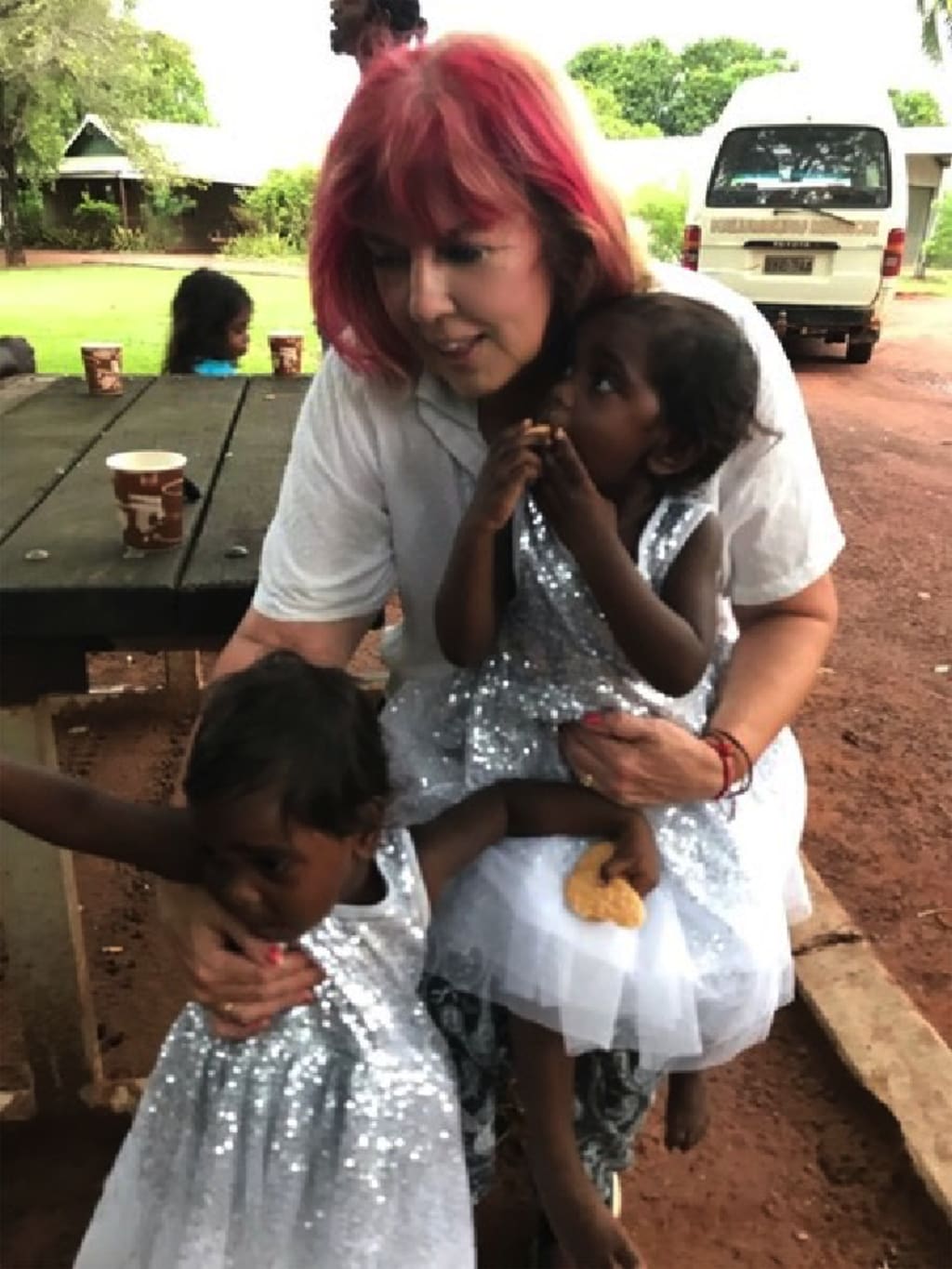
Auntie Liz and the Kalumburu kids.
Auntie Liz with kids at Kalumburu.
Teaching is a good lark for the work-shy, some say. Little physical labour, not much mental work either after the first year when you’ve got your lesson plans all done, and there’s a short working day with 12 weeks’ annual leave and you get a fulltime salary. Perhaps some teachers do take up the profession with an easy life in mind, but I know one Australian teacher who didn’t.
I first met Liz Myers in 2008 in Darwin in the Northern Territory of Australia. She was working as a teacher running a program for Indigenous kids in a local school. I soon came to realise that this was just one step in her 18-year effort to improve the shockingly poor educational outcomes and quality of life of Indigenous children in remote communities.
Liz embarked on this odyssey in 2002, when she visited the 2000-strong community of Kalumburu in the most remote corner of the Kimberley. She found all the sad clichés about Indigenous communities were true, in this case anyway – near-universal unemployment, rampant alcoholism, child abuse, domestic violence, gambling addiction, laughable attendance rates at the local school.
She saw that the attempts by various dispirited and out-of-touch government departments to improve things were largely ineffectual, and that the only path by which any of the Kalumburu children could have a bright future was for them to attend a decent boarding school. That was of course completely unaffordable for any of the Kalumburu parents, although many of them were very keen to find some way for their kids to do this. Liz was at the time teaching at Monivae College in Hamilton, Victoria, and she decided to start a programme for Kalumburu kids to attend Monivae.
Which was much easier said than done. The costs would be substantial – four return airfares from one corner of the continent to the opposite corner, plus boarding fees, uniform costs and so forth, for each child. She managed to persuade Monivae College to waive the boarding fees, fund the airfares and accommodate a number of Year 7 students with a new intake to start each year. The intake varied depending on the number of children of the right age who Liz thought would probably benefit from the programme, but was usually between 4 and 8 students.
Liz agreed to supervise the programme in addition to her regular teaching duties. This meant in essence doubling her working hours with no pay rise.
She had to arrange the air tickets (usually much complicated by last-minute parental changes of plan), and accompany the kids on the aircraft for each flight. This meant getting to Melbourne (a 300km drive) flying to Perth or Broome, flying to Kununurra, then chartering a small aircraft to Kalumburu, collecting the kids and then doing the same in reverse. Twice each holidays.
Often there would be a funeral all the kids had to attend in Kalumburu during the term (cultural protocol did not allow them to be exempt from attending these) so Liz accumulated an impressive amount of travel miles each year. While still teaching her regular classes.
During the term she acted as de facto guardian for all the kids. She had to help them adjust to a radically new way of life, while dealing with all the usual problems of teenagers as well as those inherent in children from a severely disadvantaged background. She also devised individual academic programs for those children who needed remedial tuition in one or more subjects (which was nearly all of them). She advised and liaised with all of the kids’ teachers to monitor their progress. She assigned and liaised with teacher aides when they were available.
She acted as chauffeur when one of the kids needed to go to the doctor or dentist. She often took them into town during her lunch hour to buy phone credit or some other essential item. Very often with Liz’s own money.
Her evenings were often interrupted by phone calls from a kid who was homesick or had other emotional needs, or from a mother who needed to discuss some issue or who had been drinking and was aggressive and incoherent, or sometimes from the boarding house staff if there was some problem they felt Liz could handle better than they could.
Her weekends were often entirely taken up with a visit from the current kids in the programme, to give them a break from the boarding environment.
Racism sometimes reared its head, which Liz found was the worst thing she had to deal with. Mostly it was taunts from other kids at the school, but it occurred also in less overt forms from some other staff members and from some of the parents of non-Indigenous pupils. The kids were of course very sensitive to this, and for some of them it was just too much and they dropped out of the programme.
Kids dropped out for other reasons too – they were too homesick, or couldn’t make any friends, or they became pregnant or their mother needed them back for reasons of her own.
When this happened it upset Liz very much, but she felt that the time the child had spent at the school was going to be of worthwhile value to his or her life. It is pleasing to see that Liz now has a student in Yr 8 who is the daughter of one of her very first students. Trust has been built between Liz and the people in the community, not an easy task!
And there were some full-fledged successes. Kids who went to university, or became nurses or found work on outback stations.
Perhaps the programme’s greatest achievement has been as an exemplar. When she began doing this Liz was unaware of any similar arrangements between remote communities and other private schools. Now there are many, and the Federal Government spends $145 million a year on the ABSTUDY programme to support this movement. In 2017 3000 children from remote communities went to boarding school.
Twice Liz had to take time off teaching for personal reasons and on both occasions the programme failed – all the kids withdrew and it was not until Liz returned to Monivae that it could restart. The reasons for the failures on these occasions were twofold – (a) that the teachers who replaced Liz, though motivated to make it work, could not or would not spare the enormous amount of unpaid extra time needed, and (b) they just didn’t have Liz’s profound empathy for and understanding of Indigenous people.
The main reason this programme was so successful was that Liz was able to establish a strong relationship of trust with the people of Kalumburu. After centuries of colonial oppression, violence, abuse and neglect they had a profound distrust of white people, but Liz was able to make them believe she had their and their kids’ interests at heart, and after a while she was adopted as an honorary member of the tribe and became ‘Auntie Liz’. This title was symbolic of her acceptance into the clan, and Liz is very proud of it.
As a white Australian Liz feels a deep remorse for her ancestors’ poor treatment of Australia’s First People, and has spent much of her life trying to right the wrongs that were committed.
I would very much like to see Liz honoured in some appropriate way for her extraordinary achievements.
About the Creator
Keep reading
More stories from writers in Education and other communities.
Half Dollars That Defied Time: Kennedy, Franklin & Walking Liberty
If you’ve found yourself holding an old half dollar, you’ve probably wondered: is this just pocket change, or could it be something more? I’ve had that same conversation with countless collectors in my eight years as a numismatist. The answer often hinges on three legendary names: Walking Liberty, Franklin, and Kennedy. More than just silver, these coins are tangible pieces of 20th-century America. This guide will help you understand their stories, values, and which one might be the perfect fit for your goals, whether you're building a collection or an investment.
By Laura Bennett3 days ago in Education
Silver Screen Magic with Mae West
American actress and singer Mae West became a popular film actress during the Great Depression. She started entertaining in vaudeville, then performed on Broadway, and finally went to Hollywood. She signed up with Paramount Pictures and made her debut in the 1932 film “Night After Night.” She also starred in musicals, comedies, and crime dramas. The American Film Institute named her one of the best classic Hollywood actresses.
By Rasma Raisters4 days ago in Geeks




Comments
There are no comments for this story
Be the first to respond and start the conversation.