
Half Dollars That Defied Time: Kennedy, Franklin & Walking Liberty
Expert guide by Laura Bennett. Compare 90% silver half dollars for investment & collecting. Learn key dates, values, and which coin is right for you.

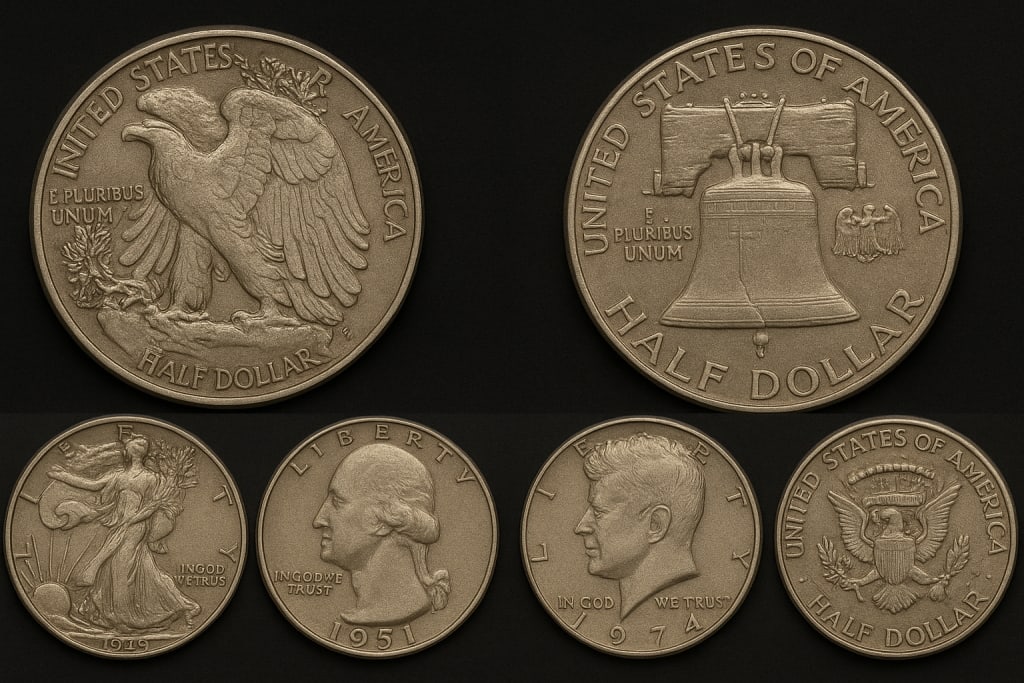
If you’ve found yourself holding an old half dollar, you’ve probably wondered: is this just pocket change, or could it be something more? I’ve had that same conversation with countless collectors in my eight years as a numismatist. The answer often hinges on three legendary names: Walking Liberty, Franklin, and Kennedy. More than just silver, these coins are tangible pieces of 20th-century America. This guide will help you understand their stories, values, and which one might be the perfect fit for your goals, whether you're building a collection or an investment.
Why These Three Half Dollars Are American Icons
Each of these series captures a distinct moment in time. The Walking Liberty half dollar (1916-1947) is widely considered the most beautiful U.S. coin ever designed. Its image of Lady Liberty striding confidently toward the dawn represents the nation’s spirit through two world wars. For collectors, it’s the ultimate prize—a coin valued for its art as much as its silver.
The Franklin half dollar (1948-1963) reflects a more pragmatic, forward-looking America. Honoring the inventor and statesman, it’s a favorite for detail-oriented collectors. The hunt is for coins with "Full Bell Lines" (FBL)—crisp, complete lines at the base of the Liberty Bell on the reverse. It’s a series where tiny details can mean a huge difference in value.
Then came the Kennedy half dollar in 1964, born from national tragedy. The public demand to honor the president was immense, and the 1964 issue became an instant piece of history. Crucially, it was the last 90% silver half dollar intended for everyday circulation. This makes it a direct link to the end of the silver coin era and the most recognizable silver coin in the world today.
Specifications, Silver Content & Key Dates
While they share a denomination, their details tell different stories. Investors care about silver content; collectors hunt key dates.
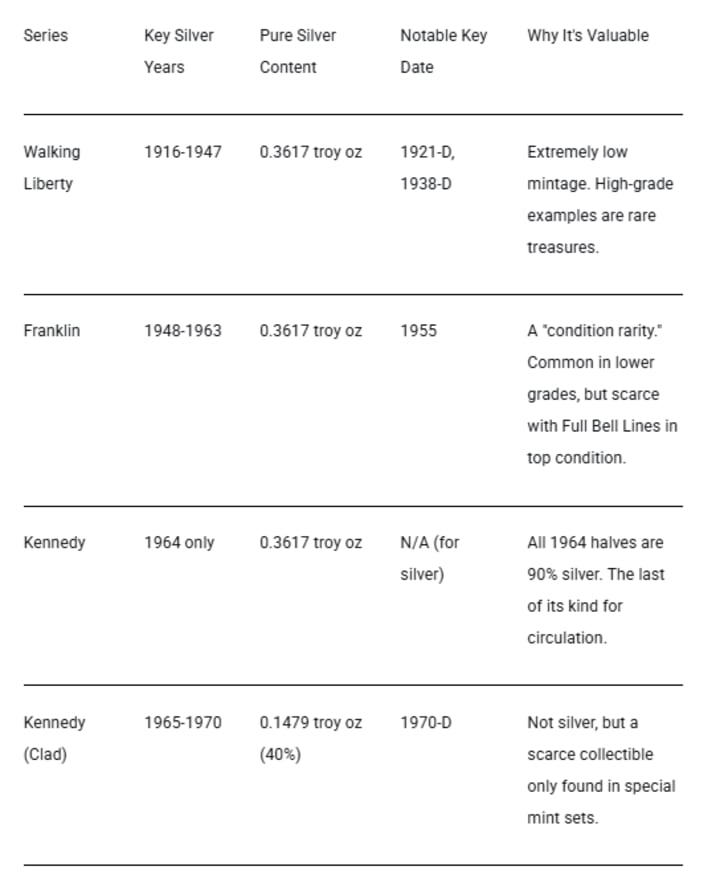
- Walking Liberty Focus: The 1921 and 1938-D are the stars. Finding one in well-worn condition is an achievement. Early issues (1916-1917) with the mint mark on the front (obverse) are also highly sought after.
- Franklin Focus: Beyond the famous 1955, look for the 1949-D and 1953-S for their low mintages. Value in this series is intensely tied to the sharpness of the strike.
- Kennedy Note: Remember, only 1964 is 90% silver. For a precise valuation on the unique 40% silver coins (1965-1970), using a dedicated coin value checker is your best bet.
The Investor's Perspective: Melt Value, Premiums & Liquidity
You can look at these coins as silver bullion, but the real story is in the premium—the extra amount you pay (or earn) above the value of the raw metal.
Let’s say silver is $25 per ounce.
Base Melt Value: 0.3617 oz x $25 = $9.04.
That’s the absolute minimum value for any worn 90% silver half.
But in the collector’s market, prices soar above that base. The chart below shows how demand and rarity create a premium for uncirculated (MS-63) coins.
Kennedy 1964: The Liquid Asset. These have the smallest premium. Think of them as the "blue-chip stock" of constitutional silver—easy to buy and sell because millions were saved. They’re perfect for building a straightforward silver portfolio.
Franklin & Walking Liberty: The Value-Play Assets. These carry higher premiums thanks to age, beauty, and fewer surviving in top condition. That premium can protect you if silver prices dip, but it also means they can be slower to sell. You’re paying for history and artistry.
The Collector's Eye: Grading and Key Details
This is where a coin becomes more than metal. A single grade point can double its value. For these series, wear shows in specific spots.
Walking Liberty: Check the center of the design—the lines on Liberty’s skirt and her left leg. On the reverse, the eagle’s breast feathers are a telltale spot. Strong detail here is crucial.
Franklin: It’s all about Full Bell Lines (FBL). Examine the horizontal lines at the Liberty Bell’s base. On a top-grade coin, every line is sharp and complete. Missing lines drastically reduce value, even if the coin looks shiny and new.
Kennedy (1964): Focus on Kennedy’s hair above his ear and the fine lines in the eagle’s claw on the reverse. Bag marks are common, so overall eye appeal is key.
Finding the Right Coin for You
So, which half dollar makes sense? It comes down to your goal.
For the New Investor or Silver Stacker: Start with Kennedy 1964 half dollars. Maximize your silver for the dollar with the easiest resale path.
For the History Buff on a Budget: Look for Franklin halves in attractive, circulated condition (XF-AU). You get a piece of history without the top-tier price tag.
For the Aesthetic Collector: Target Walking Liberty halves in the best grade you can afford. They represent the peak of U.S. coin design and are heirloom pieces.
For the Hybrid Approach: Build a core position with Kennedys for liquidity, then allocate a portion to certified (PCGS/NGC) Franklins or Walking Liberties in MS-63 or higher for collectible upside.
FAQ: Your Top Questions on Silver Half Dollars, Answered
Are all Kennedy half dollars silver?
No. Only Kennedy halves dated 1964 are 90% silver. Those from 1965-1970 are 40% silver. All from 1971 onward are copper-nickel with no precious metal content, except for special proof editions.
What is the most valuable Franklin half dollar?
In mint condition, the 1955 is often king due to its challenging strike and rarity with Full Bell Lines. In circulated grades, low-mintage dates like 1949-D and 1953-S hold significant value.
How much is a 90% silver half dollar worth in melt value?
It fluctuates with the silver market. Multiply 0.3617 troy ounces by the current silver spot price. At $25/oz silver, the melt value is about $9.04 per coin.
Where is the best place to buy these coins?
Stick with reputable sources: established coin dealers, major auction houses (like Heritage or Stack's Bowers), and well-reviewed online bullion dealers. For raw coins, local coin shows let you inspect in person. For major purchases, buy coins already graded and sealed by PCGS or NGC.
Should I clean my old half dollars?
Absolutely not. Cleaning permanently damages the surface and destroys most of the coin's collectible value. The original patina and luster are part of its story.
What’s the difference between a proof and a regular coin?
Proof coins are specially made for collectors with a mirror-like background and frosted design. They have a stunning cameo effect. Regular "business strike" coins were made for daily commerce. Proofs from the 1950s-60s are highly desirable.
Is it better to buy graded or ungraded coins?
For beginners, graded coins (slabbed by PCGS or NGC) are safer. The grade and authenticity are guaranteed. Experienced collectors might find value in raw coins, but it requires a sharp eye. For bulk silver, ungraded is fine.
How do I store my silver half dollars properly?
Use inert materials. Avoid old PVC plastic flips or albums. Store them in archival Mylar flips, acid-free paper, or inert plastic tubes. Keep them in a cool, dry, stable environment.
About the Creator
Laura Bennett
Numismatist and data science expert passionate about uncovering the stories behind historical coins through analytics. Bachelor’s degree in Archaeology and a Master’s in Data Science from Harvard University. https://coin-identifier.com/
Keep reading
More stories from Laura Bennett and writers in Education and other communities.
Avoiding Common Counterfeit U.S. Coins: Expert Tips from Laura Bennett
Expert Guide to Spotting Fake U.S. Coins I’ve handled tens of thousands of coins in my career, and that moment of doubt—the gut feeling something isn’t right—is something every collector experiences. That feeling isn't a weakness; it's your best line of defense. This guide is your toolkit to turn that doubt into decisive action. I’ll share the same systematic approach I use to separate the real treasures from the clever fakes, so you can build your collection with confidence.
By Laura Bennett4 days ago in Education
How Milwaukee Businesses Misjudge Mobile App Timelines?
Timeline optimism is one of the most expensive habits in software. In Milwaukee, it shows up quietly. A launch date is set to align with a trade show. A quarter-end deadline is chosen to please leadership. A six-month roadmap is approved because “the features aren’t that complex.” On paper, everything looks reasonable.
By Mary L. Rodriquez5 days ago in Education




Comments
There are no comments for this story
Be the first to respond and start the conversation.