
Whispers of Nature: Tree, Lake, Bloom
A journey through mountain serenity, resilience, and natural blue beauty.
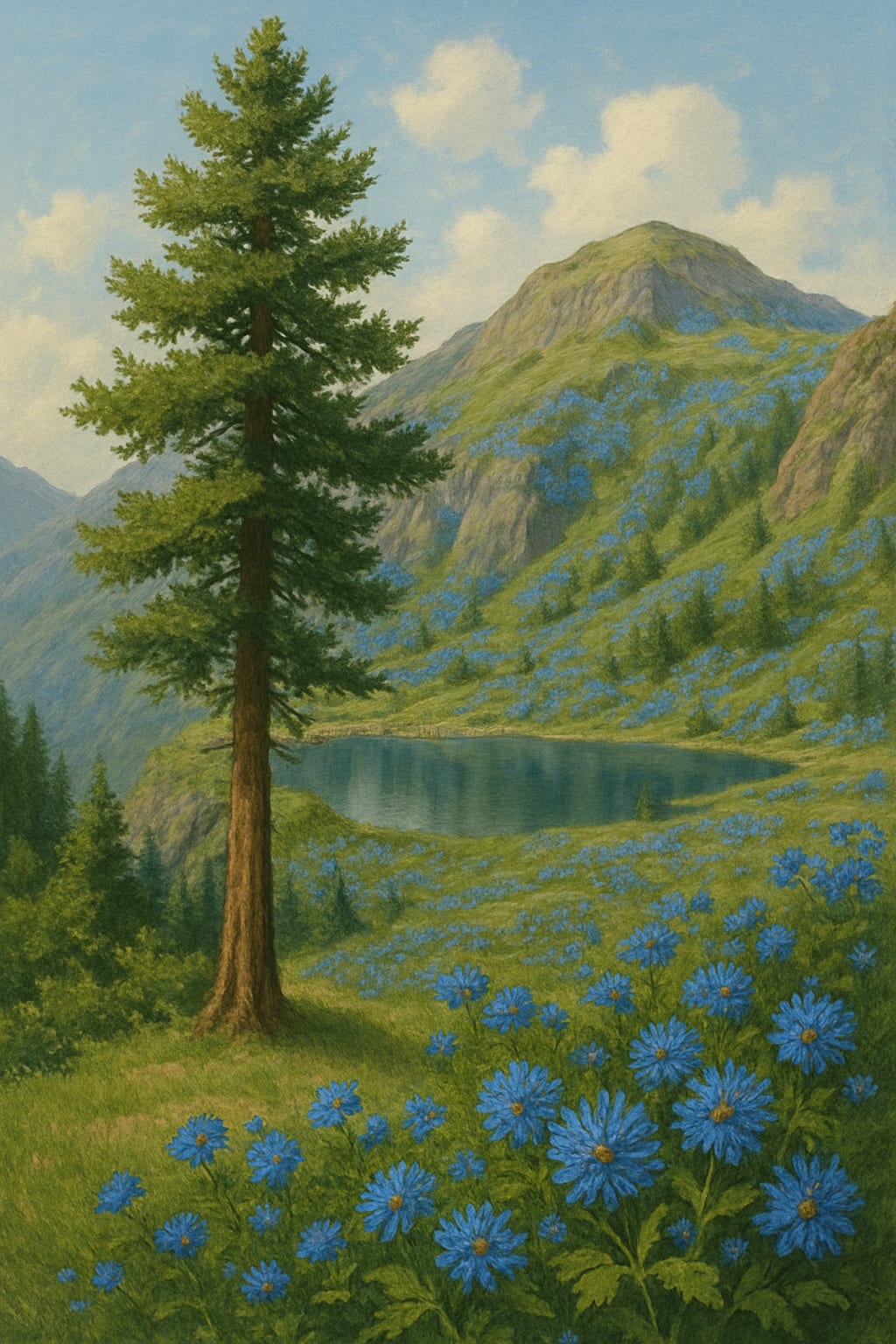
The Harmony of Nature: A Tale of the Mountain Lake and the Tree Below
At the foot of a mighty mountain, where the air is fresh and the light dances between the pines, stands a tall, ancient tree. It rises like a silent guardian, its roots deep in the earth, its branches stretching toward the sky. Above, high upon the mountain’s peak, lies a hidden lake, cradled in stone and surrounded by a halo of vivid blue flowers. This tranquil setting, untouched by time, offers a perfect example of nature’s balance and quiet majesty.
The tree at the base of the mountain is no ordinary tree. With a trunk wide enough to shelter a small gathering, and bark weathered by decades of wind, snow, and sun, it tells a story of resilience and patience. Its needles whisper in the breeze, and birds build their homes within its branches. Travelers often stop in its shade, finding comfort in the tree’s imposing, yet peaceful presence.
But the story does not end there. For those with the strength and curiosity to climb, the trail winding up the mountain reveals ever-changing views—of forests turning into meadows, and meadows into rocky slopes. At the summit, nestled like a jewel, lies the lake—a glassy pool reflecting the clouds and sky above. Around it, blue flowers bloom in profusion, painting the green earth with strokes of azure.
These flowers—small, delicate, and vibrant—are alpine asters, known for thriving in high altitudes and poor soil. Their presence marks the lake as a place of quiet fertility and rare beauty. It’s a sight not many witness, as the journey is long and the climb steep. But for those who make it, the reward is silence, peace, and a kind of spiritual clarity that cannot be found in cities or through screens.
The relationship between the tree at the foot of the mountain and the lake above is symbolic. The tree represents groundedness—the strength that comes from weathering storms, standing firm, and nurturing life around it. The lake, on the other hand, represents clarity and reflection. It gathers water from the clouds, snow, and earth, holding it gently in its stony bowl. Together, they show two sides of nature’s wisdom: one rooted, one fluid; one enduring, one changing.
Scientists have studied the ecological significance of such locations. Tall conifers like the one at the mountain's base play a crucial role in stabilizing soil, storing carbon, and maintaining local biodiversity. Their presence marks healthy forest ecosystems, which support countless species. Meanwhile, alpine lakes serve as water sources and climate indicators. Surrounded by sensitive plant species, such as the blue flowers here, they are barometers of environmental change—where shifts in temperature and precipitation are felt early and deeply.
Indigenous cultures often hold these natural settings as sacred. In many traditions, mountains are seen as the abode of spirits or gods. Lakes, especially those nestled in high places, are viewed as mirrors of the soul or gates to another realm. Trees, particularly those that live for centuries, are honored as keepers of ancestral memory. It’s not hard to see why. Standing before a great tree or looking into a silent lake on a mountaintop, one feels the weight of time and the smallness of self.
In a world driven by speed and constant change, scenes like this remind us of something essential: the power of stillness. The tree doesn’t move, yet it lives a hundred lifetimes. The lake doesn’t speak, yet it reflects everything around it. The flowers bloom quietly, unnoticed by most, yet they carry on year after year. Together, they offer a kind of wisdom we often forget—to be present, to observe, to grow without hurry.
The image of this mountain landscape also sparks a broader conversation about conservation. Such pristine places are increasingly rare. Climate change, deforestation, pollution, and development threaten ecosystems worldwide. What will become of the high mountain lakes if temperatures rise? Will the blue flowers survive? Will the tree at the mountain’s foot still stand a hundred years from now?
Conservationists argue that protecting landscapes like this is not just about beauty—it’s about survival. These environments regulate water cycles, purify air, and serve as refuges for plants and animals that can't live elsewhere. More than that, they are refuges for us—places to remember who we are without the noise of technology and commerce. To protect them is to protect our shared future.
It is not enough to admire these places from afar. We must engage with them, learn from them, and take responsibility for their preservation. Whether by supporting conservation efforts, reducing our environmental footprint, or simply spending more time in nature, each of us can play a part in ensuring that such beauty endures.
In conclusion, the tall tree at the foot of the mountain and the lake surrounded by blue flowers atop it are more than a picturesque scene—they are a lesson in harmony, endurance, and reflection. They show us that life flourishes in stillness and strength, in beauty and balance. And perhaps, if we listen closely, they offer us a way back to what truly matters.
About the Creator
Keep reading
More stories from Mukhtiar Ahmad and writers in Earth and other communities.
Guardians of Our Living Planet
Earth—our vibrant, blue-green home—is a living planet teeming with life, ecosystems, and beauty beyond imagination. From lush rainforests and coral reefs to soaring mountain ranges and rolling savannas, every inch of our planet supports a delicate web of life. But today, our home is under threat like never before.
By Mukhtiar Ahmad10 months ago in Earth
Evidence Suggests a Large Hidden Planet May Exist in Our Solar System
For centuries, scientists believed the major members of our Solar System were fully known. From the rocky inner planets to the gas giants and icy bodies beyond, astronomers thought they had mapped most of the significant objects orbiting the Sun. However, new research by American scientists suggests that a large, hidden planet may still be lurking in the distant reaches of our Solar System.
By Irshad Abbasi 4 days ago in Earth




Comments
There are no comments for this story
Be the first to respond and start the conversation.