
Unveiling Antarctica: The World's Most Mysterious Continent
What is hidden beneath the Ice?

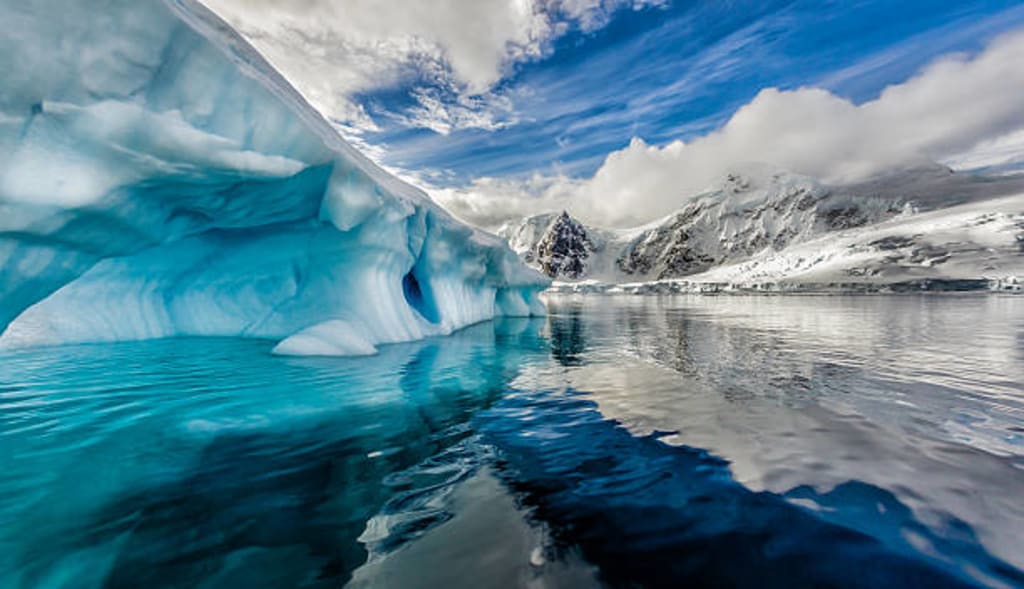
Antarctica stands as one of Earth's least understood and most enigmatic continents. Even in the 21st century, many people lack a clear understanding of Antarctica's true size and shape. Often depicted as a sprawling, misshapen blob on two-dimensional maps, Antarctica is frequently overlooked or misrepresented. In reality, it ranks as the fifth-largest continent, surpassing Australia and Europe in size and nearing South America in scale. When compared to North America, Antarctica is significantly larger than the contiguous 48 U.S. states, with distances across the continent comparable to those between the Canadian Arctic islands and Mexico. Placed over Europe, Antarctica would extend from Norway and Finland in the north down to Iran and Iraq in the southeast, while reaching past Ireland into the mid-Atlantic to the west.
This vast and remarkable continent remains largely uninhabited. The human population of Antarctica fluctuates between 1,000 and 4,000 individuals, depending on the season. During the long, dark Antarctic winters, the continent is shrouded in darkness for months, with temperatures plummeting below -34°C across the region. However, the extreme weather isn't the sole factor contributing to its low population; the continent's remote location also plays a significant role. The nearest major human settlement, Ushuaia in southern Argentina, is still about 1,000 kilometers from the Antarctic Peninsula. This distance is further complicated by the treacherous Drake Passage, known as one of the world's roughest ocean expanses, characterized by powerful waves and perilous conditions.
The Drake Passage serves as a gateway between the Southern and Pacific Oceans, allowing winds and currents to flow unimpeded, creating waves that can reach heights of nearly 20 meters during severe weather. This hazardous stretch of water, combined with the great distances separating Antarctica from nearby continents, explains why the frozen continent remained largely undiscovered until the 19th century. The first recorded sighting of Antarctica occurred in 1820 when a Russian expedition stumbled upon its shores.
Despite more than two centuries of exploration, we still know remarkably little about this icy landmass, particularly regarding the secrets hidden beneath its thick ice sheets. Antarctica is covered by ice that constitutes over 98% of its surface, averaging about 2 kilometers in thickness. In some areas, this ice reaches nearly 5 kilometers, comparable to stacking six Burj Khalifa towers, the world's tallest buildings, atop one another. Consequently, Antarctica houses approximately 61% of the world's freshwater, and if all this ice were to melt, it could raise global sea levels by around 60 meters, resulting in catastrophic flooding that would obliterate coastal regions like Florida and much of the U.S. Gulf and East Coasts.
The impenetrable nature of Antarctica's ice sheet has led to a fascinating reality: we have a better understanding of some distant worlds, such as Mars, than we do of what lies beneath Antarctica's surface. Instead of drilling through kilometers of ice, researchers primarily use a method known as radio echo sounding to visualize what lies beneath. This technique involves flying planes over the continent and sending radio waves into the ice, then analyzing the echoes that bounce back. However, given Antarctica's immense size—larger than even Europe—conducting this method across the entire continent is a time-consuming and costly endeavor.
The fascinating geological and biological features of Antarctica, which is divided into Greater Antarctica, composed of ancient rocks, and Lesser Antarctica, which is younger and volcanically active. Lesser Antarctica is part of the Great Pacific Ring of Fire and features active volcanoes like Mount Erebus, which houses subvolcanic ice caves that may support unknown life forms.
Significant discoveries include the Denman Glacier Canyon, the world's deepest canyon, and the Gamertsfjell Mountain range, both hidden beneath ice. An anomaly in East Antarctica suggests an ancient meteorite impact crater, potentially linked to the planet's largest mass extinction event.
The presence of around 675 subglacial lakes, particularly Lake Vostok, which has been isolated for millions of years and may harbor unique life forms. Recent studies suggest potential new species, including fish, in these hidden ecosystems.
Antarctica is also thought to contain vast natural resources, particularly oil, with a recent discovery indicating a super field of 511 billion barrels in the Weddell Sea. The Antarctic Treaty prohibits resource extraction, but its review in 2048 could lead to exploitation, raising geopolitical tensions, especially between the UK, Argentina, and Chile over territorial claims. The future of Antarctica remains uncertain as climate change and legal frameworks evolve.
About the Creator
Mariana
I'm a storyteller at heart, weaving narratives that uncover the extraordinary. I write to provoke thought, inspire and stir the soul. Join me in exploring the magic in the mundane, where creativity and passion leave a lasting impact.
Trump’s Greenland Threats Push Europe Toward Divorcing America
When you think of Greenland, the first things that probably come to mind are icebergs, polar bears, and maybe some adventurous explorers. But lately, Greenland has become the center of a major diplomatic drama — one that’s forcing Europe to question its long-standing relationship with the United States. And the spark? Donald Trump’s threats over Greenland. The Controversy: Trump’s Unusual Move Back in January 2026, Trump shocked the world again, not with an election campaign but with a bold — and many would say bizarre — plan to acquire Greenland. But he didn’t stop at just “expressing interest.” He threatened eight European nations with tariffs — starting at 10% and potentially climbing to 25% — unless Denmark agreed to sell Greenland to the U.S. Yes, you read that right: tariffs on allies to buy a remote Arctic island. For Europe, this was more than shocking — it felt like a betrayal from a partner they’ve relied on for decades. Europe’s Response: Outrage and Solidarity European leaders didn’t hold back. Germany, France, Norway, the UK, and others banded together to condemn Trump’s approach. The message was clear: Europe won’t be blackmailed. Even usually cautious leaders spoke up. Norway’s Prime Minister bluntly said, “Threats have no place among allies.” Meanwhile, European Commission President Ursula von der Leyen emphasized that tariffs between allies “have no place” and could undermine decades of cooperation. This isn’t just a political disagreement. Europe sees this as a test of trust, sovereignty, and alliance reliability. Why Greenland Matters At first glance, Greenland might seem like just a frozen island. But strategically, it’s a big deal: Location: Greenland sits between North America and Europe, controlling key air and sea routes. Military Importance: It hosts radar and U.S. military infrastructure critical to early-warning systems. Resources: Beneath the ice lie minerals and rare earth elements that the world desperately needs. For Europe, Greenland is also about principle. The island belongs to Denmark and the Greenlandic people, not Washington. Europe’s support for Denmark shows a broader commitment to respecting sovereignty — a principle that Trump’s threats directly challenged. The Bigger Picture: A Crisis of Trust Greenland may just be the tip of the iceberg. For years, European nations have felt frustrated by U.S. policies that seemed unpredictable — whether it’s climate agreements, trade deals, or security commitments. Trump’s Greenland threats amplified these frustrations. Suddenly, Europe is questioning something fundamental: Can the U.S. be trusted as a long-term partner? Some European leaders have even started talking about a kind of “divorce” from the U.S. — not literally leaving NATO, but rethinking how dependent they should be on America for security and strategic decisions. Europe’s Path Toward Strategic Independence This Greenland drama is accelerating discussions about European strategic autonomy. Basically, Europe is asking: Should we be able to protect our own interests without always relying on the U.S.? The EU has long talked about building stronger defense capabilities and investing more in its own military, but progress has been slow. Greenland might just be the wake-up call that finally pushes Europe to act. What’s Next? So, what happens from here? Europe isn’t just going to sit quietly. Leaders are looking at: Economic counter-measures like tariffs on U.S. goods Strengthening European defense and security collaboration Reasserting Europe’s role on the global stage, with less reliance on Washington Even if Europe doesn’t fully “divorce” America, Greenland is changing the terms of the transatlantic partnership. Europe will now demand more respect, clearer rules, and recognition of its sovereignty — and they’re not afraid to make that clear. Why This Matters to All of Us You might wonder why this matters if you’re not in Europe or the U.S. Greenland may seem remote, but this story is about alliances, trust, and how global power is shifting. The way Europe responds could reshape the world order, affect trade, military cooperation, and even the global economy. And for anyone following U.S.-European relations, it’s a reminder that sometimes the smallest places — even a frozen island — can have huge global consequences. Bottom line: Trump’s Greenland threats aren’t just a bizarre footnote in history. They’re a wake-up call for Europe, forcing the continent to rethink its ties with America and consider a future where it can act independently — strategically, economically, and politically. Greenland, icy as it is, might just melt the old rules of alliance forever.
By Muhammad Hassan5 days ago in Earth
New York Prepares for Possibly Its Heaviest Snowfall in Years
New York City and surrounding areas are preparing for what could be one of the heaviest snowfalls in years, according to meteorologists. The forecast predicts intense snow, gusty winds, and potentially hazardous conditions, prompting city officials, emergency services, and residents to take precautionary measures.
By Muhammad Hassan2 days ago in Earth



Comments (1)
Thanks for sharing