
Two billion year old nuclear reactor
A green nuclear power plant that cannot be replicated by mankind


French physicist Francis Perrin sat in front of his desk, staring wide-eyed at a black piece of ore on his desk, and his mouth just repeated the words over and over again.
"This is unlikely, this is never possible."
He was the high commissioner of the French Atomic Energy Commission, and he was at a nuclear fuel processing plant in southern France at this time because the plant had discovered something fishy about an imported shipment of uranium ore.
The uranium ore was imported from the Gabonese Republic, a country rich in natural uranium resources in Africa. The test results showed that the uranium two-thirty-five content in this 1 uranium ore on the table was only 0.717% of the uranium content. And the normal uranium ore on earth, the content of this element of uranium 235 is 0.72% of the uranium content, that is to say, this piece of ore uranium 235 is less than the normal value of 0.003%, three hundred thousandths of a percent, which is the reason for the collapse of Perrin, so a little less, uranium 235 elements it why so important?
That is because uranium this element family contains more than a dozen isotopes, from uranium 226 to uranium 242, but uranium ore inside the most content is uranium 238 and uranium 235, respectively, accounting for 92.275% and 0.72%. This is where U-235 is the chemical element that can produce nuclear fission reactions; in other words, it is the actual nuclear material used in nuclear reactors.
It has been found that when a neutron hits a U-235 atom, it causes a nuclear chain reaction that releases millions of times more energy than a chemical reaction. 1 gram of U-235, when fully fissioned, releases the same amount of energy as 2 tons of high-quality coal. This way the efficiency of electricity generation with nuclear energy completely kills coal power and so all traditional power generation methods, and after the reaction of uranium 235 involved in the fission reaction, it turns into other elements, which is the ore on Professor Perrin's desk less than three hundred thousandths.
1 possible place for uranium-235, which underwent fission, is this less-than-normal value of uranium element a consequence of fission in nature. How is this possible? So, the experts immediately moved, loaded their duffel bags, and went in groups to investigate the Oklo region of the Republic of Gabon, where the ore originated, and the results of this investigation were a nuclear bomb.
The investigation team found that the entire deposit is considered a large reactor, and hidden 17 groups of nuclear fission reactors, and the age of the reactor has nearly 2 billion years old, it was in continuous operation for 500 to 1.5 million years before it stopped working.
The investigation team stayed in Oklo for two months, and the surprises, one after another, was that the total amount of uranium-235 that could be extracted was 200 kilograms less than the normal amount of ore extracted, based on the total amount of ore collected in the 18 months before the investigation began and that some of the ore contained extremely low levels of uranium-235, a mere 0.44%, or only 61% of the normal ore.
The point is that the experts found on the deposits neodymium and samarium, two elements that are the product of the fission of U-235. After deducting the amount of neodymium and samarium produced by the natural decay of uranium-235 over a long period in nature, the residual amount in the deposit is very similar to the amount produced by artificial uranium fission reactions.
This calculation looked like direct evidence that the Oklo uranium mine was a large nuclear reactor. So Perrin went about announcing to the world that the first naturally occurring nuclear reactor had been discovered.
The world was unnerved by this, and scientists from many other countries immediately asked us to investigate as well. However, the French scientists politely declined the enthusiasm of their peers and only shared their results with the world.
The old American scientist Paul Kuroda Kazuo was excited to hear about the situation, after all, he had proposed the hypothesis back in 1956. He said, "If the conditions are right, an ancient uranium mine can produce a natural nuclear reactor," which is also the basis of the French physicist Perrin, who seemed to have found empirical evidence in line with Kazuo Kuroda's hypothesis, but when Kazuo Kuroda took a closer look at Perrin's report, he could not help but draw a big question mark in his heart, this reactor has gone through such a long The reactor has experienced such a long time, but it did not self-destruct, so how did it do it?
Generally speaking, the basic principle of an artificial nuclear reactor is to convert the heat generated by nuclear fission into water vapor, which is then used to drive a steam turbine to generate electricity, where the most important components are fuel rods, moderators, coolants, control rods, containment, pressure-resistant piping systems, and steam generation equipment.
It must have such a set of equipment systems with strict design and process assurance, it must be a system, and the reactor can work properly.
Let's take a step-by-step look at this jaw-dropping Okoro natural reactor and how it works.
The reaction starts with neutrons hitting uranium-235 atoms, which are hit by such a hit, and then a fission reaction occurs, releasing two or more neutrons and releasing gamma rays, or energy, and then these neutrons are released and then hit other uranium-235 atoms, which then fission, releasing more neutrons and energy. The energy produced gets bigger and bigger, and this is called a chain reaction.
But for this reaction to be successful, there are two key factors, the first is that the concentration of U-235 nuclear fuel must be high enough. The second is that the speed of the neutrons must be appropriate, mainly not too fast, and it corresponds to the nuclear reactor components by the fuel rods and moderators to achieve these two things.
Let's take a look at how the Okoro Natural Reactor solves these two problems. The first element of the reaction is the fuel rod, the raw material for nuclear power plants, which is the fissionable uranium-235. The fuel rod used in modern nuclear power plants is filled with enriched uranium, and the enrichment of uranium-235 can reach 3.5% to 5%, which is enriched artificially. That's why the U.S. sanctions against Iran and North Korea have focused on enriched uranium plants.
It's the sector that provides the raw materials for the nuclear industry now, the equivalent of a steel mill that provides the steel for making tanks. You jam it, you jam the neck of a country's nuclear industry. But where did such a high concentration of uranium come from in the days when the Okoro reactor was working? Could it be that U-235 atoms in the state of existence in the ore just crashed around and started fission reactions?
This is too violent to people's minds, and the hypothesis put forward by scientists represented by Kazuo Kuroda is that at that time the natural concentration of U-235 was exactly 3.6% to 4%. This U-235 concentration is related to time, that is, the Earth is in different stages, and the concentration of U-235 in the rocks it is different.
This refers to the half-life of radioactive isotopes, which is the time it takes for half of an isotope to naturally decay into other elements. For example, the half-life of uranium-235 is about 7.1 billion years, and the content of uranium-235 in uranium ore is 0.72%. Then we extrapolate back to 1.7 to 2 billion years ago, the U-235 content was 3.6% to 4%, which is the concentration that would just happen naturally.
So the start-up of the Okoro reactor happened to coincide with such a point in time. What is the role of the moderator in a nuclear power plant? As mentioned earlier, the nuclear fission reaction will release neutrons, but neutrons are a kind of particle that moves very fast, once released, if it is not slowed down, it will run out of shadow, and it is impossible to generate chain reactions, neutrons are running out of shadow, it does not hit the atom, of course, there will be no fission reaction. So an important job in the nuclear power plant is to give neutrons an artificial slowdown, play this role is called the slowing agent, so it is also called the neutron slowing agent.
There are several types of neutron moderators, the usual moderator is water, but there is also heavy water and graphite. So to distinguish, the nuclear reactor with water as a moderator is called a light water nuclear reactor, heavy water is a little higher molecular mass than ordinary water molecules.
This Okoro reactor is clever and uses groundwater as a moderator, so it is a light water reactor. One more element is the control rods, which are composed of neutron absorbers, also called neutron toxins. It is used to give the reaction brake, this thing can be freely inserted or withdrawn from the reactor, when inserted, of course, is used to slow down the reactor or stop the reaction. Just like the brakes, no matter how fast the car is going, as long as a foot down, it will be able to gradually make it stop. Otherwise, if the fission reaction goes on endlessly, the reactor will soon explode due to overheating.
So we say that nuclear energy must be a controlled nuclear reaction. But this is precisely what confused Kazuo Kuroda the most. It is this Okoro natural reactor that has been operating for hundreds of thousands of years, what makes it not explode? This sense of design would be too strong, there?
The research team found that the Oklo reactor in the reaction process will get hotter and hotter, and can even reach close to 400 degrees Celsius. This is when the water in the reactor is constantly subject to evaporation, in the rock layer below the accumulation of pressure. When the pressure is strong enough, the water is sprayed to the ground by way of geysers, and once the water disappears, the neutrons run too fast to find atoms to hit, and the chain reaction will be terminated immediately. And the water and steam ejected take away most of the heat accumulated in the reactor so that the reactor will gradually cool down, and by the time the underground water fills the deposit again, the nuclear reaction will start again.
So the Oklo works intermittently, at a frequency of about 150 minutes off for every 30 minutes of work, which is enough time to allow the reactor to cool sufficiently before it restarts. This is the reason why it has worked for hundreds of thousands of years without bursting and can be described by the words ingenuity. Then the artificial reactor inside the safety can resist the pressure piping system, and steam generation equipment, these in the Oklo reactor how to solve it?
The research team found that the natural distribution of the rock bed around Okoro solved these problems. In this way, almost all of Kazuo Kuroda's doubts were solved. The only thing that finally made him sigh was that the magic of this natural reactor far exceeded his theory.
There is more to the magic of Okoro, which is the most unique green nuclear reactor on the planet. How to dispose of nuclear waste is a big headache for all nuclear power plants. The common practice is to seal up the waste and dump it in a deep, unoccupied place.
For example, digging a hole in the ground more than 500 meters deep, so a burial, or to the deep sea so a throw, let the nuclear waste in the long years of natural decay, harmless. But once this closed container accidental breakage, then it is still potential pollution of the surrounding environment.
But the Okoro reactor does not have this problem. The highly radioactive waste generated in the reactor is firmly anchored by the surrounding granite, sandstone, and clay deep underground in Okoro.
For example, the plutonium produced by the reaction has only moved less than 3 meters after almost 2 billion years. The granite also absorbs the xenon and krypton gases produced by the fission reaction, so that these harmful radioactive gases are locked in the rock layer and cannot move, making it an excellent natural sealing vessel.
Since the discovery of Oklo, the world's major nuclear laboratories have been trying to figure out how to develop this long-lasting nuclear waste disposal technology, so that the nuclear waste can stay in place. Fifty years have passed since 1972, and still, no success stories have emerged. Such an elaborate design cannot be replicated by today's human technology, and even to do so with understanding would take years of drilling and research. So did nature make all this by complete coincidence?
Research now finds that the emergence of the Okoro reactor is closely related to the rise in oxygen concentration on Earth, and it happens to be tightly linked to changes in life forms as well. About two billion years ago, photosynthetic bacteria appeared on Earth, and their appearance led to a significant increase in the concentration of oxygen in the Earth's atmosphere.
This condition was critical to the creation of enriched uranium ore because uranium only dissolves in water with enough oxygen for water currents to carry it to the right places for deposition and the eventual formation of enriched uranium deposits.
If the Earth at that time was not an oxygenated environment, then the fuel needed for the Okoro reactor, highly enriched uranium would not have been able to form. Therefore, the emergence of photosynthetic algae on Earth at that time actually contributed to the formation of the Okoro reactor.
Scientists have now discovered the geological structure of the Okoro reactor and the structure of the deposit, which is not unique in the world. There are similar deposits in Canada and northern Australia, and they also contain ores rich in U-235. But it is impossible to find a second natural nuclear reactor like Oklo.
The structure of the uranium veins that can support the chain reaction, plus the groundwater, the rock material, and the structure around the deposit, plus the rock structure of the geyser eruption, put all these coincidental factors together to create the uniqueness of Oklo. This leaves no room for doubt that this is the work of an intelligent hand.
Some people think of an extraterrestrial intelligent civilization, while others suggest that this is the masterpiece of a prehistoric super civilization. According to current knowledge, two billion years ago, there were only primitive algae on Earth, and because it was so long ago, it certainly contains richer speculation.
For example, the Oklo reactor, may not be as old as 2 billion years but may be advanced intelligence, using superior natural conditions to modify and reach. There are myths circulating among the local indigenous people of Oklo, the Fang and the Bapulu, that their gods descended from the sky in a cloud of light, which sounds similar to a spaceship landing.
People can't preserve memories with myths that say they can go back hundreds of millions of years, it is possible to go back tens of thousands of years.
Do you know how I feel about this story? It reminds me of the Dujiangyan, a famous water conservancy project in Chinese history.
If our current period of humanity disappears one day, and the descendants of human beings whose memory is blank for another few thousand years find out that Dujiangyan has such an amazing effect, would that not also give rise to such a debate? Let's say that this thing is the masterpiece of man, or is it formed by natural coincidence? And how do you see this problem?
About the Creator
Stajila
The progress of scientific research and its increasingly expanding fields will arouse our hope。
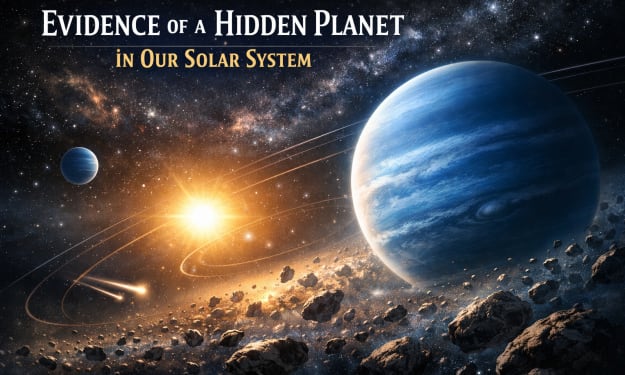
Evidence Suggests a Large Hidden Planet May Exist in Our Solar System
For centuries, scientists believed the major members of our Solar System were fully known. From the rocky inner planets to the gas giants and icy bodies beyond, astronomers thought they had mapped most of the significant objects orbiting the Sun. However, new research by American scientists suggests that a large, hidden planet may still be lurking in the distant reaches of our Solar System.
By Irshad Abbasi 2 days ago in Earth



Comments
There are no comments for this story
Be the first to respond and start the conversation.