
The Surprising Power of Orange Peels
How They Transformed a Barren Landscape into a Vibrant Rainforest
It was a sunny day like any other in Costa Rica's Guanacaste Conservation Area back in 1997. The vegetation was flourishing. Animal species were thriving. And the land had never looked better. But all of a sudden, several trucks appeared on the horizon. They tracked their way through the park, and then unbelievably, dumped all the cargo they'd been carrying right in the middle of the area and just drove off. But it wasn't just any cargo. It was... orange peels?
Over the next year, more than a thousand trucks would drive to this otherwise beautiful site, dumping a massive 12,000 metric tons of orange peels over the land. Was the owner of these trucks trying to ruin the landscape? Was dumping them here some sort of super weird act of vandalism or protest? Were they trying to clear the area of its flora and fauna for their own means using a weird all-natural deterrent? Well, get comfy, because we are about to dive deep into this strange story of man versus nature, and many others like it.
To get to the bottom of this orangy mess, we need to rewind all the way back to 1976. That's when Daniel Janzen and Winnie Hallwachs graduated from Princeton University and began focusing their careers on ensuring a future for endangered tropical forest ecosystems. They became ecologists at the University of Pennsylvania and worked as advisors for many years at Guanacaste Conservation Area. Though the country only covers 0.03% of the Earth's surface, Costa Rica accounts for a massive 6% of the entire world's biodiversity. And Janzen and Hallwachs were keen to keep it that way.
However, in 1995, fruit juice company Del Oro set up a large factory in extensive groves near this conservation area in the borderlands between Costa Rica and Nicaragua. The conservation organization had initially wanted to acquire this land, keen to keep its forests safe from the hazards and pollutions of industrialization. But Janzen and Hallwachs suddenly realized there was a deal to be made, one that both sides would benefit from. In exchange for the borderland, Del Oro would be permitted to dump their waste in the conservation park.
From the outside, a deal allowing a corporation to turn a conservation area into a dump site seemed utterly insane, but Janzen and Hallwachs were confident that securing this borderland for the conservation organization, regardless of the drawbacks, was a huge win. Before this juicy deal could go ahead, though, certain conditions had to be met.
First, Del Oro could only dump agricultural waste, mainly its orange peels and pulp. Second, it was not allowed to use any pesticides on its crops, so no nasty chemicals on the peels could harm the native plants. The pulps also had to be rinsed in their limonene oil, which Del Oro did happily as it could sell this off for use in household cleaning products. And finally, the orange waste could only be dumped on parts of the park previously used for cattle grazing, where the soil quality was poor and degraded.
For Del Oro, it was a weird but small price to pay for being able to rid themselves of the otherwise useless orange peels and pulp for free. And so they agreed. Janzen and Hallwachs' plan was in motion, and they were so confident they were doing the right thing that they struck a deal to receive a thousand truckloads of Del Oro's peels annually for 20 years. In total, this would mean around a quarter of a million metric tons of peels and pulp would be dumped on the land. What on earth were they thinking?
But the plan was interrupted when jealousy struck from a rival juice company, TicoFrut. Previously having had to overhaul their entire waste disposal system, TicoFrut envied the ease Del Oro had just dumping their waste peels in the national park. And so they launched a lawsuit to stop them. They alleged the dumping was dangerous, with piles of rotting peels and flies causing hazards to locals and wildlife alike. TicoFrut also began an all-out media war decrying that the orange peel project was destroying the national park, even though this was all pulp fiction.
TicoFrut's smear campaign worked and turned the whole country against Del Oro. The public outcry was so great that the case ended up in the Costa Rican Supreme Court. Despite evidence from environmental groups, like the Rainforest Alliance, assuring the project was ecologically safe, the Supreme Court ruled against Del Oro. In the end, the project was shut down, but the 12,000 metric tons of orange peels already dumped over three hectares of land were left behind.
Over time, the project was completely forgotten about until 16 years later. A team of researchers from Princeton University, having read up on the orange peel experiment, decided to return to the site to find out what had happened. But when the team arrived, they couldn't find the site. The orange peels had completely disappeared.
While searching for any trace of the missing peels, the team found themselves lost in the thick overgrown rainforest. That was until they stumbled across an old yellow sign wrapped up in giant jungle vines. It was strange. It was the same style of sign the researchers had used all those years ago to label the barren, poor-quality soil the peels had been dumped on. And then finally, it dawned on them. The rainforest they were stumbling around in was the original barren-soiled orange peel site. Man, even M. Night Shyamalan couldn't come up with a twist that good.
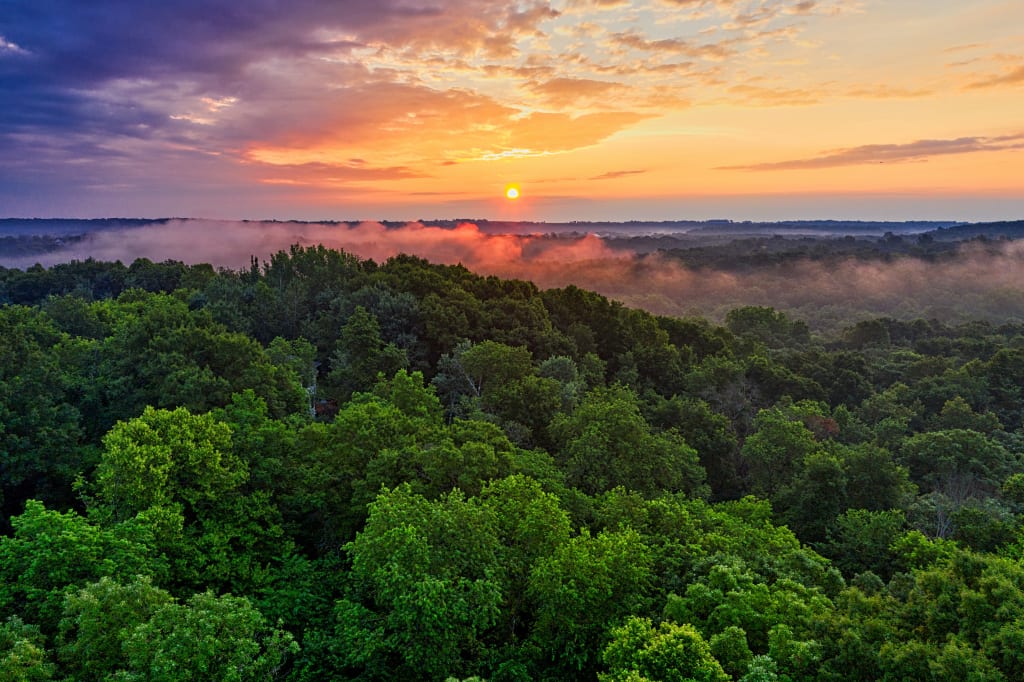
It turned out the orange peels had completely transformed the barren landscape. After inspecting the area, the Princeton team discovered a phenomenal 176% increase in above-ground biomass within the seven-acre area. They measured a fig tree so large it took three people to wrap their arms all the way around it. And among its branches, researchers spotted a tayra, a rainforest weasel the same size as a small dog. Cute.
Though what stunned the team the most was the rich diversity of the tree canopy. They counted 24 tree species, the most common of which were associated with old-growth forests, a stark contrast to the untreated pastureland a little over 300 feet away, where the team counted only eight tree species. That meant that on this previously barren patch of land, a healthy, vibrant rainforest had been entirely regrown.
Some might think magic beans had been sewn, but this was Janzen and Hallwachs' plan all along. The site had been originally overrun with invasive grass species. However, the grasses were smothered under the tons of orange rinds and decomposed into a lomi-rich compost. The pressed oranges were perfect for the task as they had been leached of limonene oil, which can prevent plants from growing. And the degraded peels packed the compost full of powerful nutrients like potassium, nitrogen, and phosphorus. This nutrient-rich compost provided lush ground for native plants to take hold and grow. Given a mere 16 years to thrive along with the perfect weather conditions Costa Rica had to offer, a whole new rainforest was born.
Now, hold on. Before you go yeeting orange peels around your neighborhood to try turning your town into a rainforest. This rainforest success is a special case. Costa Rica is near the equator, and that means it's warm and humid all year round, providing a perfect temperate climate for things to decompose and grow quickly. Similar tactics used in other parts of the globe where temperatures drop below freezing would slow this process or prevent it entirely. So this rainforest phenomenon truly was a case of the orange peels being dumped in the right place at the right time.
The story of nature's transformative power continues with another remarkable example, this time in the Wadi Rum desert in Southern Jordan. Known as the "Valley of the Moon," this arid landscape has become home to Jordan's largest farm, called Rum Farm. Despite the extreme water scarcity in the region, the farm stretches across nearly 5,000 acres and produces an astonishing amount of food each year.
The key to farming in such a water-poor environment lies in the ingenious use of underground aquifers. The farm draws water from deep underground, between 100 to 1,300 feet, through pumps that bring it to the surface for irrigation. The circular fields of Rum Farm, resembling crop circles from above, are watered using a pivoting ramp with nozzles. Plastic poly tunnels are also used to protect some crops from the harsh desert conditions and to minimize water loss through evaporation.
To further conserve water, farmers have introduced hardy succulent plants and legumes as ground cover. Succulent plants, with their gel-like content, lower soil surface temperatures and help prevent shifting sands, all while using minimal water. These agricultural techniques have ancient origins, similar to those used by civilizations like the ancient Egyptians and Nabataeans.
Transforming the Wadi Rum desert into fertile farmland has been a game-changer for Jordan. As a country that currently imports 98% of its food, the booming harvests from Rum Farm provide hope for greater self-sufficiency. This innovative approach to desert farming could inspire other countries facing similar challenges as the global population continues to grow, and food production becomes an increasingly critical issue.
However, it's important to note that not all deserts should be converted into farmland. Deserts play a vital role in providing important mineral resources to the world, such as gypsum, nitrates, and potassium. They are also home to unique ecosystems and serve as habitats for specialized flora and fauna. Converting all deserts into farmland could compromise these valuable resources and disrupt fragile desert ecosystems.
In conclusion, while humans have the power to transform nature in extraordinary ways, we must be mindful of the long-term implications and balance our actions with the preservation of essential natural resources and ecosystems. The examples mentioned here showcase the potential for innovative approaches to overcome challenges like deforestation, desertification, and water scarcity, but they also highlight the need for sustainable and responsible practices.
About the Creator
Keep reading
More stories from Myke & Amy and writers in Earth and other communities.
From Stingers to Bites
Have you ever experienced the excruciating pain of a honeybee sting? It's a burning sensation that lasts for hours, followed by swelling and a prominent red welt that lingers for days. However, as terrible as it feels for us, the honeybee actually suffers an even worse fate. Within a few minutes of stinging, the bee dies.
By Myke & Amy3 years ago in Earth
Exploring the Amazing World Beneath the Waves
Beneath the surface of the world’s oceans lies a vast and mysterious universe that few humans have truly experienced. Often described as Earth’s “final frontier,” the underwater world is filled with stunning landscapes, colorful creatures, and ecosystems that are both fragile and vital to life on our planet. From shallow coral reefs to the dark depths of the ocean floor, this hidden realm continues to amaze scientists, explorers, and nature lovers alike.
By Irshad Abbasi about 22 hours ago in Earth



Comments
There are no comments for this story
Be the first to respond and start the conversation.