
The Straggle of Addison
Fighting Battles No One Else Can See
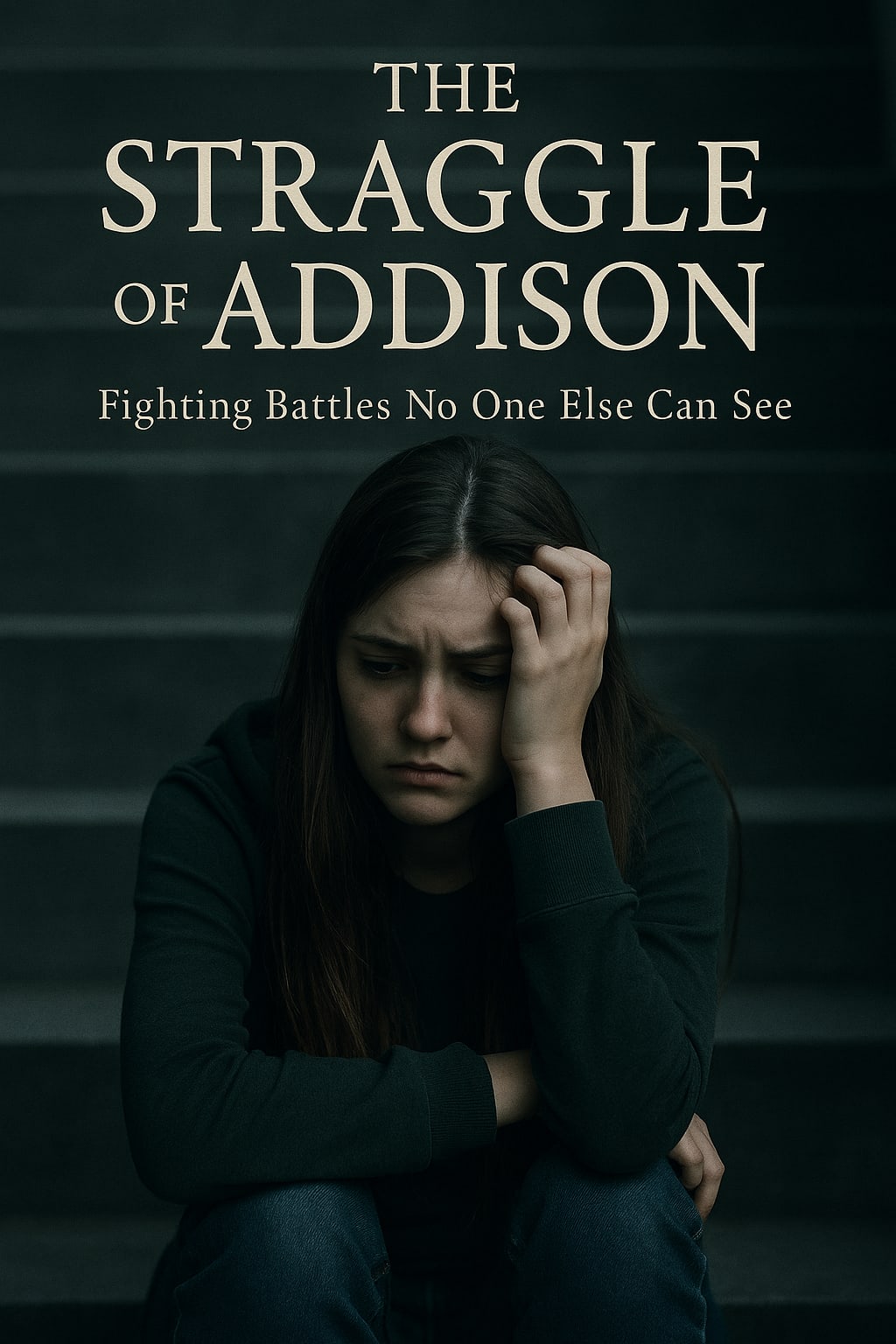
Addison Clarke was not the kind of girl who drew attention. She moved through the world like a shadow—quiet, unnoticed, and unbothered. On the outside, she was ordinary: a seventeen-year-old girl with long brown hair, a green hoodie that always seemed a size too large, and eyes that seemed far too tired for someone her age. But inside her, storms raged. Not the kind you could see. Not the kind anyone cared to ask about.
Her days started early, not because she wanted to, but because sleep rarely came easy. The silence of the early morning was the only time Addison felt like the world wasn’t spinning too fast. She’d sit at the window, hugging her knees, and watch the neighborhood slowly come alive—mothers yelling for their kids to get ready, engines starting, bikes rolling past. All of it felt like a movie she wasn’t cast in.
Addison’s struggle wasn’t loud. It wasn’t the kind that made you scream or cry out in public. It was a silent war—fought in hallways filled with whispers, in classrooms where her hand stayed down, and at lunch tables where seats beside her were always mysteriously empty. Her thoughts weren’t always kind to her, and some days, they were downright cruel.
“You’re not enough.”
“No one would notice if you disappeared.”
“You’re just a burden.”
These voices weren’t audible to others. Only Addison could hear them. And she believed them.
At home, things weren’t much better. Her mother, distant and distracted by an endless string of boyfriends, rarely noticed when Addison skipped dinner. Her father was long gone—just a name on a birth certificate and a few stories told with bitterness and wine. Addison had learned early on not to expect comfort. It never came.
The only place she found any sense of control was her sketchbook. Lines and shapes gave her freedom—portraits of people she imagined, places she’d never been but longed to go. Art was her voice when words failed. Sometimes, she drew herself—not as she was, but as she wanted to be: strong, confident, unbreakable.
One rainy afternoon, something changed.
Mr. Carter, her English teacher, had assigned a personal essay titled “What I Wish People Knew.” Addison stared at the prompt for three days before writing a single word. When she finally put pen to paper, the dam broke.
She wrote about the loneliness that clung to her like a second skin. About the anxiety that paralyzed her in crowded halls. About the nights she spent crying quietly, the mornings she dreaded waking up. And most of all, she wrote about the crushing feeling of being invisible in a world that demanded you be loud to matter.
She didn’t expect Mr. Carter to read it. Not really. Teachers were always busy, skimming pages for grammar and spelling errors. But he did read it. Every word.
The next day, he pulled her aside.
“Addison,” he said gently, “Your essay—it was brave. Painful, but brave. You’re not invisible. I see you.”
She didn’t know how to respond. Her throat tightened. Her eyes burned. And for the first time in a long time, she let herself cry—in front of someone.
Mr. Carter introduced her to the school counselor, Mrs. Greene. Addison resisted at first, unsure if talking to another adult would make a difference. But Mrs. Greene didn’t ask too many questions. She just listened. And that, Addison learned, was powerful.
Week by week, the walls around her began to crack. She joined an after-school art club. She started saying “hi” to a girl in her history class—Jules—who, it turned out, also knew what loneliness felt like. They started sitting together at lunch, drawing together, talking about books they both hated and songs they secretly loved.
Addison’s battles didn’t vanish overnight. The dark days still came—sometimes out of nowhere. But she no longer faced them alone. She found strength in small victories: making it through a presentation without panicking, asking for help when she needed it, looking in the mirror and seeing more than just her flaws.
One day, she taped a drawing to her bedroom wall. It was of a girl standing on a cliff, wind in her hair, looking out at the sea. The caption read: “She stood, not because the storm had passed—but because she chose to keep standing.”
That girl was Addison.
About the Creator
Keep reading
More stories from Noor Hussain and writers in Earth and other communities.
The power of money
The Power of Money Money is one of the most powerful forces in the modern world. It influences almost every aspect of our lives, from the choices we make daily to the broader structures of society and the global economy. While it is often said that “money can’t buy happiness,” there is no denying that it can buy freedom, comfort, security, and access to opportunities. The power of money lies not just in its purchasing ability but also in its capacity to shape lives, influence decisions, and dictate the direction of entire nations.
By Noor Hussain9 months ago in Earth
In Maduro’s Capture, Russia Sees a Great-Power Rival Act with Impunity
The world watched in early 2026 as U.S. special forces struck in Venezuela and captured President Nicolás Maduro. It was a dramatic move that upended politics in Caracas — and sent shockwaves through Moscow. For Russia, Maduro wasn’t just an ally; he was a key piece in a global chess game stretching from Latin America to the Middle East. His capture has forced Russian strategists to reconsider how far they can project power — and what it means when a rival acts seemingly without consequence. A Blow to Russian Influence Venezuela has long been one of Russia’s few footholds in the Western Hemisphere. Moscow supplied weapons, energy investments, loans, and political backing to Maduro. The goal was simple: counterbalance U.S. influence and maintain a strategic ally near American borders. Maduro’s capture has changed that calculus. Russia’s foreign ministry condemned the operation as “armed aggression” and demanded respect for Venezuela’s sovereignty. At the same time, Moscow backed Delcy Rodríguez as interim leader, framing it as support for Venezuela’s self-determination. But behind the formal statements, analysts suggest Moscow is feeling the sting. The U.S. operation was fast and effective — a stark contrast to Russia’s costly, prolonged campaigns elsewhere. For many, it exposed gaps in Russia’s ability to defend its allies abroad. The Kremlin’s Dilemma Inside Russia, commentators and analysts are debating what Maduro’s capture says about global power dynamics. Some see it as a glaring demonstration of U.S. military reach. Others point out the hypocrisy of international law, given Russia’s own record in Ukraine. But the underlying concern is strategic. Venezuela was one of the few places where Russia could claim a geopolitical win outside Europe and the Middle East. Losing leverage over Caracas diminishes Russia’s influence in energy markets, political alliances, and the narrative of great-power competition. A New Era of Great-Power Competition Russian experts are framing the event as evidence that international norms are eroding. In their view, powerful nations now act where it suits them, regardless of global rules — a logic Russia often uses to justify its own interventions. The U.S. capture of Maduro, framed as a law-enforcement operation targeting corruption and drug trafficking, has inadvertently reinforced Moscow’s messaging: great powers act with impunity. It’s a convenient narrative for Russian state media, even if the reality exposes Russia’s own limitations. Economic and Strategic Consequences Maduro’s removal isn’t just political; it has economic ramifications for Russia. Caracas was part of OPEC+ and home to joint energy ventures. U.S. access to Venezuelan resources could impact oil markets, squeezing Moscow’s budget further. Other projects, from weapons sales to industrial partnerships, now face uncertainty. What was once a partnership built on mutual opposition to the U.S. may now be a casualty of American assertiveness. Domestic Perception in Russia How Russians perceive the operation matters as much as the operation itself. Some voices call for a tougher stance to defend Moscow’s allies. Others acknowledge the gap between Russian and American capabilities. This debate influences both public sentiment and the Kremlin’s policy decisions. It shapes how Russians see their country’s role in the world — whether as a global power able to project influence, or a state constrained by geography, economy, and international reaction. What This Means for Global Politics Maduro’s capture is more than a headline. It signals a shift in global power dynamics. For the U.S., it shows the willingness to project force far from home. For Russia, it underscores limits in influence and credibility. Moscow may continue to use this event in propaganda and rhetoric, but the reality is stark: words without action may not sustain alliances or deter rivals. The event also raises questions about the rules-based international system. If powerful countries intervene militarily at will, what does that mean for global stability? The Takeaway Russia’s reaction to Maduro’s capture reflects a broader truth: modern power is measured not just by intent, but by capability. Russia may want to project global influence, but when rivals act decisively, even long-standing allies can be lost. Maduro’s removal also highlights a changing world order. Great powers no longer operate in isolated theaters. Every move, whether in Latin America or elsewhere, is scrutinized and reverberates globally. For Moscow, the message is clear: ambitions must match capability. For the world, it’s a reminder that power without action is only potential — while decisive, well-resourced rivals can act with apparent impunity.
By Muhammad Hassan5 days ago in Earth
Tea of Silence
The snow had covered the hills for days, turning the land into a quiet white world where sound seemed afraid to exist. On the highest of these hills, beneath a dry, leafless tree, a young man sat alone. The tree had long ago lost its strength, its branches thin and broken, but it still stood, as if refusing to disappear. The young man chose this place often, not because it was comfortable, but because it was honest.
By Bilal Mohammadia day ago in Earth


Comments (1)
This description of Addison really hits home. We've all felt like an outsider at some point. Her silent struggle is so relatable. It makes me wonder how many people are going through similar things, dealing with self - deprecating thoughts and a lack of support at home. And her art as an outlet is powerful. I'm curious how her story will unfold. Will she find the strength to break free from those negative thoughts and find real connection?