

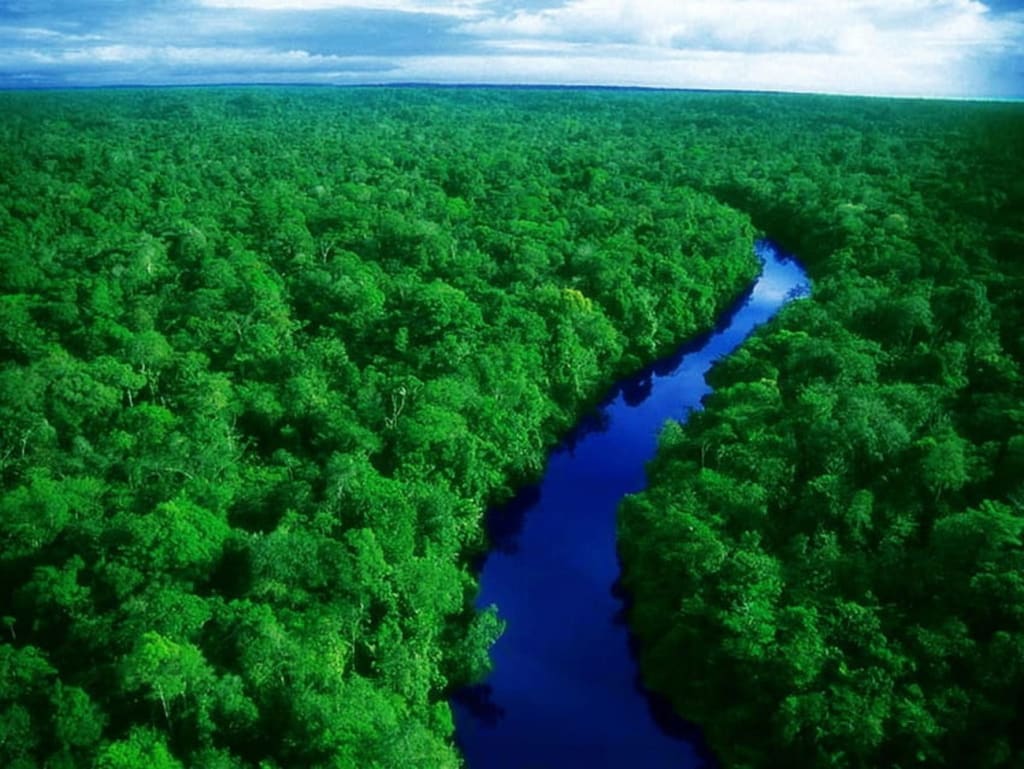
The Amazon Rainforest holds great biological relevance, cultural diversity, and environmental value in its history. The Amazon Rainforest is the world's biggest tropical rainforest, spanning nine nations in South America, mostly Brazil, Peru, Colombia, and Venezuela, with an area of approximately 5.5 million square kilometers (2.1 million square miles). This is a synopsis of its tale:
Origins and Formation: Following the extinction of the dinosaurs about 65 million years ago, the Amazon Rainforest started to take shape. The climate and geology of the area progressively molded the rich and diversified ecology that we know today over millions of years. Drained by the Amazon River and its tributaries, the Amazon Basin evolved into a unique hotspot for plant and animal diversity that cannot be found anywhere else.on the planet Earth.
Biodiversity: With millions of species of insects, plants, birds, and mammals, the Amazon Rainforest is home to an estimated 10% of all known species. It is home to several lesser-known but just as important species as well as famous animals like macaws, jaguars, sloths, and anacondas. From microscopic invertebrates to fungi and bacteria, the forest floor is teeming with life that forms an intricate web of interactions essential to the forest's survival.
Indigenous Peoples: For millennia, people of indigenous descent have lived in harmony with the Amazon, drawing food, shelter, and medicine from its natural resources. These tribes have created sustainable methods that suit their needs and protect biodiversity, and they have invaluable knowledge of the ecosystems of the jungle.
Threats & Deforestation: The Amazon Rainforest is threatened by a number of factors, chief among them being deforestation brought on by mining, logging, agriculture, and infrastructure development, despite the rainforest's significance to the environment. There has been significant forest loss and degradation as a result of large-scale land clearing for soy farming and cattle ranching, illicit logging, and gold mine. These risks are made worse by climate change, which makes wildfires and droughts more frequent and severe.
Environmental Impact: The devastation of the Amazon Rainforest has a significant impact on indigenous people, biodiversity loss, and global climate trends. By absorbing significant volumes of carbon dioxide, the forest serves as an essential carbon sink that helps control the planet's temperature. This process is hampered by deforestation, which releases stored carbon and causes global warming. In addition, numerous species are threatened by habitat loss.extinction, whereas native populations experience cultural deterioration and dislocation.
Conservation Efforts: Government regulations, international accords, community-based activism, and sustainable development programs are all used in the fight to protect the Amazon Rainforest. The goals of conservation organizations are to support indigenous land rights, create protected areas, and advance sustainable land management techniques. International cooperation is essential, and programs such as the Amazon Cooperation Treaty Organization (ACTO) encourage cooperation amongst Amazonian nations in order to tackle shared difficulties.
Future Prognosis: Deforestation, climate change, and irresponsible development continue to put pressure on the Amazon Rainforest, leaving it in jeopardy. In order to preserve this priceless ecosystem, there needs to be a global push for sustainable alternatives to extractive industries, support for indigenous rights, and an understanding of the underlying causes of deforestation. The Amazon Rainforest's future will have a significantinfluence the planet's health and the welfare of coming generations.
Numerous amazing and sometimes hazardous creatures can be found in the Amazon Rainforest. The following are a some of the most famous and dangerous creatures found in the Amazon jungle:
The largest cat in the Americas and the top predator in the Amazon Rainforest is the jaguar (Panthera onca). Capable of bringing down prey far larger than themselves, such as caimans, capybaras, and even anacondas, they hunt stealthily and with powerful jaws.
The green anaconda is the largest species found in the Amazon. Anacondas (Eunectes spp.) are among the largest snakes in the world. By coiling around their victim and applying pressure until they suffocate, these constrictors ambush their prey. Although assaults on humans are uncommon, anaconda encounters can be fatal because of their enormous size.and power.
Melanosuchus niger, often known as the black caiman, is the largest alligator species and the top predator in the waterways of the Amazon. They hunt fish, birds, and animals, and they are quite skilled hunters. Black caiman attacks humans rarely, but when they do, they can cause fatalities or severe injuries.
Poison Dart Frogs (Dendrobatidae family): Throughout the Amazon Rainforest, tiny, vividly colored frogs can be found. Despite their seemingly insignificant size, these frogs are actually protected from predators by strong poisons on their skin. Certain species have poisons that can result in cardiac arrest or paralysis, making them deadly to humans.
Phoneutria spp., also known as banana spiders or Brazilian wandering spiders, are some of the world's most venomous spider species. They are renowned for their extremely strong neurotoxic venom, which, if left untreated, can paralyze and even kill humans.
The bullet ant, also known as Parapenetra clavata, gets its name from its unbearably painful sting, which has been likened to being shot with a bullet. Although not fatal, a bullet ant's sting can produce excruciating agony, swelling, and fever that can endure for several hours.
The Amazon Basin is home to the unusual electric eel (Electrophorus electricus), a freshwater fish. They are a kind of knifefish, not real eels despite their name. They have unique organs that can produce strong electric shocks, which they employ for self-defense as well as hunting. A powerful electric shock from an eel can be fatal or severely incapacitating, even if it is not dangerous to humans.
These dangerous animals are rarely encountered, and they usually avoid people rather than attack them. When visiting the Amazon Rainforest, one must, nevertheless, proceed with caution and show respect for the local fauna and natural ecosystem.
About the Creator
Keep reading
More stories from Vijay Kumar and writers in Earth and other communities.



Comments
There are no comments for this story
Be the first to respond and start the conversation.