
The shrinking geography of grain cultivation in Ukraine threatens global supplies
The liquidity crisis, high costs, and confronting mines in the fields squander the chances of achieving a bountiful harvest this season.

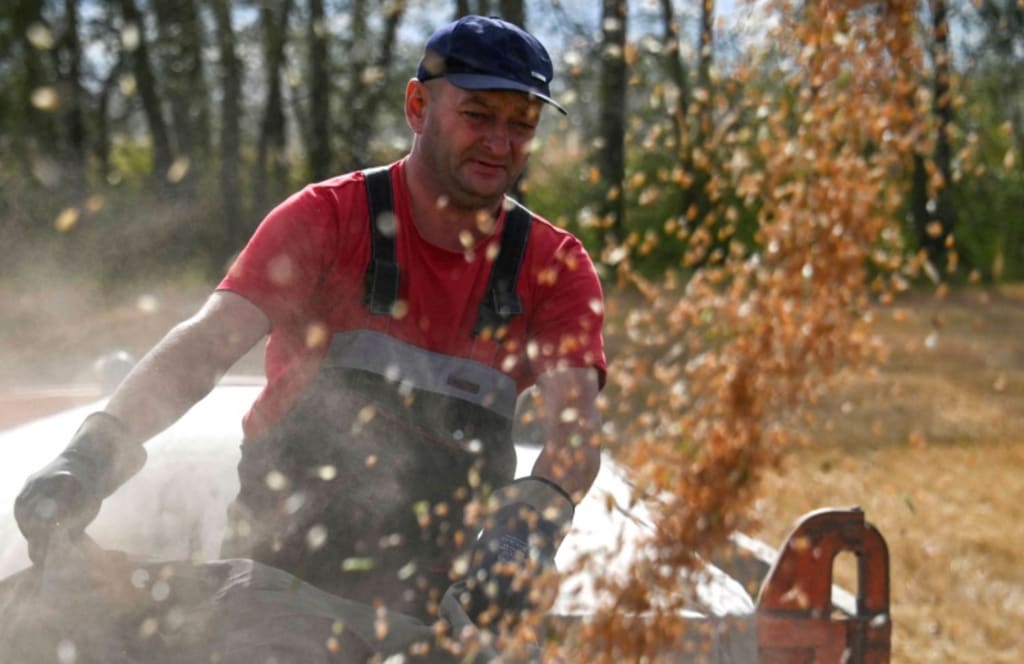
The continuation of the war in Ukraine, which has undermined the sustainability of grain supplies in global markets, prompts most of the country's farmers to think about reducing the geography of wheat crop cultivation in light of the many challenges that have become the dominant feature facing producers.
KIEV - Facing mined fields and cash shortages, many Ukrainian farmers are increasingly likely to plant a smaller area this spring than they did in the aftermath of the Russian invasion, in what could be another blow to global food supplies after last year's turmoil.
Ukraine is a major supplier of wheat and corn to world markets. A decline in production and exports last year due to the war caused commodity prices to rise sharply before stabilizing.
With farmers hurt by higher costs including fertilizer, Ukraine's export capacity is severely limited due to Russia's control of some areas, and unexploded ordnance near former front lines, which could further reduce supply.
Farmers, who began planting the country's spring crop last week, are also earning less than before as a result of rising costs and the logistical risks of war, giving them little incentive to ramp up production.
Under the current circumstances, Ukraine can ship from only three ports on the Black Sea, which are operating at half their capacity, under an international shipping deal concluded last September, one of which is Moscow.
"Almost all crops are being lost at the moment," said Dmitry Skornyakov, CEO of Harve East, a major agricultural producer, in a statement to Reuters.
The Ukrainian Agricultural Council said the companies cultivating most of the fields had an estimated shortfall of more than $1 billion in resources to carry out spring work. Spring crops mostly include maize, oilseeds and vegetables.
Denis Marchuk, vice president of the council, the country's largest farmers' organization, expects plantings of maize, a fertilizer-intensive crop, to drop 20 percent from last year, which in turn saw a 27 percent drop in the area harvested.
Overall, the government expects spring planting to fall by just five percent from last year, confirming a more optimistic official assessment of potential losses.
The smaller spring crop will come as Ukraine's winter wheat crop is expected to decline sharply, although not enough to spur export restrictions.
"Of course it's not heaven," Taras Vysotsky, Ukraine's first deputy agriculture minister, told Reuters. The situation is still difficult.”
Mike Lee, director of consulting firm Green Square Argo, said farmers should prioritize cheaper sunflowers.
Ukraine's fields have traditionally been dominated by grain, but low-cost, high-priced oilseeds are gaining popularity during the war.
Ukraine was the world's fourth largest corn exporter before Russia's full-scale invasion in 2022 and the largest exporter of sunflower oil.
Farmers in the United States, the largest exporter, plan to boost corn cultivation, which could mitigate the impact of lower Ukrainian production.
"Ukrainians are also likely to grow less potatoes, a Ukrainian staple, because of the weak profit potential," said Mykola Hordychuk, managing director of Aggreko Ukraine.
"This could lead to a shortage of quality potatoes for retail sale, leading to higher prices for Ukrainian consumers later in the year," he added.
Amid it all, there is one optimistic sign: Ukrainian agronomists say that soil moisture reserves appear to be plentiful and beneficial for crop germination.
Mines are an increasing occupational hazard. Last Monday, the authorities said, "Two farm workers were killed in separate mine explosions in work fields in the southern regions of Kherson and Mykolaiv."
One million hectares of arable land is mined, and half a million hectares are difficult to cultivate
Vasyl Shtendera, who grows in the Kherson region, which Ukraine took back last year, doubts he will plant crops this spring. He emphasized that his fields were mined, some equipment was destroyed, and fertilizers were expensive.
"I have no moral right to send workers to the fields because it is life-threatening," he told Reuters, adding that "there is no demining work there."
And Ukrainian media reported on Tuesday that companies without demining certificates are charging farmers up to $3,000 per hectare to clear fields.
Some Ukrainian officials estimate that all the land in conflict zones is mined, totaling about 10 million hectares or roughly a third of arable land.
However, Vysotsky estimated that the arable area mined might be only 2.5 million hectares, with only 500,000 hectares that would be impossible to use this spring.
"The ministry aims to clear up to 800,000 hectares of agricultural land in time for cultivation," he noted.
Michael Terry, director of the Europe program at the US State Department's Office of Demining, which funds Ukrainian mine clearance operations, says he sees impatient farmers trying to clear them themselves. "It's a sad reality because there are not enough demining teams," he said.
Farmer Oleksandr Klipach removed dozens of shells around his farm in the Mykolaiv region himself, using advice from demining experts and videos on the Internet.
Devising a plan to make money is equally difficult, fertilizer and transport costs have doubled, but he plans to plant sunflowers and peas on land that turned to weeds during the occupation. However, he said, "I think it will be difficult to make a profit."
Another news- Collecting truffles in the Syrian desert for a bite dipped in blood, Syrians face mines and ISIS bullets while searching for their livelihood.
Truffles are considered an important source of livelihood for the inhabitants of the Syrian desert who have been living without raising livestock for years because of the war in Syria. However, truffles are not an easy morsel, even though the land gives them to them, because ISIS has mined the land, and the terrorists are waiting for anyone who appears to them in the crosshairs of their guns, even if it is among the poor and innocent. .
Hama (Syria) - In the largest market in the city of Hama, vendors are shouting for “yellow gold,” in reference to truffles, which are a source of livelihood for Syrians who risk their lives to collect them from the desert, ignoring the danger of scattered mines or the fires of the Islamic State (ISIS).
In the present market, Muhammad Salih (31 years old) displays bags of truffles for sale, after he toured for a week in desert areas near his village of Aliyah in the eastern countryside of Hama.
“It is a morsel dipped in blood,” he says as he removes dirt from the fruits. We risk our lives and bodies to get it, but we no longer care because we want to feed our children.”
More than 130 people were killed in the Syrian desert while collecting truffles, most of them were killed by ISIS fire last February
"I leave my house every day, and I don't know if I will return to my wife and daughter alive, carrying their strength with me," he added.
Desert truffles, known for their quality in Syria, are generally harvested between February and April. During the Friday season, civilians often face the threat of mines planted by the Islamic State or the fire of its elements who are hiding in large desert areas and who carry out sudden, bloody attacks.
Since last February, the Syrian Observatory for Human Rights has counted more than 130 people killed in the Syrian desert, who were killed while collecting truffles, and most of them were killed by ISIS fire.
And truffles are sold at a high price, which explains the desire of citizens in rural areas to collect them to sell them in light of the difficult economic conditions with the war going on for 12 years.
In the Hama market, the price of one kilogram of truffles ranges between 5 and 25 dollars, according to the quality and size of the fruits. "We make big profits during the two months of the truffle season, but we also put our lives on our hands," Salih explains.
"We call these fruits 'yellow gold' because their price is as high as gold, and it is difficult to obtain," he continues.
In the market, where dozens of vendors spread out on the ground, boxes of truffles are topped with other vegetables and fruits. From time to time, one of them shouts, “Auction, auction,” and merchants gather around him who want to buy large quantities, so that the auction starts with fifty kilograms that will be won by whoever proposes the highest price.
Omar Al-Bush opens his auction at a price of 32,000 pounds ($4.5) per kilogram, to close it after less than a quarter of an hour at a price of 61,000 pounds ($9).
Al-Bush, 52, says, “There are families who prefer to buy truffles over meat,” explaining that “its price varies according to its quality, and we have brands suitable for middle-income people.”
According to merchants, the most expensive is the black truffle, which is famous for the Badia regions in the countryside of Aleppo and Hama. Because of the vast extension of the Syrian Badia, Syria produces different types of truffles.
A number of merchants, according to Jamal al-Din Dakak (51 years old), a wholesaler from Damascus, took the initiative to buy good quality crops and export them individually to Iraq and Lebanon. Also, quantities were exported to the Gulf by smuggling through Jordan.
The price of truffles is on the rise this year due to the dangers of collecting them.
Youssef Safaf, 43, who sat behind a stall displaying dozens of truffles, explains, “There are mines, bandits, and vast lands infested with ISIS (…) People sacrifice their lives for some money in order to support themselves.”
Safaf buys his goods from the Bedouins who go to the city every morning, and they have different quantities of truffles. He explains with excitement, “There are stains of blood on the clothes of some Bedouins, and there are those who lost members of their family while collecting truffles, and they continued to do so (…) because they have no choice, they want to live, and I excuse them.”
Despite security warnings from the competent authorities, truffle collecting is flourishing.
At the beginning of this month, the Syrian newspaper Al-Watan quoted a military source as appealing to the citizens “not to go to the desert to collect truffles, because they are areas that have not yet been declared safe, and are witnessing cleansing operations from ISIS cells.” He stated that "many sectors are planted with mines and explosive devices."
Three years ago, Jihad Al-Abdullah (30 years old) lost one of his feet when a landmine exploded while he was driving his truck while collecting truffles in the village of Al-Saan in the eastern countryside of Hama. Since then, he has been using two metal crutches to get around.
Nevertheless, he continues to collect truffles sometimes, although he devotes most of his time this year to selling the harvest that his brothers collect from the desert.
“I no longer have anything to lose after I lost my feet, and I continue with my work to secure my daily sustenance, and I surrender my command to God,” he says, while he is lying on the ground near a stall offering truffles in the market.
Explosive devices, including mines, are among the thorny files related to the war in Syria, which is about to end its twelfth year. The danger of confronting it does not seem easy in a country witnessing a complex conflict that has claimed the lives of about half a million people, during which several parties have pursued a strategy of laying mines in various regions.
Abandoned mines on agricultural lands and between residential areas pose a constant threat to farmers, passers-by and herders.
About 10.2 million Syrians live in mined areas, killing nearly 15,000 people between 2015 and 2022, according to the United Nations.
While waiting to sell his crops to return home, Al-Abdullah likens collecting truffles to “playing cards.” “You win once, you lose once,” he says. It's a gamble and I accepted it."
About the Creator
News Correct
Information WorldWide MORE INFORMATION
Keep reading
More stories from News Correct and writers in Earth and other communities.
Green Colonialism: A Dark Side to Investing in Renewable Energy in Africa
An economic and industrial project of unprecedented proportions LONDON - Europe turned the energy crisis into a clean energy revolution in the last moments before the disaster, as the Russian intervention in Ukraine created an urgent rush to reduce dependence on Russian energy imports, especially natural gas.
By News Correct3 years ago in Earth
El Niño is likely to return in 2026. Here's what that means for Houston and Texas.
La Niña has been active since mid-October. However, according to the January update from the National Oceanic and Atmospheric Administration, it’s likely to end over the next couple of months, and a transition to El Niño is likely to occur later this year.
By Dena Falken Esq5 days ago in Earth
Trump’s Greenland Threats Push Europe Toward Divorcing America
When you think of Greenland, the first things that probably come to mind are icebergs, polar bears, and maybe some adventurous explorers. But lately, Greenland has become the center of a major diplomatic drama — one that’s forcing Europe to question its long-standing relationship with the United States. And the spark? Donald Trump’s threats over Greenland. The Controversy: Trump’s Unusual Move Back in January 2026, Trump shocked the world again, not with an election campaign but with a bold — and many would say bizarre — plan to acquire Greenland. But he didn’t stop at just “expressing interest.” He threatened eight European nations with tariffs — starting at 10% and potentially climbing to 25% — unless Denmark agreed to sell Greenland to the U.S. Yes, you read that right: tariffs on allies to buy a remote Arctic island. For Europe, this was more than shocking — it felt like a betrayal from a partner they’ve relied on for decades. Europe’s Response: Outrage and Solidarity European leaders didn’t hold back. Germany, France, Norway, the UK, and others banded together to condemn Trump’s approach. The message was clear: Europe won’t be blackmailed. Even usually cautious leaders spoke up. Norway’s Prime Minister bluntly said, “Threats have no place among allies.” Meanwhile, European Commission President Ursula von der Leyen emphasized that tariffs between allies “have no place” and could undermine decades of cooperation. This isn’t just a political disagreement. Europe sees this as a test of trust, sovereignty, and alliance reliability. Why Greenland Matters At first glance, Greenland might seem like just a frozen island. But strategically, it’s a big deal: Location: Greenland sits between North America and Europe, controlling key air and sea routes. Military Importance: It hosts radar and U.S. military infrastructure critical to early-warning systems. Resources: Beneath the ice lie minerals and rare earth elements that the world desperately needs. For Europe, Greenland is also about principle. The island belongs to Denmark and the Greenlandic people, not Washington. Europe’s support for Denmark shows a broader commitment to respecting sovereignty — a principle that Trump’s threats directly challenged. The Bigger Picture: A Crisis of Trust Greenland may just be the tip of the iceberg. For years, European nations have felt frustrated by U.S. policies that seemed unpredictable — whether it’s climate agreements, trade deals, or security commitments. Trump’s Greenland threats amplified these frustrations. Suddenly, Europe is questioning something fundamental: Can the U.S. be trusted as a long-term partner? Some European leaders have even started talking about a kind of “divorce” from the U.S. — not literally leaving NATO, but rethinking how dependent they should be on America for security and strategic decisions. Europe’s Path Toward Strategic Independence This Greenland drama is accelerating discussions about European strategic autonomy. Basically, Europe is asking: Should we be able to protect our own interests without always relying on the U.S.? The EU has long talked about building stronger defense capabilities and investing more in its own military, but progress has been slow. Greenland might just be the wake-up call that finally pushes Europe to act. What’s Next? So, what happens from here? Europe isn’t just going to sit quietly. Leaders are looking at: Economic counter-measures like tariffs on U.S. goods Strengthening European defense and security collaboration Reasserting Europe’s role on the global stage, with less reliance on Washington Even if Europe doesn’t fully “divorce” America, Greenland is changing the terms of the transatlantic partnership. Europe will now demand more respect, clearer rules, and recognition of its sovereignty — and they’re not afraid to make that clear. Why This Matters to All of Us You might wonder why this matters if you’re not in Europe or the U.S. Greenland may seem remote, but this story is about alliances, trust, and how global power is shifting. The way Europe responds could reshape the world order, affect trade, military cooperation, and even the global economy. And for anyone following U.S.-European relations, it’s a reminder that sometimes the smallest places — even a frozen island — can have huge global consequences. Bottom line: Trump’s Greenland threats aren’t just a bizarre footnote in history. They’re a wake-up call for Europe, forcing the continent to rethink its ties with America and consider a future where it can act independently — strategically, economically, and politically. Greenland, icy as it is, might just melt the old rules of alliance forever.
By Muhammad Hassanabout 11 hours ago in Earth
Center Stage with Paul Stewart
*** I'm keen to republish the interviews I did for my series with Vocal creators. It's been a few years and I thought it might be nice to revisit these wonderful conversations. I'll be releasing them one at a time for a few weeks/months.
By Heather Hubler4 days ago in Interview



Comments
There are no comments for this story
Be the first to respond and start the conversation.