
Green Colonialism: A Dark Side to Investing in Renewable Energy in Africa
Europe's inability to provide a climate to achieve what the continent needs of clean energy is pushing it to turn towards Africa to take advantage of its climate.

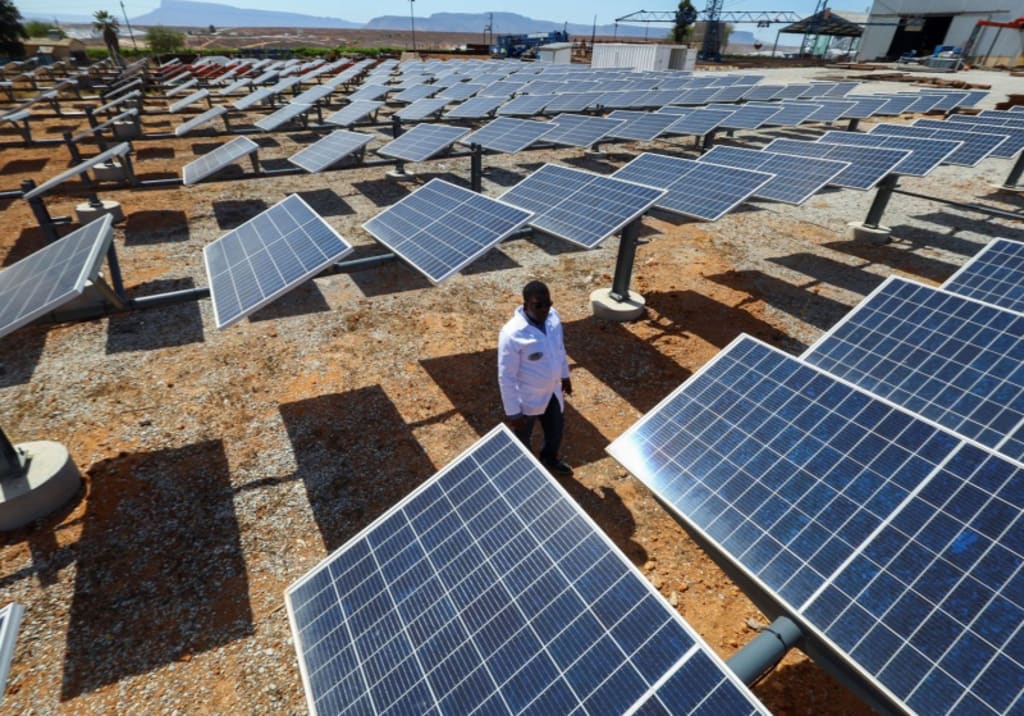
An economic and industrial project of unprecedented proportions
LONDON - Europe turned the energy crisis into a clean energy revolution in the last moments before the disaster, as the Russian intervention in Ukraine created an urgent rush to reduce dependence on Russian energy imports, especially natural gas.
However, the main problem impeding the pursuit of clean energy is that the climate of Europe is not sufficient to achieve what the continent needs, which makes it turn to Africa to exploit its climate, which brings the relationship back to the historical square, the history of colonialism, but this time green colonialism with a dark face.
The European Union's use of Russian natural gas fell from about 40 percent to less than 17 percent between 2021 and 2022. While part of this gap has been filled by a disappointing return to coal-fired energy, the EU continues to ramp up investments in clean energies with unprecedented policy measures aimed at accelerating the transition to green energy.
Solar and wind power overtook Europe's total energy mix of natural gas for the first time in history last year. The European Union is trying to maintain this trend.
The European Commission's 2022 Global State of Renewables Energy Report states that the new green trend "helps renewables grow on a large scale and occupy a large and growing share of the total energy mix".
The report predicted that the result of growth would reach 69 percent from renewable energy by 2030, which constitutes a huge increase from 37 percent recorded in 2021.
The ambitious continental RePower EU plan is the European Commission's response to US President Joe Biden's administration's deinflationary law that provides unprecedented tax breaks and subsidies to clean energy producers in the United States.
And while the path of green legislation has been launched, the establishment of a large clean energy infrastructure will not be easy. The expansion of large-scale solar and wind farms faces major issues, such as land allocation, onerous bureaucratic measures to start businesses, and inadequate power grids.
"Clean energy developers in Europe, some of whose countries suffer from land poverty, are looking to implement their largest and most ambitious plans in the less populated regions of North Africa," said economic analyst Haley Zarmba, in a report for the American Oil Price website.
Not only is there more undeveloped land, but North Africa's dry and sunny climate lends itself well to solar power generation, with panels on the continent generating up to three times more power than those installed in Europe. This energy can then be returned to the European Union via the huge transcontinental submarine cables.
While some of the benefits of this quasi-symbiotic relationship highlight Europe's need for energy as much as North Africa's need for economic stimulus, Zarmba points out, it is not without the drawbacks of familiar and dangerous imperial currents.
North African countries need energy as much as they need investment and industry to support their economies. Major renewable energy projects have already been undertaken to power African grids and reduce the region's carbon footprint. However, it is witnessing an increasing shift of this planned production to European markets.
The Yalla 360 program, which specializes in climate and the environment, recently stated that Morocco has “links through a regional energy pool that can send green electricity to most countries in West Africa, while Egypt is connected to most of the eastern continent. But the two countries' electricity exports are destined for European markets" rather than going to African links.
The scale of these projects indicates North Africa's readiness for a new round of land allocation, which could cause significant disruptions to flora, fauna and population systems when solar and wind farms are established.
Yalla warns that these developments are likely to occur "with minimal community consultation or environmental assessment". The false portrayal of Saharan Africa as an empty space continues, as the desert remains a fragile ecosystem for nomadic pastoralists whose lives and grazing patterns will change after the establishment of the energy industry.
These projects are likely to prioritize development in densely populated coastal areas, where transportation will be easier.
The transition to green energy creates significant trade-offs. It is an economic and industrial project of unprecedented dimensions and uncertain results. But compromises and sacrifices will be inevitable in the public interest in combating catastrophic climate change.
This does not mean that the ethics of those who bear the brunt of these sacrifices should not be questioned, and it is important that the issue of mitigating trade-offs be studied.
Climate change is already a morally contentious issue, since phase one energy exploitation has caused most of the greenhouse gas emissions that now greatly threaten less developed countries, especially those in Africa.
Pushing controversial green energy projects from first-world countries into countries with weaker systems remains an easy option, but certainly not an ethical one.
Green hydrogen now from salty sea water
If hydrogen is extracted from seawater, demand for cobalt will skyrocket and become more expensive.
No more worries about the scarcity of fresh water
LONDON - Analysts fear that an increase in demand for hydrogen to replace energy from fossil fuels will increase the scarcity of limited fresh water resources, but a new discovery based on the extraction of green hydrogen from seawater reduces concerns.
Professor Xizang Qiao of the University of Adelaide and Associate Professor Yao Zheng of the School of Chemical Engineering led an international team that successfully split seawater without pretreatment to produce green hydrogen.
"We split natural seawater into oxygen and hydrogen with almost 100 percent efficiency to produce green hydrogen by electrolysis, using a commercial analyzer that was a cheap catalyst," Qiao said.
The team published the research in the journal Natural Energy. The non-precious catalyst was cobalt oxide with chromium oxide on its surface.
“We used seawater as a feedstock without the need for any pre-treatment processes such as reverse osmosis, purification or alkaline methods. The performance of the commercial electrolyzer with the catalysts was close to that of the platinum/iridium catalysts operating in a feedstock of high purity deionized water. We continue to run the existing electrolyzer with a high-purity aqueous electrolyte solution. Increasing demand for hydrogen to partially or fully replace energy from fossil fuels will further scarce the already limited freshwater resource.”
But sea water seems to be an infinite resource and is a natural electrolyte. This is more practical for areas with long coastlines and plenty of sunshine. However, it would not be practical in areas where sea water is scarce.
Seawater electrolysis is still at an early stage compared to pure water electrolysis due to negative electrode interactions and corrosion resulting from the complexities of using seawater.
Zeng pointed out, “It is always necessary to treat impure water so that we adopt traditional electrolyzers, including water desalination and deionization, which increases the cost of operation and maintenance. Our work provides a solution for direct utilization of seawater without pre-treatment and alkaline addition systems, showing performance comparable to that of pure water.”
The team will work to scale up the system with a larger electrolyser so that it can be used in commercial processes such as hydrogen generation for fuel cells and ammonia synthesis.
Seawater electrolysis is still at an early stage compared to pure water electrolysis
"If the process is repeated with similar success, the scientific breakthrough will be significant," said Brian Westenhouse, a writer for the American Oil Price website. Where it does not depend on precious metals. But cobalt, although not very rare, is not abundant, and it is often bought from areas where child labor is prevalent. This leaves the future of cobalt pending evaluation.” "If the efficiency of this research is proven, the demand for cobalt will skyrocket and become more expensive," he added.
The second thing is that the source of energy is not discussed, with the details of its operations kept secret, although the energy input is certainly electric and the efficiency is close to 100 percent.
"However, the prospect of significantly reducing the cost of the water source and not using precious metals creates a reason for much anticipation," he added. Let us hope that the next steps can be solved at low costs and do not require decades of political maneuvering to achieve the desired results.
About the Creator
News Correct
Information WorldWide MORE INFORMATION
Keep reading
More stories from News Correct and writers in Earth and other communities.
Without Democracy, Donald Trump’s Venezuelan Oil Quest Will Fail
Donald Trump’s renewed interest in Venezuelan oil may seem, on the surface, like a hard-nosed geopolitical calculation. Venezuela holds the world’s largest proven oil reserves, and amid global energy uncertainty, access to those resources is undeniably tempting. But history, economics, and politics all point to the same conclusion: without democratic reform in Venezuela, any attempt by a Trump-led US administration to secure reliable Venezuelan oil will ultimately fail.
By Aarif Lashari6 days ago in Earth
So You Decided To Become a Nurse Practitioner:
So you decided to become an "Advanced Practice" nurse. Congratulations!... is what I would say if this was a good idea. Grad school? In this economy? What were you thinking? Likely it was something along the lines of either 1) “I've seen these other chucklefucks do it— Why can't I?” or even 2) “I've got a nice career, I should shake it up. I miss feeling like I have no clue what I'm doing.”
By Sandor Szabo3 days ago in Fiction



Comments
There are no comments for this story
Be the first to respond and start the conversation.