
The Meteorite Hidden in Plain Sight
How an Australian Man Mistook a Cosmic Treasure for a Stone Filled With Gold—and Discovered Something Far More Valuable
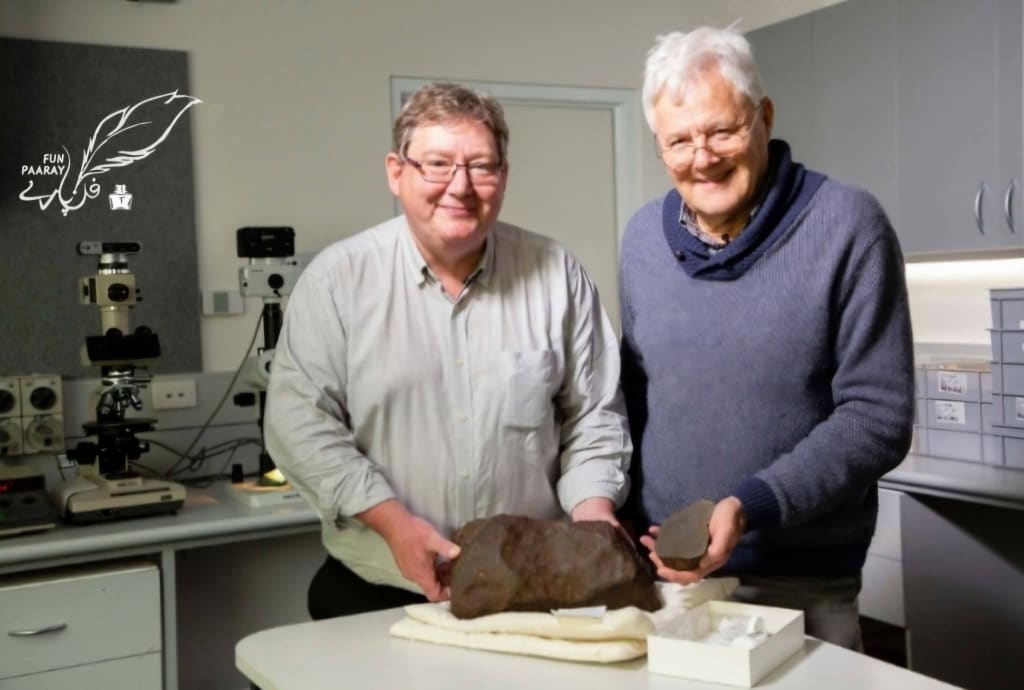
In the vast landscape of Australia, where gold hunters and adventurers often roam the earth in search of fortune, one man found something that defied imagination. What he believed was a strange rock hiding gold turned out to be a priceless relic from outer space—a meteorite older than Earth itself.
This extraordinary discovery began in 2015 in a quiet Australian town called Maryborough, near Melbourne. A man named David Hole, equipped with a metal detector and high hopes of finding gold, wandered into the bushland in search of a lucky strike. Little did he know that his journey would gift the world one of the rarest and most scientifically valuable space rocks ever found in Australia.
The Mysterious Red Stone
As David swept his metal detector across the ground, the machine suddenly emitted a strong signal—indicating that something metallic lay beneath the surface. Excited and curious, he began digging. What he unearthed was unlike the ordinary stones sprinkled across the Australian soil.
It was heavy.
It was reddish-brown.
It had a smooth, iron-like texture, and an unusual density that made it feel almost alive.
David’s first thought was simple and logical for a gold hunter: “Maybe there’s gold inside.”
Australia’s goldfields have produced countless gold-studded quartz rocks, so his assumption wasn’t unusual.
Determined to uncover the secret inside, David tried everything he could to crack it open.
He struck it repeatedly with a hammer—nothing happened.
He used a grinder to shave off pieces—but the stone resisted.
He attempted to drill into it—no effect.
He even poured acid over it, hoping it would reveal a hidden core—yet the rock remained unchanged.
It was as if the stone was indestructible.
Perplexed and disappointed, David eventually stored the rock at home. For years, it sat untouched, neither broken nor understood—just a strangely heavy object with a story waiting to be told.
The Day the Truth Finally Emerged
After holding on to the mysterious rock for several years, David finally decided to take it to the Museums Victoria, where geologists and experts examined it closely. The moment they began testing it, they realized it was no ordinary stone.
The results were astonishing:
**It wasn’t a rock...
It was a METEORITE.**
A real piece of outer space—a fragment of the cosmos that had survived a fiery descent through Earth’s atmosphere.
According to experts, the meteorite likely fell to Earth over 1,000 years ago, long before Australia was colonized, long before modern civilization. But what truly left the scientists speechless was its age.
The meteorite was 4.6 billion years old.
Older than every mountain on Earth.
Older than every ocean.
Older even than Earth itself.
It carried within it the history of the early solar system—when planets were just beginning to form.
A Treasure Beyond Gold
Composition tests showed that the meteorite contained high levels of iron, mixed with traces of nickel—typical of ancient meteorites formed during the birth of the solar system. It weighed an impressive 17 kilograms, making it one of the heaviest meteorites discovered in Victoria.
Scientists named it the Maryborough Meteorite, in honor of the region where it was found.
Today, the meteorite is safely preserved in an Australian museum, where researchers study its structure, composition, and cosmic origins. Such meteorites are incredibly rare: fewer than 1% of all objects found by metal detectors turn out to be meteorites, and even fewer are this old, this heavy, and this scientifically valuable.
Experts estimate that such a meteorite could be worth hundreds of thousands to millions of dollars, depending on its scientific significance, rarity, and condition.
But beyond financial value, its scientific worth is immeasurable. This rock is a time capsule—a messenger from the formation of the universe.
A Lesson Hidden in Stone
The most beautiful part of this story is the irony:
David Hole believed he had found a rock that might contain gold.
Instead, he found something far more valuable than gold—a piece of the cosmos.
Gold can be mined again and again.
Mountains can be split open to reveal minerals.
But a 4.6-billion-year-old meteorite is a treasure that nature gives rarely and unexpectedly.
It reminds us that the Earth still hides secrets older than imagination. Most of us walk past such mysteries without noticing them. Nature is full of wonders—silent, waiting, ancient, and beyond price.
Why Stories Like This Matter
This discovery teaches us several powerful lessons:
1. Not everything valuable shines at first glance.
The meteorite was dull, rusty, and unattractive—but it held secrets older than the planet.
2. The universe is far more mysterious than we know.
Space rocks, comet fragments, dust from dead stars—they still fall to Earth, carrying stories from other worlds.
3. Sometimes we hold onto something special without realizing it.
David kept the stone for years without knowing its worth. Life often works this way—we only later discover the value of what we already had.
4. Curiosity leads to discovery.
Had David not taken the stone to the museum, the world might never have known of the Maryborough Meteorite.
A Cosmic Gift to Humanity
Today, thousands of visitors admire the meteorite at the museum. Scientists analyze it using advanced instruments to learn about the early universe. Students read about it. Space researchers use it to understand the formation of planets and the role of iron meteorites in shaping the young solar system.
What started as a simple day of gold hunting became a moment of science, wonder, and global interest.
And all because one man followed a metal detector beep into the bushes of Maryborough.
A Glimpse Into the Unknown
As we read this story, we’re reminded of how much of the world—and the universe—still lies undiscovered. How many ancient rocks are still buried beneath the soil? How many pieces of lost stars lie silently waiting for someone curious enough to dig them up?
Perhaps the universe leaves these gifts for ordinary people to find.
Perhaps every forgotten corner of Earth hides a story from the heavens.
And perhaps—just like David—we might one day stumble upon something that changes everything we know.
About the Creator
Keep reading
More stories from Ikram Ullah and writers in Earth and other communities.
Body Emerges from the Glacier After 28 Years
Body Emerges from the Glacier After 28 Years: Kohistan Witnesses a Stirring Scene of Nature, Memory, and Loss In accordance with the immutable laws of nature, ice has long been known to preserve objects, bodies, and memories across decades — sometimes even centuries. It conceals the past within its cold grip, keeping it frozen in time until the moment of release arrives. Such a moment has recently occurred in the snow-clad highlands of Kohistan, where an extraordinary discovery has captivated local residents and resonated deeply with anyone who has known loss.
By Ikram Ullah7 months ago in Earth
Why Everyone Is Talking About the Next Solar Maximum
The Sun looks calm from 93 million miles away. It rises. It sets. It warms our skin and fades behind buildings like it always has. But beneath that steady glow, something is building — a cycle of magnetic chaos that peaks every eleven years.
By Abubakar2202 days ago in Earth
A Historic Declaration
We the People of the Husbands of the United States of America, in Order to form a more perfect Union, and I mean you...with me...establish Justice, insure domestic Tranquility, provide for the common defence, promote the general Welfare, and secure the Blessings of Liberty to ourselves, after Puberty, do ordain and establish this Declaration of Co-Dependence.
By Gerard DiLeo4 days ago in Humans



Comments
There are no comments for this story
Be the first to respond and start the conversation.