
Why Everyone Is Talking About the Next Solar Maximum
Scientists, tech experts, and skywatchers prepare as solar storms threaten skies and systems.”

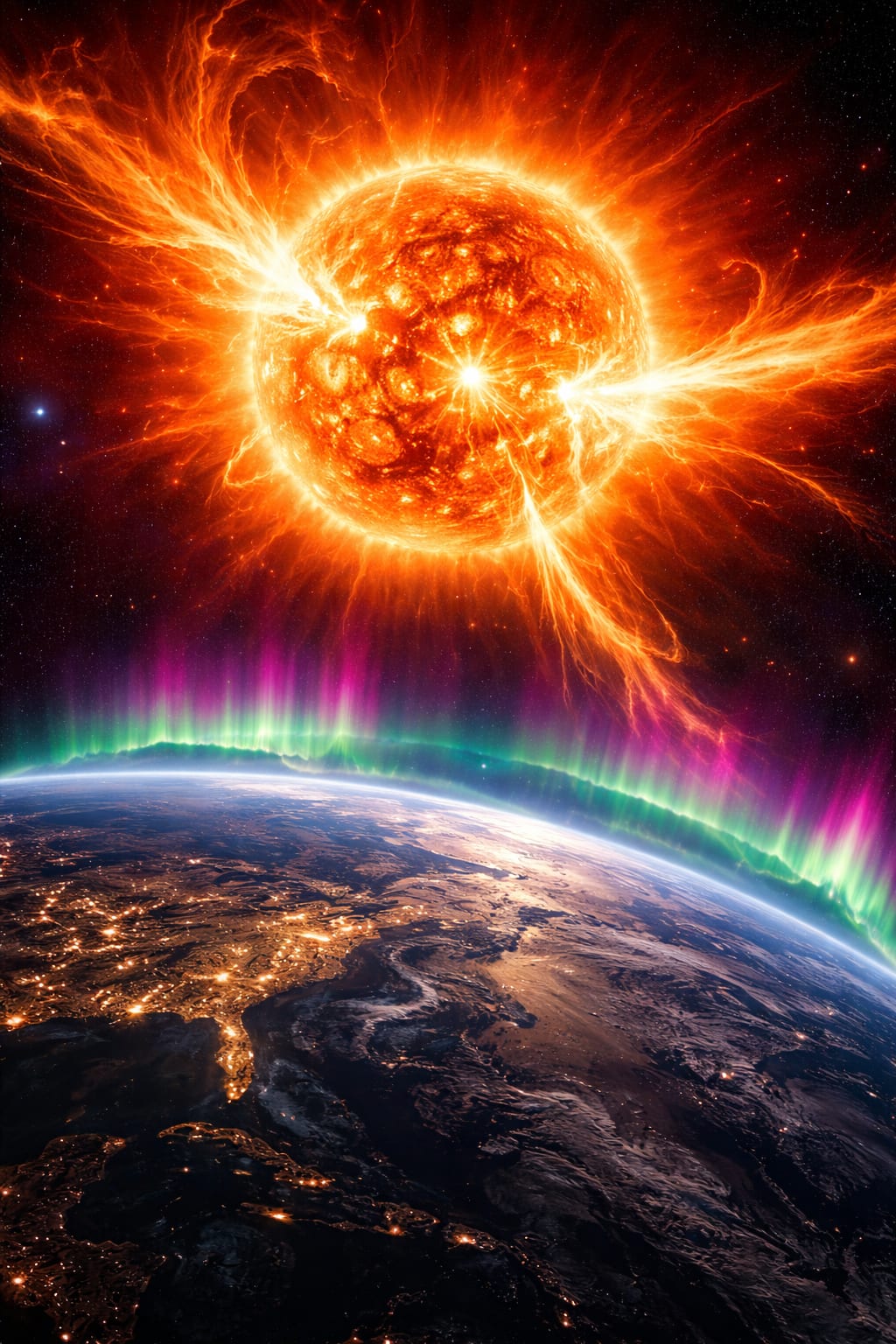
The Sun looks calm from 93 million miles away.
It rises. It sets. It warms our skin and fades behind buildings like it always has. But beneath that steady glow, something is building — a cycle of magnetic chaos that peaks every eleven years.
And we’re getting close to the next one.
It’s called the solar maximum, the most intense phase of the Sun’s natural activity cycle. During this period, the Sun’s magnetic field flips, sunspots multiply, and powerful bursts of energy erupt into space. Most of the time, we don’t notice.
But sometimes, we do.
☀️ What Is a Solar Maximum?
The Sun operates on roughly an 11-year cycle known as the solar cycle. At its quietest phase — solar minimum — sunspots are rare, and solar flares are less frequent. But as activity increases, the Sun enters solar maximum.
During solar maximum:
Sunspots become more numerous
Solar flares intensify
Coronal Mass Ejections (CMEs) occur more often
Auroras appear farther from the poles
In simple terms: the Sun becomes more energetic, more unstable, and more unpredictable.
🌎 Why It Matters on Earth
Most solar activity is harmless. Earth’s magnetic field shields us from the worst of it. But when a powerful CME is directed toward Earth, it can disturb our magnetosphere — the protective bubble around our planet.
That disturbance can:
Trigger geomagnetic storms
Disrupt satellite communications
Interfere with GPS systems
Affect airline routes near the poles
In extreme cases, impact power grids
The most famous example? The Carrington Event of 1859 — a massive solar storm that caused telegraph systems to spark and fail. If something of that magnitude happened today, experts believe the impact on modern infrastructure could be significant.
That’s one reason people are paying attention.
🌌 The Beautiful Side: Auroras Everywhere
But it’s not all danger and disruption.
Solar maximum also means brighter, more frequent auroras — the Northern and Southern Lights dancing across the sky. During strong geomagnetic storms, auroras can become visible much farther south than usual.
Cities that rarely glimpse the lights might suddenly see the horizon glowing green, pink, or violet.
For photographers and skywatchers, solar maximum is an opportunity.
For power companies and satellite operators, it’s a period of caution.
📱 Why It’s Trending Now
There are three big reasons everyone is talking about it:
Modern Dependence on Technology
We rely heavily on satellites — for internet, navigation, banking systems, and communication. Increased solar activity means higher risk to these systems.
Recent Strong Solar Storms
Over the past year, several geomagnetic storms have already produced unusually vivid auroras, sparking viral videos and headlines.
Improved Monitoring & Media Attention
We now track solar activity in real-time. Space agencies provide constant updates, and social media spreads dramatic sky footage within minutes.
In the 1800s, a solar storm was a mysterious spectacle.
Today, it’s a trending topic.
⚡ Should We Be Worried?
Not panicked — but prepared.
Scientists monitor solar activity closely using satellites designed to detect flares and CMEs. If a significant event is heading toward Earth, agencies can issue warnings that allow power grid operators and satellite controllers to take protective steps.
The good news? Earth has endured countless solar cycles before.
The difference now is our technological vulnerability.
We’ve built a civilization that depends on invisible signals traveling through space. And during solar maximum, space becomes more turbulent.
🌞 A Reminder of Our Place in the Cosmos
Perhaps the real reason solar maximum fascinates people isn’t fear — it’s perspective.
We like to believe we’ve mastered our environment. Yet every eleven years, the Sun reminds us that we orbit something far more powerful than ourselves.
A star capable of disrupting our signals.
A star capable of painting our skies neon.
A star that pulses, flips, and flares on its own schedule.
Solar maximum is not an apocalypse.
It’s a cycle.
But it’s also a reminder that even in our digital age, we are still tethered to cosmic rhythms older than civilization itself.
And when the next major solar storm hits — whether it simply brightens the night sky or briefly rattles our satellites — we’ll be watching.
Not just with telescopes.
But with curiosity.
About the Creator
Abubakar220
I am best Stories writer
Keep reading
More stories from Abubakar220 and writers in Earth and other communities.




Comments
There are no comments for this story
Be the first to respond and start the conversation.