
The Hidden Colors of Light: The Magic of the Rainbow
How sunlight, raindrops, and nature’s artistry create one of the sky’s most breathtaking wonders.

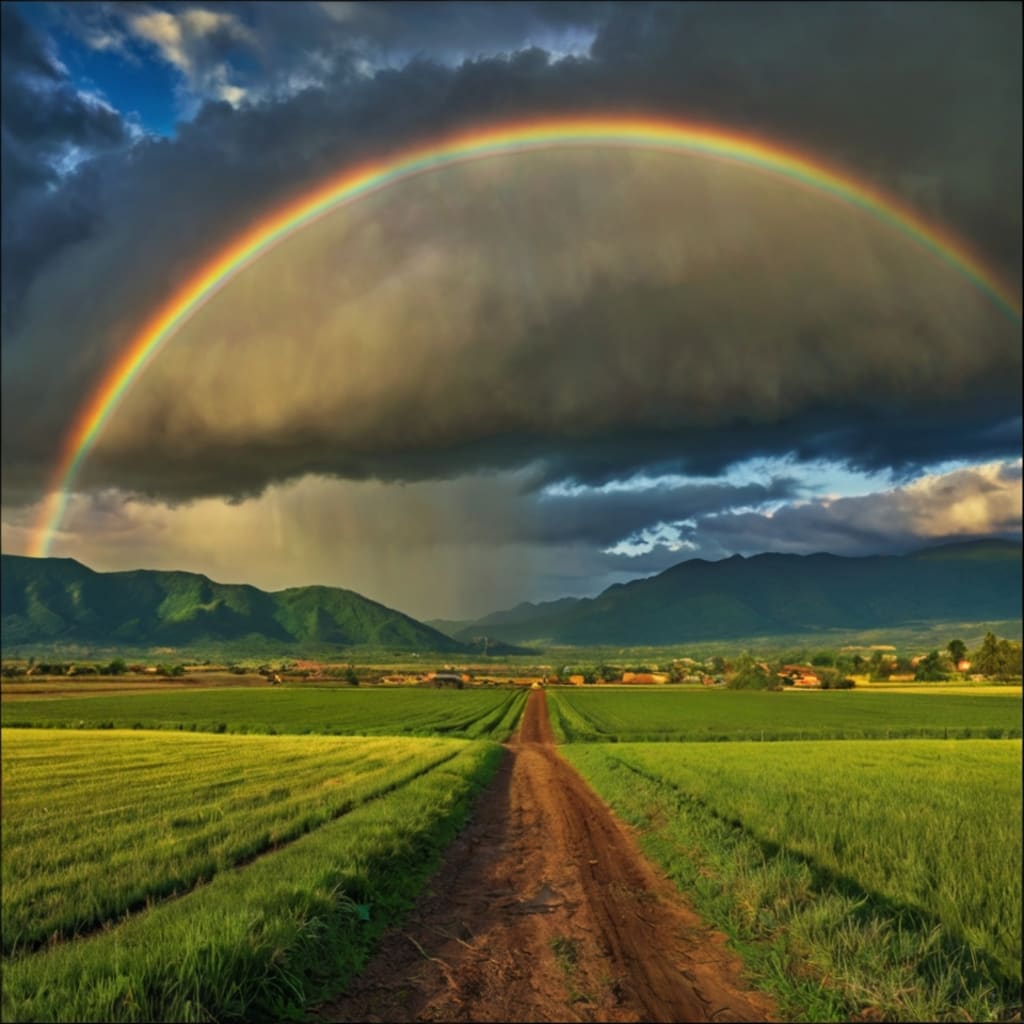
The Magic of the Rainbow
BY:Ubaid
When the rain stops, the clouds begin to scatter, and the sun peeks out with its glowing golden face, something magical sometimes happens in the sky. Right in front of the sun, a colorful arch appears, shining gently yet brightly. We call it a rainbow. In Urdu it is known as Qaus-e-Qazah or Dhanak.
A rainbow is a gift of daylight; you can never see it at night because it is created by the rays of the sun. At first glance, sunlight looks plain and white, but in truth, it carries within it a hidden treasure—many different colors woven together so tightly that we cannot see them separately.
But when sunlight passes through glass or water, it bends and scatters, revealing its secret. The rays separate into distinct colors, each one glowing in its own identity. This is what allows us to see the brilliant spectacle of the rainbow.
The Science Behind the Colors
To understand this better, imagine holding a prism in your hand. A prism is a triangular piece of special glass. When you face it towards the sun and slowly turn it, you begin to notice a spectrum of colors—reds, yellows, blues, and violets—dancing inside the glass.
Now let’s make the experiment even more exciting. Picture yourself in a dark room with just one small window left slightly open. Through that opening, a thin beam of sunlight slips in. Place a table under the beam, spread a white sheet of paper across the table, and hold your prism in the light. As you slowly turn the prism, something magical happens—the paper lights up with shimmering bands of color, like a rainbow captured indoors.
This tiny demonstration is the very same process that happens high above us in the open sky.
Rainbows in Nature
After a rainfall, countless tiny droplets of water remain suspended in the air. These droplets are like countless little prisms floating everywhere. When the sun’s rays strike them, the light bends and separates into its hidden colors. The result is the magnificent arch across the sky—a rainbow.
But this show is temporary. It is as if nature gives us a short performance and then draws the curtain. The moment the water droplets dry out or disperse, the rays of light merge back together, and the rainbow quietly fades away. That is why people often rush outdoors, children point with wonder, and adults reach for their cameras, because they know the rainbow is not here to stay.
The Right Place, The Right Time
For a rainbow to appear, the position of the sun is crucial. The sun must be low in the sky—either exactly in the east during morning hours or in the west during late afternoon. This is because the rays of sunlight need to fall slanting, not straight, onto the water droplets.
If the sun is in the east, the rainbow will form in the west. If the sun is in the west, the rainbow will form in the east. It is always opposite the sun. That is why you can never chase a rainbow by walking towards it; it keeps moving away because it depends entirely on your angle of vision and the position of the sun behind you.
More Than Just Science
Although the rainbow has a perfectly scientific explanation, it has always carried meanings far beyond physics. For centuries, people have looked at it as a bridge between the heavens and the earth, a symbol of peace, beauty, and hope. Many cultures and stories around the world describe the rainbow as a sign of blessings after hardship, a reminder that storms do not last forever.
Children see it as magic, artists paint it as inspiration, and poets describe it as nature’s smile. Even though we know it is simply sunlight refracting through droplets of water, the wonder of the rainbow remains timeless.
A Lesson from the Sky
The rainbow teaches us something subtle yet powerful: sometimes beauty comes not from being whole and united but from being broken and spread apart. Sunlight is just plain white when it is together. But when it bends and divides, the world sees its hidden brilliance—seven distinct colors, each necessary to complete the arch of wonder.
In a way, this is true for life as well. Challenges may bend us, hardships may scatter us, but sometimes in those very moments, our hidden strengths and colors shine the brightest. The rainbow becomes a reminder that even after the storm, beauty can emerge.
Conclusion
So the next time the rain stops and the clouds clear, do not rush indoors. Step outside, look up at the sky, and if you are lucky, you will see the miracle of colors arching above you. For a brief moment, let yourself marvel at the perfect combination of sunlight, raindrops, and nature’s artistry.
Rainbows last only a short while, but their memory lingers. They remind us of the hidden beauty in ordinary light, the joy of fleeting moments, and the promise that after every storm, there will always be light and color again.
About the Creator
Without Democracy, Donald Trump’s Venezuelan Oil Quest Will Fail
Donald Trump’s renewed interest in Venezuelan oil may seem, on the surface, like a hard-nosed geopolitical calculation. Venezuela holds the world’s largest proven oil reserves, and amid global energy uncertainty, access to those resources is undeniably tempting. But history, economics, and politics all point to the same conclusion: without democratic reform in Venezuela, any attempt by a Trump-led US administration to secure reliable Venezuelan oil will ultimately fail.
By Aarif Lashari5 days ago in Earth
So You Decided To Become a Nurse Practitioner:
So you decided to become an "Advanced Practice" nurse. Congratulations!... is what I would say if this was a good idea. Grad school? In this economy? What were you thinking? Likely it was something along the lines of either 1) “I've seen these other chucklefucks do it— Why can't I?” or even 2) “I've got a nice career, I should shake it up. I miss feeling like I have no clue what I'm doing.”
By Sandor Szabo2 days ago in Fiction


Comments
There are no comments for this story
Be the first to respond and start the conversation.