
The Cosmic Brain: Exploring the Intriguing Parallels Between the Universe and the Human Mind
Unveiling the Similarities: Are the Universe and Brain More Alike Than We Think

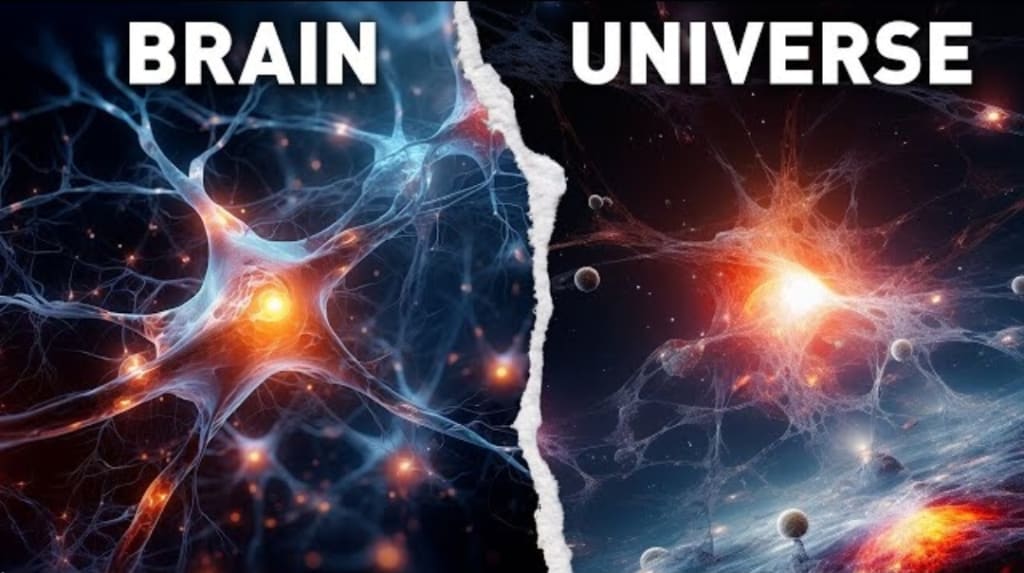
At first glance, these two images might seem identical: one shows a galaxy cluster in space, and the other a neuron in the human brain. But upon closer inspection, the two are vastly different, though both represent incredibly complex structures that scientists are still trying to fully understand. This comparison between the universe and the human brain has intrigued some thinkers, sparking the question: could the universe be similar to a giant brain?
Before we get too carried away with this idea, let's pause for a moment and acknowledge something known as *pareidolia*—our brain’s tendency to spot patterns, even where none exist. For instance, when we look at clouds, we might see shapes of animals or faces, but those are simply our imaginations at work. Could it be that the brain is doing something similar when it compares the universe to a neural network? To explore this notion, scientists decided to investigate further to see whether the similarities between the two structures were more than just coincidental.
First, let's examine the brain. It's one of the most intricate systems we've studied, with more than 80 billion neurons. These neurons are the core components of the brain, responsible for transmitting electrical signals. Think of them like workers in a factory—they don’t just perform their individual tasks but communicate with one another, thanks to components called axons and dendrites. Axons carry the electrical signals away from the neuron, while dendrites receive the signals. Altogether, they form a massive network, with around 100 trillion connections within the brain.
The universe, similarly, is a vast network of galaxies. When we think of the cosmos, we often picture an endless sea of stars, planets, and empty space. But the observable universe, which spans over 90 billion light-years across, is not just empty space. Galaxies exist in clusters, and even these clusters aren’t isolated. Our Milky Way galaxy is part of a group called the Local Group, which includes other galaxies like Andromeda and Triangulum. Together, they belong to a larger collection known as the Virgo Supercluster. The space between these galaxies isn’t truly empty; it's filled with threads of regular matter and perhaps the mysterious substance known as dark matter.
Taking inspiration from the brain, scientists began to look for patterns by comparing thin slices of the cortex—the part of the brain responsible for thought, memory, and consciousness—with similarly thin slices of the universe, which they simulated on a computer. Even though the size difference between the brain and the universe is enormous, at higher magnifications, certain patterns started to emerge that made the two seem somewhat alike. In particular, when zoomed in 40 times, the brain’s neural network resembled the galaxy clusters found in the universe.
To confirm these similarities, scientists used two key methods. The first method involved studying how the neurons and galaxies were connected. They observed that the central part of a neuron—the nucleus—is much smaller compared to the long, connecting axons and dendrites. Likewise, galaxy clusters appear tiny in comparison to the long, thread-like structures that link them together. The second method examined how organized the networks were. Scientists looked at the structure of connections in both the brain and the universe to see if they were more than just random patterns. What they found was a kind of similar organization between the two.
The similarities didn’t end there. The human brain is composed of about 70% water, and intriguingly, the cosmic web of the universe also contains around 70% dark energy. While water and dark energy may not be the primary components of each system, they do play a significant role in the overall structure. Another comparison emerged when scientists looked at the storage capacity of both systems. It turns out that a computer simulation of the universe requires a similar amount of memory as the human brain—roughly 2.5 petabytes. This means that, theoretically, a part of the universe could be mapped onto the human brain, or vice versa, suggesting a fascinating connection between the two networks.
Of course, there are clear differences between the universe and the brain that we must take into account. For one, the universe is more or less uniform throughout, with the same basic composition across vast distances. On the other hand, the human brain is highly specialized. Different parts of the brain are responsible for different functions, such as processing sensory information, controlling motor functions, and enabling higher cognitive processes like decision-making. The connections within the brain also change depending on what you're seeing, touching, or experiencing. The connections in the universe, however, are more like energy pathways, constantly flowing through the cosmic web without the kind of purpose-driven specialization that characterizes the brain.
Another key difference lies in their origins. The patterns in the universe are shaped by physical forces like gravity, dark matter, and the cataclysmic explosions of supernovae, all of which influence the arrangement of galaxies. Meanwhile, the brain’s structure evolved over millions of years. The shape and connections within the brain were fine-tuned through evolution to maximize efficiency for survival, helping humans think quickly in response to environmental threats. For instance, having a quick reaction time to danger, like avoiding a predator, was a trait that helped early humans survive.
Now, you might be wondering if, in this comparison, the universe is like a gigantic brain, what would its "body" look like? Could it be that we are merely small neurons within a larger, cosmic system? While this is an intriguing thought, it remains purely speculative. With no way to test such ideas, we can only wonder. The universe is estimated to be about 95 billion light-years in diameter, and even if we could somehow travel at the speed of light, it would take an unimaginable amount of time to reach its outer edges.
Furthermore, the idea of the Multiverse suggests that our universe might be just one of many. Some of these other universes could operate under different rules or contain life forms unlike anything we can imagine. This opens the possibility that we could be part of something far larger and more complex than we can currently comprehend.
Understanding both the universe and the brain is crucial for unlocking many of the mysteries we face. While we’ve learned a great deal about the brain, there’s still much we don’t know, particularly regarding memory storage and retrieval. Similarly, the cosmos holds countless unanswered questions, from the nature of dark matter to the true scale of the universe. As we continue our journey of discovery, we might find that the connections between the two—the brain and the universe—are even deeper than we could have ever imagined.
About the Creator
Nora Ariana
Empowering through stories and sound igniting purpose, sparking growth, and awakening the power within.
Keep reading
More stories from Nora Ariana and writers in Earth and other communities.
A goal is a dream with a deadline
A goal is a dream with a deadline. This powerful quote reminds us that without action, dreams remain just that wishes floating in our imagination. But when we set a timeline and commit to achieving them, they evolve into goals, bringing clarity, direction, and purpose. Many people go through life holding on to dreams, hoping they will come true someday. But someday is not a day on the calendar. Dreams without structure often fade with time or get buried under the weight of daily responsibilities. Turning a dream into a goal is what separates those who achieve from those who continue to wish.
By Nora ArianaExclusive • 11 months ago
The Zo ne of Silence: America’s Enigmatic Corner Where Laws and Logic Vanish
Deep within the rugged, breathtaking wilderness of Yellowstone National Park lies a geographical oddity so unsettling that it sounds like the plot of a legal thriller. Known to scholars and conspiracy theorists alike as the **"Zone of Death,"** this 50-mile stretch of land represents a terrifying glitch in the American judicial system—a place where, theoretically, a person could commit a major crime and walk away a free man.
By Irshad Abbasi 6 days ago in Earth




Comments
There are no comments for this story
Be the first to respond and start the conversation.