Science
What will the world be like in 2050?
The World in 2050: A Glimpse into the Future As we look ahead to 2050, the world stands on the cusp of profound transformation. Driven by rapid technological advancements, evolving geopolitical dynamics, and the pressing challenges of climate change, the planet in 2050 will be a radically different place—both more connected and more complex.
By Salauddin Manik 10 months ago in Earth
NASA. AI-Generated.
NASA: Exploring the Final Frontier The National Aeronautics and Space Administration (NASA) stands as a symbol of human curiosity, scientific ambition, and technological innovation. Established on July 29, 1958, NASA emerged during the height of the Cold War in response to the Soviet Union’s launch of Sputnik, the world’s first artificial satellite. Over the decades, NASA has evolved from a space race participant to a leader in global space exploration, scientific discovery, and aeronautical research.
By MD SUMON HOSSAIN10 months ago in Earth
A Mysterious Jawbone Found Near Taiwan Sheds Light on Ancient Human Cousins. AI-Generated.
A remarkable fossil discovery near the coast of Taiwan is offering fresh clues about a mysterious group of ancient humans called Denisovans. This group, related to both Neanderthals and modern humans, once roamed vast areas of Eurasia. What makes this discovery even more exciting is that it shows just how far Denisovans may have traveled and how adaptable they were to different environments.
By Waqar Ahmad10 months ago in Earth
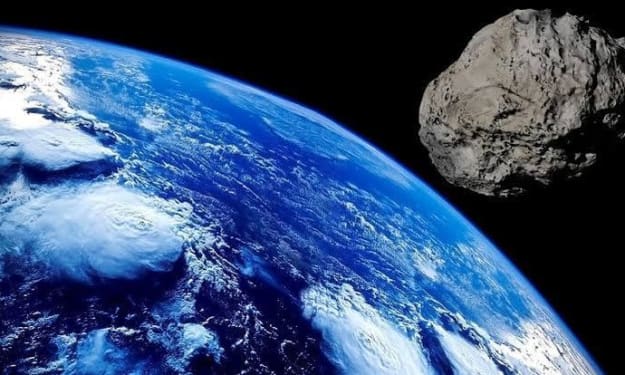
Most Carbon-Rich Asteroids Never Make It to Earth—and Now We Know Why
A cosmic mystery has baffled scientists for decades: why are carbon-rich asteroids so uncommon on Earth in comparison to other types of space rocks? Carbonaceous chondrites, or asteroids with organic compounds, water, and other essential elements for life, are among the most primitive materials in the solar system. Yet, despite their abundance in the asteroid belt, they make up only a small fraction of meteorites found on Earth.
By Tasbir Kabir10 months ago in Earth
Jupiter, Earth, and the Cosmic Love Triangle: A Tale of Gravity, Auspice, and Cosmic Jealousy. AI-Generated.
In the astronomical theater of space, where celestial bodies perform their perpetual waltz, a tale as old as time—yet ever unfolding—grips the solar system: the peculiar, invisible pull of a cosmic love triangle between Earth, Jupiter, and the illimitable space that circumvents them. This isn’t just a story of planetary dynamics. It's a mythic tale of gravity, destiny, and the mute envy indited into the stars.
By Sadman Arefin 10 months ago in Earth
The Final Frontier: Why Space Still Captivates Us
Since the first time humans looked up at the stars, space has captured our imagination like nothing else. It’s vast, mysterious, and completely indifferent to our existence—and yet, we’re obsessed with it.
By Mahibul Mahtab Rumman10 months ago in Earth
The Heart of Darkness: The Supermassive Black Hole That Anchors Our Galaxy
If you look up at the night empyrean, you’re staring into a cosmic mystery that has fascinated humanity for thousands of years. The stars seem halcyon, distant, and perpetual. But deep within the Milky Way, there’s something far more potent than any star — something we can’t optically discern with the unclad ocular perceiver, but we ken is there because of the way the macrocosm bends around it. That something is a supermassive ebony aperture, and it sits mutely at the center of our galaxy, pulling everything toward it.
By Sadman Arefin 10 months ago in Earth
San Diego just got rocked by a 5.2 magnitude quake.
Los Angeles — A 5.2 magnitude earthquake struck Southern California Monday morning, according to preliminary reports. The quake was recorded at 10:08 a.m. PT near Julian, California, by the Seismological Laboratory at the California Institute of Technology. It followed a 3.3 magnitude foreshock that occurred just before 4 p.m. Sunday.
By Harry potter10 months ago in Earth