Science
Curiosity Rover Finds Largest Carbon Chains on Mars from 3.7-Billion-year-old Rock. AI-Generated.
### Introduction: A Game-Changing Discovery on the Red Planet In a monumental scientific breakthrough, NASA’s **Curiosity rover** has uncovered the most **complex carbon chains on Mars** to date. Found in sedimentary rocks estimated to be **3.7 billion years old**, these organic molecules could provide vital clues about the **potential for ancient life on Mars**.
By Kankon Mondal10 months ago in Earth
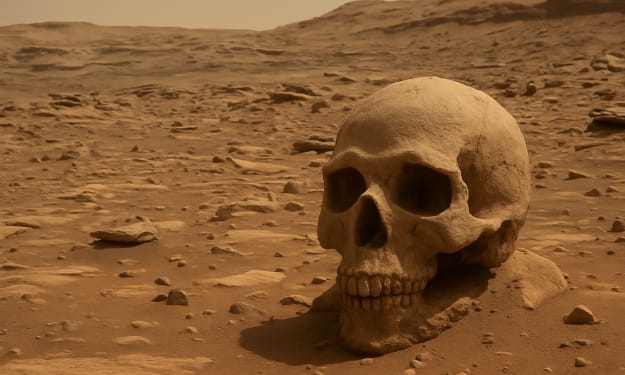
NASA Discovers Skull Shaped Rock on Mars Real Evidence of Alien Life or Optical Illusion?
NASA Discovers Skull Shaped Rock on Mars Real Evidence of Alien Life or Optical Illusion? Strange Martian rock formation sparks debate among scientists and UFO enthusiasts is it proof of life on Mars or just a trick of the eye?
By Adnan Rasheed10 months ago in Earth
Earth's Crust Is Peeling Beneath the Sierra Nevada - A Geological Mystery Unfolds
Sierra Nevada, California: Researchers have discovered rare and convincing evidence that the Earth's lithosphere—the rigid outer shell of our planet—is actively peeling away beneath the Sierra Nevada mountains, in a groundbreaking discovery that reads more like science fiction than science fact. Lithospheric delamination is a rare phenomenon that has the potential to dramatically alter landscapes, influence volcanic activity, and shed new light on the long-term geological evolution of the Earth.
By Ashraful Hosen10 months ago in Earth
NASA's Lucy Probe to Fly by Asteroid Donaldjohanson on Easter 2025 Key Mission Milestone Explained
NASA's Lucy Probe to Fly by Asteroid Donaldjohanson on Easter 2025 Key Mission Milestone Explained Discover how NASA's Lucy spacecraft will make a historic flyby of asteroid Donaldjohanson revealing secrets of our solar system’s ancient past on Easter Sunday 2025.
By Adnan Rasheed10 months ago in Earth
Next week, a rare planetary alignment will create a "smiley face" in the sky. Verify the Specifics
From Earth's perspective, a triple conjunction is an astronomical event in which three celestial bodies, such as planets, the Moon, or stars, appear to align closely in the sky. Because of their respective positions and motions along the ecliptic, the objects appear to be close to one another, creating a striking configuration in which they appear to converge within a small portion of the celestial sphere. Astronomy enthusiasts worldwide are poised to witness a captivating celestial display as a rare triple planetary conjunction graces the night sky on Friday, April 25. According to Live Science, this extraordinary astronomical alignment will have a striking visual composition that includes Venus, Saturn, and a slender crescent Moon. Although it will only last for a short period of time, it will be globally observable. With Venus and Saturn acting as the bright "eyes" and the gently curved crescent Moon acting as the "smile," this unusual arrangement will give the impression of a "smiley face" suspended in space. The phenomenon is a remarkable combination of perspective and orbital mechanics that provides a brief but delightful spectacle for observers all over the planet. A significant celestial event known as a triple conjunction occurs when three astronomical bodies, typically the Moon or planets, are visible from Earth in close angular proximity in the sky. Although it is the result of line-of-sight perspective rather than actual spatial convergence, this optical alignment provides a compelling visual display. As Venus, Saturn, and a slender crescent Moon get closer to one another in the early hours of April 25, they will form a triangular arrangement that looks like a smiling face. This is a rare and beautiful sight. Live Science claims that in the early morning twilight, this alignment will be visible to observers with an unobstructed view of the eastern horizon, providing a brief but captivating spectacle. What exactly is a triple junction? From Earth's perspective, an astronomical phenomenon known as a conjunction occurs when two or more celestial bodies, such as planets, the Moon, or bright stars, appear to be in close alignment. The alignment of their orbital paths along the ecliptic plane results in this apparent proximity. A triple conjunction occurs when three of these bodies meet in this manner. Even though they are far apart in space, their alignment from Earth's perspective gives the impression of close proximity, resulting in a unique and striking arrangement in the celestial sphere.
By Muhammad Mehebub Alam10 months ago in Earth
Innovative Green Technologies and Technology:
Introduction Sustainable technology and green innovations have emerged as the need of the hour and the foundation of future progress in an era when environmental and climate change issues dominate the news. Industries all over the world are reorienting to adopt greener practices, ranging from environmentally friendly manufacturing to breakthroughs in renewable energy. This change is not only beneficial to the environment but also smart business.
By Dipak Chakraborty10 months ago in Earth
Google is in more danger than ever of being broken upGoogle will fight to keep its Chrome browser in a search antitrust trial starting Monday, after losing an ad-tech suit.
Google Faces Unprecedented Pressure Amid Antitrust Trials Google, one of the most powerful tech companies in the world, is facing perhaps its greatest legal challenge yet. As the company prepares to defend itself in a major antitrust trial over its Chrome browser and search dominance, it does so under the looming shadow of another recent setback—losing an important case tied to its advertising technology business. These legal battles, taken together, mark a turning point for the tech giant and could alter its business model significantly or even cause it to dissolve. A Legacy of Disputes in Court Antitrust authorities around the world have long targeted Google. In the European Union, the company has already faced billions in fines over its Android operating system, search practices, and online shopping services. However, the current wave of U.S.-based litigation is different—more direct, more aggressive, and potentially more damaging.
By GLOBAL NEWS10 months ago in Earth