

SOLAR SYSTEM AND LUMINARIES The solar system consists of the Sun and its eight main planets, their satellites, asteroids, comets, meteors and other dwarf planets. The Sun is at the one of the two “centers” of the Solar system and the planets revolving around it in elliptical orbits. There have been a lot of criticisms concerning the placement of Pluto which is ice. Others have argued that there will be no more Pluto if the sunlight reaches it at any time because it will be melted. These and other claims are sufficient to declassify Pluto from being considered a planet but a dwarf planet. THE SOLAR SYSTEM: All the heavenly or celestial bodies surrounding a particular star is because of the star’s dominant mass and gravity. The sun is the center and the unifying body of our solar system. LUMINARIES: It is known that the night time sky has uncountable objects that either give their own light or reflect the light attracted to them by the sun. The sun is a star and the moon is a satellite. These stars and their planets and satellites are called the luminaries. Nowadays, luminaries include the moon, the sun, planets, stars, meteors, comets and besides, faded nebulae, pulsar, Black Dwarf, Black Holes are also included. All these have formed the universe. We are not able to figure out the beginning and end of the universe. GENERAL UNDERSTANDING OF THE SOLAR SYSTEM The closest planet to the Sun is Mercury and the farthest is Neptune. The Sun is the only star in our solar system and it moves. The hottest planet is Venus. Pluto is a no longer considered a planet but a dwarf planet. The eight planets of the solar system are: Mercury, Venus, Earth, Mars, Jupiter, Saturn, Uranus, and Neptune. You can remember the order using the mnemonic: My Very Excellent Mother Just Showed Us Noon. THE STARS: the night time luminaries that give their own light are called stars. If we have a view in either moonlit or moonless night, we discover that there are uncountable stars in the firmament. These can be seen by using our naked eyes but some can be seen by powerful telescope. They are burning gaseous masses. They give their own light. The distances from the stars to the earth are so huge that one may not be able to use unit of kilometers but the number of years the light may travel from those stars. A ray of light from the sun to the earth only travels for 8 minutes 11 seconds with the average distance of 184, 800, 000 kilometers. Alpha Centauri is a binary star which is the closest to the sun, as well to the Earth. It is composed of three stars: Rigil Kentaurus (Alpha Centauri A, yellow dwarf), Toliman (Alpha Centauri B, orange dwarf), and Proxima Centauri (Alpha Centauri C, red dwarf.) Among these stars of Alpha Cantauri, Proxima Centauri is the closest star to the Earth with a distance of 4 light years; meaning, the light from this star will be travelling for 4 years before it reaches the earth. Can you compare that with that of the sun’s light’s journey, which only travels for 8 minutes before it reaches the earth? God is great!
16
THE SUN: The Sun is the primary source of energy for life on Earth. It is the closest star to the Earth, about 150 million kilometers. It is situated at the corner of Milky Way galaxy but at the center of our solar system. SOME FACTS ABOUT THE SUN It has an equatorial distance about 1.39 M kilometers. It completes its rotation in 27 years. It completes its revolution in 225 million years. The movement of the sun and the entire solar system around the Milky Way galaxy is called Galactic Movement. About three-quarter of sun’s mass is made up of hydrogen It also has insignificant gaseous compositions like carbon, iron, neon, and oxygen only constituting 1.69% of its mass. The average distance of the sun from the earth is 148, 800, 000 km. The light from the sun to the earth travels about 8 minutes and 11 seconds. It is brighter than about 85% of the stars in the Milky Way galaxy. Despite, it is still inferior to many stars in terms of size, density, brightness, energy. It holds 99.9% of the solar system’s mass and is roughly 109 times the diameter of the earth. The visible part of the sun is about 5, 500 degrees Celsius and surface gaseous temperature of about 6,000 degrees Celsius. Planets are celestial bodies that rotate and revolve around the sun. Their The Planets: paths of orbit are always elliptic. There is a total of eight planets in the solar system. They have no light of their own. All of them rotate round the sun and get light and heat from it. They do not twinkle in the sky. These luminaries are called planets. The Earth, Mars, Venus, Saturn, Mercury, Jupiter, Uranus and Neptune are the eight planets of our solar system. Jupiter is the biggest planet in the Solar System and Mercury is the smallest. CHARACTERISTICS OF PLANETS
17
The planets are divided in the two groups - Inner planets and Outer planets. Inner planets or Terrestrial planets These planets include Mercury, Venus, Earth, and Mars. These are also known as terrestrial planets or rocky planets. These are denser and have a shorter period of revolution. They have solid surfaces. They do not have rings. They have no or a few moons. They relatively small.
Outer or Jovian planets They are subdivided in two—Gas Giants which are Jupiter and Saturn, and Ice Giants which are Uranus and Neptune. Gas Giants constituted predominantly of helium and hydrogen. Ice Giants contain ice, rock, and a mixture of water, methane and ammonia. They have no solid surfaces. They are big in size. They support ring system. They have multiple moons. They have a longer period of revolution.
PLANETS IN ORDER
Mercury
Mercury in Roman Mythology is the god of commerce, travel and thievery, the Roman counterpart of the Greek god Hermes, the messenger of gods. Closest planet to the Sun with the distance of 57. 91 million kilometers. It is the second hottest planet after Venus. It has no living thing. Orbits the Sun the quickest. It completes its revolution in 88 days. It has a diameter of 4,880 kilometers and a radius of 2,440 kilometers. No significant atmosphere. Rotation period is longer than its orbital (revolution) period. No natural satellites (moons). Can be seen from the earth only before sunrise and after sunset.
Venus
(Greek: Aphrodite; Babylonian Ishtar) is the goddess of love and beauty. The planet is so named probably because it is the brightest of the planets known to the ancients.
18
Known as Earth’s twin because of similarities in size, mass, and density. It has the longest rotation period of any planet. Its rotation period (243 Earth days per Venus days) is longer than its orbital (revolution) period. It is hottest planet in the solar system because of its thick atmosphere of carbon dioxide and extensive lava flow. It rotates (east to west) around the sun in clockwise manner while most others are rotating in anti-clockwise. It has a distance of 108, 200,000 kilometers and a diameter of 12,103.6 kilometers. It is the second brightest natural object in the night sky (after Moon). It can be seen from the earth only before sunrise (Morning Star) and after sunset (Evening Star). It has no natural satellites (moons).
Earth
Only planet in the solar system to be known to support life. Has water in all three states because of its distance from the sun – liquid, solid and gas. Gasses present in the earth’s atmosphere are Nitrogen, Hydrogen, Oxygen, Carbon Dioxide, etc. It takes 23 hour 56 minutes 46 seconds to rotate around its axis. It takes 365.26 days to revolve around the Sun. The average distance of the sun from the earth is 148, 800, 000 km. The Ozone layer present in the Earth’s atmosphere protects it from the ultra violet rays. Moon is the only natural satellite of the Earth. The distance between the Earth and the Moon is 384,629 km.
Mars
Mars, the red planet, was named after a Roman god of war. According to Roman myth, Mars rode on a chariot pulled by two horses named Phobos and Deimos (meaning fear and panic). It is known as the ‘Red Planet’ due to presence of iron-rich red soil. Despite its red colour, it is cold because it has lost most of its atmosphere. After Earth, it is believed that Mars has the ability of possibilities of supporting some plant’s life. Phobos and Deimos are the two moons of Mars. Has polar ice caps and traces of sub-terrestrial liquid water has been found. Has the largest known volcano (and second tallest mountain) in the solar system – Mons Olympus. Its distance from the sun is 227.9 M km. It takes Mars 687 days to complete its revolution. It has a diameter of 6,779 km and it is the second smallest planet in the solar system after Mercury. Spacecraft to Mars: Mariner 4, 2001 Mars Odyssey, Mars Orbiter Mission (India), MAVEN etc.
19
Jupiter
The fifth planet and by far the largest in the solar system a gas giant planet. Jupiter is known for its Great Red Spot and many satellites including Galilean moon. In Roman mythology the king of gods, also called Jove. Equivalent to the Greek Zeus, Jupiter was one of the children of Saturn. Largest planet of the solar system with the diameter of 119,700 km. It has two and a half times the mass of all other planets put together. It has the shortest rotation period. Meaning, despite its size, it is the fastest spinning planet in the solar system. A gas giant, primarily composed of hydrogen and helium with no discernible solid surface. If one wants to land on Jupiter, they will land IN it. It has a giant storm (three times the diameter of earth) since 1831 called the ‘Great Red Spot’. It has a faint ring, say, circular light and dark bands around it. Its distance from the sun is 772,800,000 km. It takes Jupiter 11.9 years to complete its orbit around the sun. It has 67 moons. 4 largest moons discovered by Galileo – Ganymede (largest moon in the solar system – bigger than Mercury), Callisto, Io (volcanic), Europa (has water-ice). Missions to Jupiter: Galileo, Juno (upcoming).
Saturn
It is the Roman god of fertility and agriculture, equivalent to the Greek Kronos. It has three rings Second largest planet in the Solar system with the diameter of 119,700 km. It has three concentric rings revolving around it made up of tiny rocks and pieces of ice. Its distance from the sun is 1,417,600,000 km. It takes Saturn 29.5 years to complete its revolution around the sun. It has 62 moons. Moons of Saturn: Titan is the largest (has a major atmosphere, complex organic chemistry and ICE VOLCANOE), Rhea (it has its own ring system), Enceladus. Missions to Saturn: Cassini-Huygens.
Uranus
Discovered by Sir William Herschel in 1781, Uranus is blue-green (cyan) in colour. The Greek god who personified of the sky and heavens and fathered the Titans. Roman counterpart Caelus. Third biggest planet of the solar system with a diameter of 51,000 km. Its distance from the sun is 2,584,400,000 km. It takes Uranus 84 years to complete its orbit. It is composed of Hydrogen, Helium, Water, Ammonia, and Methane.
20
Uranus and Venus rotate unlike other planets around the sun. Uranus rotates upside down. Its north pole does receive sunlight for 21 years and vice versa for the South Pole. The rotation of Venus and Uranus are also different—Venus rotates from east to west, while Uranus rotates sideways. It is tilted sideways so that its poles lie where most other planets have their equators. It also has faint rings. It has 27 known moons (5 main – Miranda, Ariel, Umbriel, Titania, and Oberon). Spacecraft Flyby: Voyager 2. Neptune
In Roman mythology it is the god of the ocean and of earthquakes. Discovered through mathematical predictions and disturbances in Uranus’ orbit, first proposed by Alexis Bouvard, and first observed by Johann Galle. It is the farthest planet from the Sun with the distance of 4,468,800,000 km from the sun. It takes Neptune about 164.8 years to complete its orbit around the sun. It has a diameter of 45,000 km. It is primarily composed of hydrogen, helium, nitrogen, water, ammonia, methane. It is blue in colour because of methane. It has a storm called ‘Great Dark Spot’. It has 14 known moons (Triton – largest) Spacecraft Flyby: Voyager 2. PLUTO: Because of our long-term notion about the planet’s placement, we still find it natural to study Pluto and make it exclusive from the rest of the other dwarf planets. It used to be the ninth planet after when it was demoted to the status of “Dwarf Planet”. It is Icy and cold. Though, not considered planet, Pluto has five moons – Charon, Styx, Nix, Kerberos, and Hydra. Asteroids
Almost like planets but smaller in size, Asteroids are small rocky celestial bodies that also revolve around the sun between the orbit of Jupiter and Saturn. They are not spherical in appearance. They are termed “Small Planets”. They are fragments from planets. The largest asteroid in the Asteroid Belt is Ceres.
Meteorites
They are formed when asteroids collide. Those fragments from asteroids collision make meteorites. They are fragments of rocks floating about in space. Sometimes they come across earth and fall into the earth’s atmosphere. That is when they become meteors or “shooting stars”. Most of these meteors cannot reach earth’s surface and burn up in the atmosphere due to the friction with air. The meteors that do reach the earth’s surface are known as meteorites. It can be pointed out that when these fragments float in the space they will be called meteors.
About the Creator
Keep reading
More stories from Sanusi Camara and writers in Earth and other communities.
Performance in the African Oral Literature
PERFORMANCE IN THE AFRICAN ORAL LITERATURE BY SANUSI CAMARA, AN AWARD-WINNING AUTHOR Especially in Africa, performance occupies a central role in the oral literature. Tala describes the performance as the representation of an oral script, reading of a poem, the performance of a ditty or narration of occasional tales. Largely, African literature was in the form of words which were consumed through interaction in artful performances as one of the aesthetic symbols of the culture. It is apparent that, in its specific context, oral literature in Africa has not always followed the Western formula, which has always resulted in the misunderstanding of the verbal arts by Western scholars. However, performance in African oral literature is essential as it has been the act of passing down cultures, adding more meanings to speeches, and fostering societal cohesion.
By Sanusi Camaraabout a year ago in Art
Polar Vortex Collapse Forecast: What It Means and Why It Matters
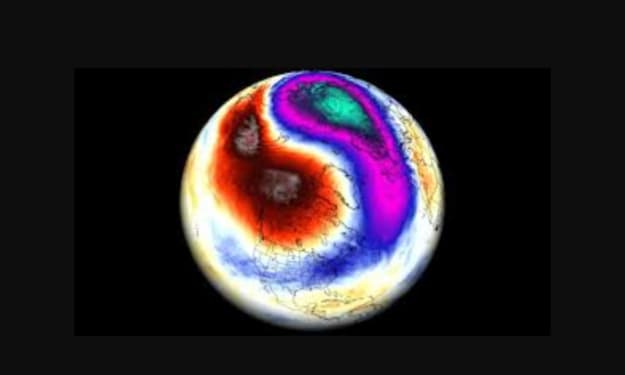
As winter progresses in the Northern Hemisphere, scientists are closely monitoring forecasts suggesting a potential polar vortex collapse. The term “polar vortex” has entered mainstream conversations in recent years, often associated with extreme cold snaps in North America, Europe, and parts of Asia. But what exactly is a polar vortex collapse, why does it happen, and why should people care? Understanding this phenomenon is crucial, not just for weather enthusiasts, but for anyone concerned about climate change, energy infrastructure, and global weather patterns. What Is the Polar Vortex? The polar vortex is a large area of low pressure and extremely cold air surrounding both of Earth’s poles, contained by a fast-moving band of winds known as the polar jet stream. In the Northern Hemisphere, it sits over the Arctic, spinning in a counterclockwise direction. Under normal conditions, the vortex keeps the Arctic air largely contained. However, fluctuations in atmospheric pressure and temperature can cause the vortex to weaken, shift, or even split, allowing frigid air to escape southward into populated regions. This is often what leads to extreme winter weather events in the United States, Canada, Europe, and Asia. What Does a Polar Vortex Collapse Mean? A “polar vortex collapse” refers to a significant weakening or breakdown of the vortex, often caused by sudden stratospheric warming events high in the atmosphere. When the polar vortex collapses: Arctic air can spill into mid-latitudes, leading to extreme cold in regions unaccustomed to such temperatures. Weather patterns become more erratic, causing longer-lasting cold spells or shifts in precipitation. Jet streams weaken or meander, which can contribute to storms, heavy snowfall, or unusual weather events across continents. The term “collapse” doesn’t mean the vortex disappears entirely — it is still present — but its structural integrity is compromised, allowing Arctic air to move into areas that typically enjoy milder winter conditions. Why Scientists Are Concerned Meteorologists and climate scientists pay close attention to the polar vortex because its behavior has far-reaching implications: Energy Demand: Sudden cold snaps increase heating demand, which can strain power grids and fuel supply chains. Agriculture: Extreme cold can damage crops, delay planting, and reduce yields for sensitive crops like winter wheat. Transportation: Snowstorms and icy conditions disrupt travel, affecting both local commuting and international logistics. Global Weather Links: A collapsed polar vortex can influence weather far beyond North America, including unusual rainfall patterns, storms, and temperature anomalies in Europe and Asia. Recent studies suggest that climate change may be making the polar vortex more unpredictable, with warmer Arctic temperatures affecting the jet stream’s stability. This could lead to more frequent or intense cold waves in regions far from the pole. Historical Examples of Polar Vortex Events The polar vortex has been linked to some of the most memorable winter events in recent decades: January 2014 (United States): Millions faced record-breaking cold as Arctic air plunged southward, with temperatures in the Midwest dropping to -30°F (-34°C) in some areas. February 2021 (North America): A weakened polar vortex contributed to extreme cold across Texas and the central U.S., causing widespread power outages and water supply disruptions. Europe 2018–2019: Fluctuations in the Arctic vortex led to extended cold spells across parts of northern and eastern Europe. Each of these events illustrates how disruptions in the Arctic atmosphere can quickly translate into severe conditions thousands of miles away. Why a Polar Vortex Collapse Matters Globally Although the polar vortex is centered over the Arctic, its collapse affects global weather in multiple ways: Economic Impacts: Cold snaps can halt industrial activity, increase heating costs, and strain insurance systems due to property damage. Climate Feedback Loops: Extreme Arctic events can accelerate ice melt, altering sea levels and global weather patterns. Human Health: Extended periods of extreme cold increase risks of hypothermia, frostbite, and other health emergencies, particularly for vulnerable populations. Ecosystem Effects: Wildlife adapted to stable seasonal patterns may struggle to survive sudden temperature fluctuations, affecting biodiversity in affected regions. The interconnectedness of global systems means that an Arctic event can ripple across continents, affecting agriculture, energy, and even food security. What Can People Do to Prepare? While individuals cannot control atmospheric phenomena, there are practical steps to prepare for polar vortex-related extreme cold: Home Safety: Insulate homes, check heating systems, and prepare emergency kits with blankets, food, and water. Travel Caution: Monitor forecasts before traveling and have contingency plans for snow or ice-related disruptions. Community Awareness: Check on neighbors, especially the elderly or vulnerable, during prolonged cold events. Government Preparedness: Authorities often increase readiness of power grids, emergency services, and transportation systems ahead of forecasted events. Being informed and proactive can reduce the human and economic impact of a polar vortex collapse. Looking Ahead: Climate Change and the Polar Vortex Scientists warn that the Arctic is warming faster than the rest of the planet, which may make the polar vortex more unstable. As the vortex weakens, the frequency of extreme cold events in mid-latitudes may rise, even while the planet as a whole becomes warmer. This paradox — colder extremes amid global warming — can be confusing but is consistent with climate models. It emphasizes the need for global cooperation in climate mitigation, adaptation, and disaster preparedness. Final Thoughts The forecast of a potential polar vortex collapse is a reminder that Earth’s climate system is complex and interconnected. What happens in the Arctic does not stay in the Arctic; it has tangible consequences for energy, health, ecosystems, and economies across the Northern Hemisphere. Understanding these dynamics, staying informed, and taking proactive steps can help societies mitigate risks and adapt to a changing climate. Whether you’re a casual weather watcher or a climate enthusiast, the polar vortex collapse is a phenomenon worth following — because its reach extends far beyond the Arctic Circle.
By Muhammad Hassan2 days ago in Earth
Philippines Paper Bags Market: Packaging Shifts, Environmental Policy & Changing Consumption Patterns
Philippines Paper Bags Market Overview The Philippines paper bags market is undergoing a structural shift as environmental regulation, packaging reform and consumer awareness increasingly influence material choices across industries. According to IMARC Group, The Philippines paper bags market size was valued at USD 28.59 Million in 2025 and is projected to reach USD 46.95 Million by 2034, growing at a compound annual growth rate of 5.66% from 2026-2034. This expansion reflects gradual but consistent changes in packaging practices rather than a single disruptive trend.
By Manisha Dixit6 days ago in Earth



Comments
There are no comments for this story
Be the first to respond and start the conversation.