
Slithering Through History: A Comprehensive Look at the Fascinating World of Snakes
Exploring the Fascinating World of Snakes: Anatomy, Behavior, Habitats, and Conservation Efforts
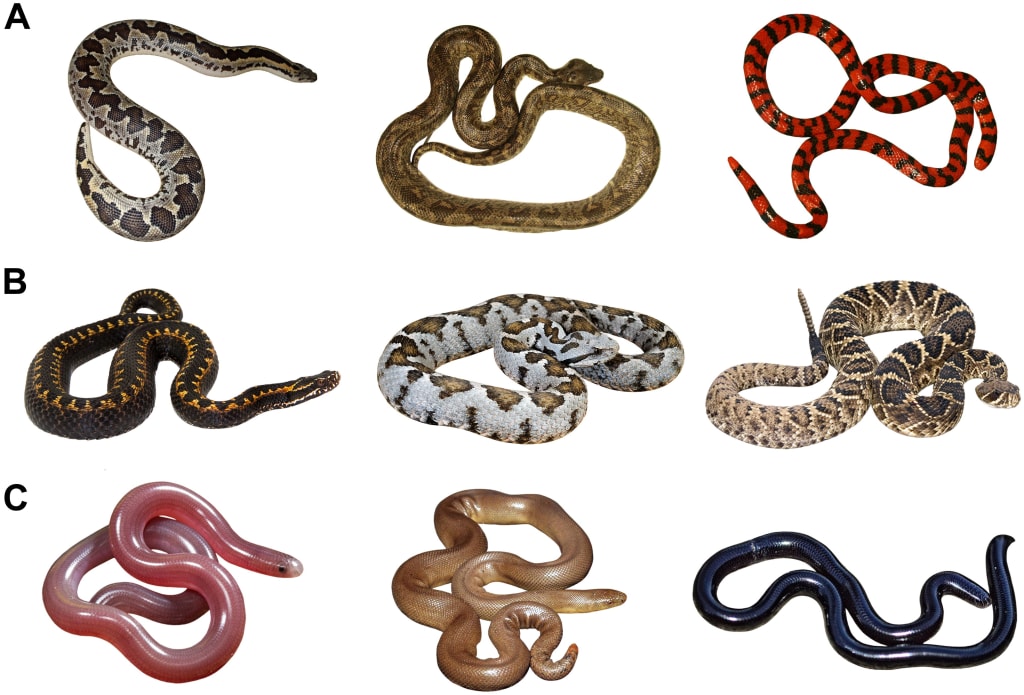
Snakes are fascinating creatures that have been around for millions of years. They are a diverse group of reptiles that vary greatly in size, color, and behavior. There are over 3,000 species of snakes, and they can be found on every continent except for Antarctica. In this article, we will explore the world of snakes, including their anatomy, behavior, habitats, and conservation efforts.
Anatomy of Snakes
Snakes are elongated, legless reptiles that have a cylindrical body shape. They are covered in scales, which are made of keratin, the same material as our hair and nails. The scales of snakes help to protect them from predators and allow them to move smoothly across rough terrain.
Snakes have a unique jaw structure that allows them to swallow prey that is larger than their head. Their lower jaw is not attached to the skull, and instead, it is connected by ligaments and muscles. This enables the snake to open its mouth wide and stretch its jaws to accommodate prey that is much larger than its head.
Snakes have a forked tongue that they use to sense their environment. The tongue collects scent particles, which are then analyzed by the vomeronasal organ, located in the roof of the mouth. This allows the snake to detect prey, predators, and potential mates.
Behavior of Snakes
Snakes are known for their unique behavior and adaptations. Some species are active during the day, while others are more active at night. Some species are arboreal, meaning they live in trees, while others are terrestrial, living on the ground.
Snakes are ectothermic, meaning they rely on external sources of heat to regulate their body temperature. This is why you will often see snakes basking in the sun or hiding in shady areas to stay cool.
Most snakes are carnivorous and feed on a variety of prey, including rodents, birds, and other reptiles. Some snakes, like the anaconda, can consume prey that is larger than their body size. Snakes kill their prey by constricting it, using their powerful muscles to squeeze the animal until it suffocates.
Habitats of Snakes
Snakes are found in a wide variety of habitats, from deserts and grasslands to forests and wetlands. Some species of snakes are adapted to live in aquatic environments, while others are adapted to live in arid deserts.
Snakes are often associated with tropical rainforests, which are home to a large number of snake species. The Amazon rainforest, for example, is home to over 400 species of snakes, many of which are endemic to the region.
Conservation of Snakes
Snakes face a number of threats, including habitat loss, climate change, and human persecution. Many snake species are also hunted for their skins, which are used to make leather goods and fashion accessories.
Conservation efforts for snakes are often focused on protecting their habitats and reducing human-snake conflict. This can involve creating protected areas for snakes, educating communities about the importance of snakes, and developing strategies for reducing snakebite incidents.
In addition, captive breeding programs are being developed for some snake species that are threatened with extinction. These programs involve breeding snakes in captivity and then releasing them back into the wild to help boost populations.
Famous Snakes
Snakes have played important roles in human culture and mythology for thousands of years. Here are some of the most famous snakes in history:
Medusa's snakes - In Greek mythology, Medusa was a Gorgon who had snakes for hair. Anyone who looked at her turned to stone.
Nagini - Nagini was the pet snake of Lord Voldemort in the Harry Potter series.
Kaa - Kaa is a python in Rudyard Kipling's
About the Creator
Keep reading
More stories from Kamal Mourya and writers in Earth and other communities.
Land Birds: An Exploration of their Biology, Behavior, and Conservation
Land birds are a diverse group of birds that are adapted to living primarily on land, as opposed to water or air. They can be found in nearly every part of the world, from tropical rainforests to deserts and tundra. In this article, we will explore the fascinating world of land birds, their biology, behavior, and conservation.
By Kamal Mourya3 years ago in Earth
Trump Signs Order to Limit Wall Street Investors in Single-Family Housing
In a move signaling renewed focus on housing affordability, former President Donald Trump has signed an executive order intended to limit Wall Street investors’ ability to buy single-family homes. The announcement comes amid growing public concern over the role of large investment firms in driving up home prices and reducing access to affordable housing for everyday Americans. Advocates say the order could help restore balance to the housing market, while critics question whether the measure will be effective or face legal challenges.
By Muhammad Hassan5 days ago in Earth



Comments
There are no comments for this story
Be the first to respond and start the conversation.