
Researchers say universe may end sooner than anticipated.
No need to worry

The universe has been a subject of curiosity for mankind since its beginning. Thinking and researching about the fate of the universe is a universal subject for mankind. Although different studies have said different things at different times, recent studies are revealing that the destruction of the universe is much sooner than we thought.
The Accelerating Expansion of the Universe
Scientists believed that dark energy maintained a constant pressure, gently pushing galaxies apart . In the late 1990s, astronomers discovered that the universe is not just expanding—it’s accelerating. This phenomenon, driven by an enigmatic force called dark energy. It says that galaxies are moving apart at an ever-increasing rate. But new models suggest that dark energy may be dynamic and unstable. If this is true, it could reverse its behavior, turning from a repulsive to an attractive force— leading to a slow, cold demise known as the "Big Freeze" or "Heat Death," where stars burn out, black holes evaporate, and the cosmos fades into darkness.
More Description about ''DARK ENERGY''
Dark Energy is related to the Cosmological Constant (Λ). Einstein originally introduced Λ as a "fudge factor" in his equations to keep the universe static. Subsequently, it became associated with dark energy. Fudge factor represents the energy of empty space (vacuum energy) in quantum physics but theoretical predictions are far larger than observed. Dark energy has negative pressure, described by the equation
w= P/ρ (where P is pressure and ρ is energy destiny).
w=−1, it behaves like Einstein's cosmological constant.
if w≠−1, it might evolve over time (e.g., quintessence models).
Current composition of the universe: Dark Energy (68%), dark matter (27%), normal matter(atom) (5%).
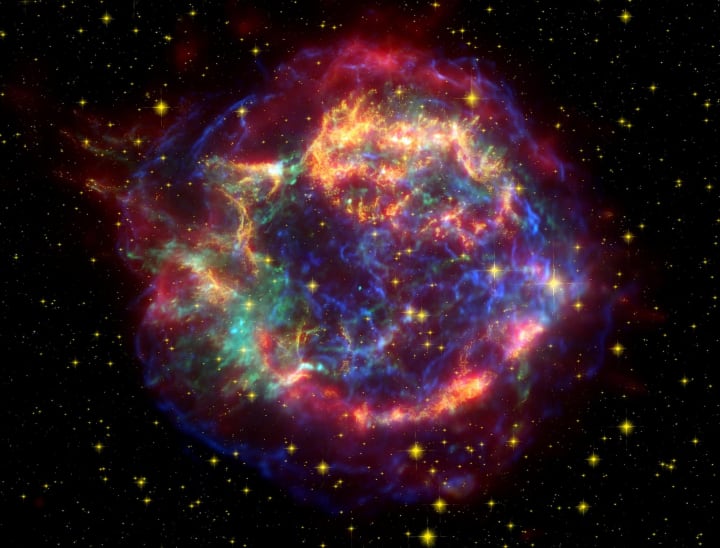
The Big Rip scenario
The Big Rip stands out as one of the most dramatic and terrifying. This scenario suggests that the accelerating expansion of the universe, driven by dark energy, could eventually tear apart galaxies, stars, planets, and even the fabric of spacetime itself.
Black Hole Dominance and the "Big Crunch"
Alternatively, if dark energy weakens, gravity might eventually reverse the expansion, pulling everything back into a singularity—a "Big Crunch." Some models suggest that this collapse could happen sooner than expected if mysterious forms of matter or energy alter the universe’s trajectory.
Vacuum Decay – A Quantum Bubble of Destruction
Quantum physics gives another doomsday scenario : vacuum decay. Our universe might exist in a "false vacuum"—a stable but not perfectly balanced state. If a quantum fluctuation triggers a true vacuum bubble, it could expand at the speed of light, rewriting all physics and erasing existence.
• Could it happen tomorrow? Technically yes, but the probability is extremely low.
• Would we see it coming? No—it would be instantaneous and unstoppable.
How could humanity survive
Some theorists, including renowned physicist Stephen Hawking, warned that this could happen spontaneously, with no warning. If such an event has already begun somewhere in the cosmos, the end could be imminent and unstoppable. Escaping would be impossible, if the universe ends in a Big Rip or vacuum decay. However, if given enough time, a hyper-advanced civilization might find a way to create a new universe or enter a different dimension—though this remains speculative.
Is there something to worry about
Even if the new researches correct, the changes would unfold over tens of millions of years. However, the unsettling truth is that the universe’s fate hinges on forces we barely understand.
The cosmos is still full of mysteries. For now, the ultimate fate of the universe is uncertain. But one thing is clear, our time in the universe, whether long or short, is precious.

About the Creator
Reader insights
Nice work
Very well written. Keep up the good work!
Top insight
On-point and relevant
Writing reflected the title & theme
Keep reading
More stories from writers in Earth and other communities.
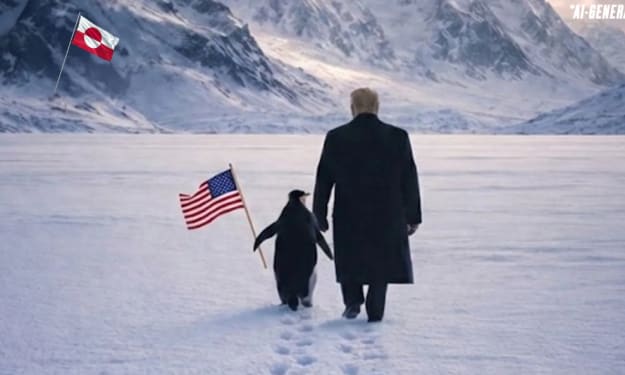
Trump, 79, Revives Greenland Fantasy With Absurd AI Post
In early 2026, a seemingly strange social media post reignited a discussion that many had hoped was behind us: Donald Trump, now 79, posted an AI-generated image referencing Greenland. The image went viral, sparking laughter, criticism, and a flurry of international commentary. While the post appeared absurd on the surface, it also highlighted deeper issues about political messaging, digital media, and the ongoing fascination some U.S. leaders have with Greenland. The AI-generated post showed Trump marching toward Greenland, holding an American flag, accompanied by a penguin — an animal that, scientifically speaking, has no connection to Greenland. The bizarre imagery immediately caught the public’s attention. Many observers viewed the penguin as a humorous metaphor for the mismatch between the symbolic post and geopolitical reality. Critics questioned whether the post was a serious attempt at commentary, an intentional meme, or a sign of how AI is being used in modern political communication. The Social Media Storm The post, captioned “Embrace the penguin”, appeared on the official White House X account. Within hours, it became the subject of viral memes, news reports, and expert analyses. Internet users were quick to point out the geographic error — penguins live in the Southern Hemisphere, nowhere near Greenland. While the comedic aspect dominated social media, analysts noted that the post reflected a long-standing pattern of Trump using bold or unconventional messaging to capture public attention. The use of AI-generated imagery represents a new layer in this strategy, blending political content with internet culture. Many critics argued that this approach, while attention-grabbing, risks confusing the public and undermining the credibility of official communication. Trump and Greenland: A Longstanding Obsession Trump’s fascination with Greenland is not new. In 2019, he proposed that the United States could purchase Greenland from Denmark, an idea that was widely ridiculed and rejected by Danish leaders. Despite the public backlash, the notion persisted in Trump’s rhetoric and continued to appear in informal discussions about U.S. strategic priorities. Greenland holds significant geopolitical value: it is rich in minerals, occupies a strategic Arctic location, and is home to vast natural resources. For Trump, the island has long symbolized a geopolitical prize — a potential point of influence for the U.S. in the Arctic region. The AI post, absurd as it was, reignited global attention to these strategic questions, reminding the world that some leaders still see Greenland as a focal point of American ambition. AI and Politics: A Strange Combination The viral AI image is part of a broader trend of using artificial intelligence to create content for political messaging. AI allows leaders and communicators to produce highly visual, shareable content at scale. However, it also introduces challenges: Accuracy: AI can generate visually striking content that may be factually incorrect, as with the penguin in Greenland. Interpretation: Viewers may misinterpret AI-generated imagery, assuming it represents reality or policy intent. Credibility: Official use of memes and AI art can blur the line between serious communication and entertainment, potentially undermining authority. In Trump’s case, the AI post highlighted both the power and pitfalls of digital media in politics. It reached millions of people worldwide, but the absurdity of the imagery also drew ridicule and raised questions about the seriousness of the message. The International Response European leaders and diplomats responded cautiously, recognizing the post as part humorous, part symbolic. Danish officials, who oversee Greenland’s defense and foreign policy, reiterated that the island is not for sale. Some analysts suggested that while Trump’s AI post is unlikely to affect formal negotiations, it does shape public perception and keeps Greenland in the spotlight as a topic of U.S. interest. The global reaction underscores the influence of social media on diplomacy. In an era where viral content spreads instantly, even symbolic or absurd posts can have real-world implications, influencing discussions, media coverage, and public opinion. Why the Penguins Matter While the image of Trump marching alongside a penguin seems nonsensical, many commentators see it as a metaphor for the disconnect between digital imagery and practical geopolitics. Penguins, being out of place in Greenland, symbolize the absurdity of claiming influence over a sovereign region through symbolic gestures. The penguin also illustrates how modern politics blends serious issues with entertainment and internet culture. Leaders are increasingly aware of the viral potential of online content, and AI-generated visuals provide a new way to capture attention — for better or worse. The Role of AI in Political Communication Trump’s AI post demonstrates both the potential and limits of artificial intelligence in politics: Engagement: AI-generated visuals can capture attention and create shareable moments. Creativity: AI allows for imaginative ways to communicate ideas, blending humor and symbolism. Risk: Misrepresentation or absurdity can undermine credibility and invite international criticism. As AI tools become more common in politics, officials will need to carefully weigh creativity against clarity, ensuring that symbolic content does not overshadow substantive policy discussions. What This Means for the Future The Greenland AI post is more than a viral meme; it reflects trends in modern political messaging: Leaders increasingly use AI and digital media to communicate directly with the public. Absurd or humorous content can attract attention, but may blur the line between entertainment and diplomacy. Symbolic posts can reignite interest in longstanding geopolitical debates, even when they seem playful. For observers, the post offers a lens into how social media, AI, and politics intersect — a mix of strategy, humor, and unintended consequences that will likely shape political communication for years to come. Final Thoughts Donald Trump’s AI-generated Greenland post is absurd, humorous, and viral — but it also underscores the enduring fascination some political figures have with strategic regions like Greenland. Beyond the comedy, it illustrates the power of AI in shaping political narratives, the challenges of modern digital diplomacy, and the importance of understanding how viral content influences public perception. Whether one laughs at the penguin or ponders the implications, the post reminds the world that politics today is as much about perception and digital storytelling as it is about policy. In Trump’s case, a single AI-generated image can revive decades-old geopolitical fantasies, spark global discussion, and turn a playful meme into a moment of serious reflection.
By Muhammad Hassan4 days ago in Earth
Dollar Falls to Four-Year Low as Trump Insists US Currency Is ‘Doing Great’
The US dollar has fallen to its lowest level in four years, rattling global currency markets and reigniting debate over the strength of the world’s dominant reserve currency. The decline comes amid mounting economic uncertainty, shifting interest rate expectations, and renewed political rhetoric—most notably from former President Donald Trump, who has insisted that the US currency is “doing great.”
By Aarif Lashariabout 11 hours ago in Earth
Whiskey At Dusk
Guess the whiskey was more important to you in the end, wasn’t it? It was more than the well-being of your friends; more vital than showing up to the places you promised you would and could come to; more critical of a matter than fulfilling your damn responsibilities and getting the press off your back.
By Snarky Lisa4 days ago in Humans


Comments (1)
Informative post. 😍 I subscribed you, it's your turn . 😊