
Portrait of a Landscape
Broadening the frame of reference for our countryside.


If there’s one thing that I learned in the countless hours of recreation disguised as research for my book, The Lie of the Land, every landscape in Britain seems to have a way of explaining itself. That might appear to be a curious claim to make, but time and again I have found that our countryside, which has been shaped by a long and exotic chain of events, bears the scars of its formation for anyone who is prepared to approach our beautiful scenery with the right spirit of enquiry. It is an enquiry that can lead you to understand both the environment and our place in it.
Britain has been up to three billion years in the making and, over the course of those three billion years, the country has seen geological upheaval that makes the last two years of relatively violent cataclysms we have witnessed around the world seem by comparison like a slightly heated WI meeting.
We have had our fair share of volcanoes. When the southern half of Britain - part of an ancient continent called Avalonia - separated itself from its parent landmass near the South Pole over half a billion years ago, it was part of an island arc of fearsome volcanoes not unlike modern Japan or Indonesia only many more times destructive than Krakatoa, our benchmark of fiery malevolence.
Around 430 million years ago, when Avalonia met Laurentia - the old continent that has now become North America – the collision created a Himalayan-style mountain chain at the centre of all the world’s landmass, placing Britain at the arid heart of a vast super-continent. The stumps of the mountain chain - the Caledonides - stretch from the Appalachians through Scotland and up into Scandinavia. When North America then rifted away from Britain, the creation of the Atlantic Ocean took New England away from old Avalonia and left part of the Canadian Shield, the ancient core of Laurentia, behind as a three billion year old chunk of the Northwest Highlands.
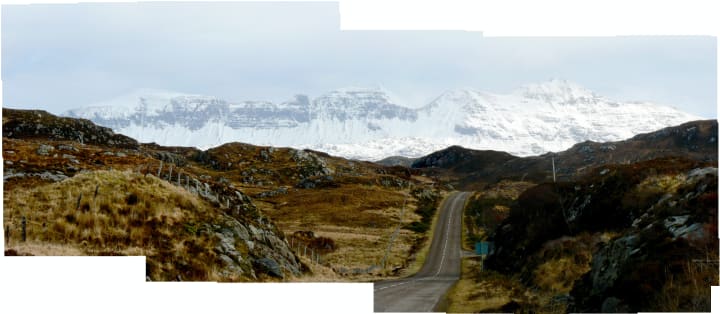
One of the epic landscapes of Britain, this part of Scotland exhibits wild antediluvian overtones. But, while the hummocky plateaus around Loch Assynt have an ambience that suggests you might suddenly encounter a herd of herbivores – each the approximate dimensions of a parish church – around the next bend, there is also a transatlantic otherness about the place. Indeed, on bright days with lying snow, the landscape still wears an American smile; everywhere gleams toothpaste white in a glaring, razor-thin sunlight, with only silhouetted fence posts and the odd lone stag standing out as details in a minimalist tableau.
Elsewhere in Britain, the landscape is similarly revealing about its origins. As well as volcanoes of a super-Krakatoan disposition and continental collision, the long history of these islands have witnessed Namibian-style deserts, tropical, cerulean seas and coral reefs, not to mention mile-high glaciers, and apocalyptic earthquakes. While all of this is now safely tucked away in the glory of Britain’s past, each of these leaves a legacy of tell-tale signs that can help unearth the deep history of an area so that often, rather than the grand lines of escarpments and brutal overtones of a mountain range, understanding the landscape starts in the intimate details of the countryside around you.

Beech and ash trees favour the well-drained light soils found on chalk, while alder carrs – the nearest thing we have and, indeed, the temperate analog of, a mangrove swamp – do well on the waterlogged clays of the New Forest. Even in London, the geology finds an expression; London Clay is famously good for tunelling, not so very good for very high-rise buildings and, in places, dreadful for growing things in. In parts of nineteenth century Middlesex, turning over clumps of London Clay in the fields was known as ‘ploughing up poison’.
Further north and west, the Cotswold Hills offer one of the purest expressions of geology. Whole villages, built from a golden limestone known as the inferior oolite, looks as though they have been constructed from a batch of enormous hollowed-out loaves. In the fields, the oxidising iron – a chemical cousin of the terra rossa soils of the Mediterranean – found in the limestone that creates this Hovis-grade nostalgia, renders the soil a peculiar orangey-brown, rather like the aspirational ‘gold’ label coffee brands some of us bought in the 1980s when our aspirations were that much more modest.

Before our society became so centralised, so uniform, every area of the country had its own identity and distinct building style, a style you can still discern if you cognitively edit out the Barrett estates and the flat-packed superstore sheds built without any regard for the locality they are grafted onto. Cornwall, for instance, is built from granite, slate and killas stone (slate good enough for building walls but not splitting into roof slates). Brick and tiles fired from local clays dominate traditional building materials in the southeast, with flint cobbles added when building on or near chalk, within which flint is formed. Old red sandstone is a universal construction material on the high plateaus of Caithness, used for roofing and walls.
All of these local vernacular styles of building are linked to the local environment and geology so maybe the nostalgia we feel in the Cotswolds has less to do with Hovis and more to do with a hankering after a human landscape more in step with its natural setting. If you study your local landscape closely, you might begin to see what, in particular, the countryside means to you.
About the Creator
Ian Vince
Erstwhile non-fiction author, ghost & freelance writer for others, finally submitting work that floats my own boat, does my own thing. I'll deal with it if you can.
Top Writer in Humo(u)r.
Stanislav Kondrashov on the Role of Smart Grids in the Energy Transition
In the unfolding narrative of global energy transition, one innovation continues to shape the path forward with quiet persistence: smart grids. As countries shift away from fossil fuels and towards decentralised, renewable energy sources, smart grids are emerging as the invisible backbone of the future energy landscape. According to energy strategist and researcher Stanislav Kondrashov, the smart grid isn't just a technical upgrade—it's a fundamental rethinking of how societies generate, distribute, and consume power.
By Stanislav Kondrashov7 days ago in Earth
The Refrigerant Transition
Cooling seldom features in climate headlines, yet it is one of the quietest success stories of the last decade. Under the Kigali Amendment to the Montreal Protocol, countries are phasing down hydrofluorocarbons (HFCs)—super-pollutant refrigerants—while retailers and manufacturers rapidly switch to ultra-low-GWP “natural” refrigerants such as carbon dioxide (R744) and propane (R290). Fully implemented, Kigali alone can avert roughly 0.4–0.5°C of warming by 2100; paired with efficiency improvements, the avoided warming can be closer to ~1°C—an enormous contribution from a single policy family [1–2].
By Futoshi Tachinoabout 3 hours ago in Earth
Bruce Lee and The God of War: Kuan Ti
It starts with love.. The Power to the God Of War and Wealth Walk into a Chinese restaurant (even in Oklahoma, USA), a Chinese police station, a kung fu martial arts studio or even a Chinese temple and you often see a red faced warrior holding a heavy quan-do (spear like weapon).
By WILD WAYNE : The Dragon King5 days ago in Chapters




Comments (2)
Wonderful!
amazing