

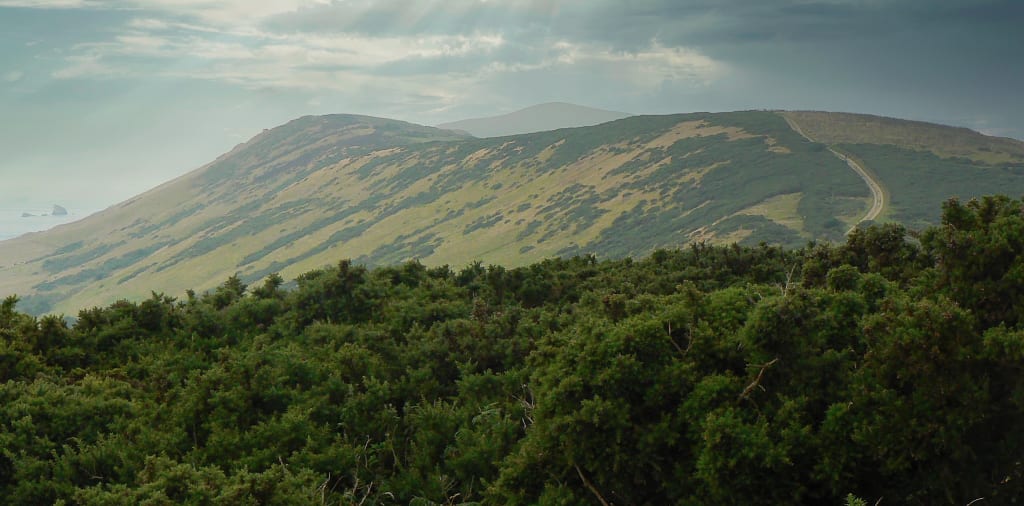
Set back from the sea and secreted in the Dorset countryside between ridges of vertiginous hills, there is something of the Lost World – a land that time forgot – about the deserted village of Tyneham.
Notwithstanding the fossilised delights of Purbeck and its Jurassic Coast, the lost world that Tyneham calls to mind, with its limestone ruins and dry stone walling, is a much more domestic affair than Conan Doyle’s; it is the world we all think of when we read Edward Thomas or hear the first strains of Barwick Green at the top of The Archers. It is Britain – specifically, England – between the wars or just after, a world long gone, a postcard from a Laurie Lee novel, all woodcuts and haystacks and slanting sun.

The only way in is over an impressive hogs back – a ridgeway of chalk, which snakes like the spine of a colossal sauropod, dipping and rising for 15 miles from Ballard Down near Swanage to Lulworth in the west. From the top of Povington Hill, an exhilarating view of a deep, largely deserted and verdant valley opens before you; at its centre lies a demure little church partly obscured by trees and a large car park which, unfortunately, is not. The valley runs east-west behind the coastline which it meets at Worbarrow Bay with its eponymous Tout, a hummock of headland, a lookout, almost severed from the cliff line; it’s a place which would have delighted Conan Doyle for its footprints of dinosaurs imprinted in the rocks.
Unlike deserted villages elsewhere – consumed by bubonic plague or levelled by an avaricious Georgian squire intent on sheep farming or emparkment – Tyneham, along with all its surrounding hamlets and farmsteads made it all the way into the twentieth century. When it was commandeered by the British Army during the last years of the Second World War for D-Day training, assurances were made that the villagers – who were given only a month to leave before being evicted the week before Christmas, 1943 – would be allowed back at the end of the war. Despite the promises, the occupants of Tyneham never returned.

The villagers’ loss is incalculable and threads itself through every thought you have in Tyneham. The squire enjoyed compensation of course, but the tenants only received the value of their garden produce and alternative accommodation, mostly in nearby Wareham. Nearly half of the front page of the Western Gazette for December 3, 1943 is taken up with lineage ads, auctions of livestock and equipment – 700 cattle, 600 chickens, the stock and effects of fifteen farms offered up without comment. A total of 7300 acres of Dorset were fenced off by the War Department, but when peace came, the Government stalled, the army found the area invaluable and time wore on. Campaigns were launched to win back the village but, in 1948, it was lost to a compulsory purchase order. It went the same way as most of the other requisitioned ranges like Imber on Salisbury Plain or the Stanford Battle Area in Norfolk’s Breckland.
Like Salisbury Plain and Breckland, however, Tyneham has gained something, a sense of wilderness unusual in modern Britain, untainted by contemporary environmental woes; there has been no intensive agriculture and the landscape has not been warped by road building and its fussy filing system of white lines, parking bays, signs that caution and cavil at every turn.

A schoolhouse and church are modest museums and a row of ruined cottages, among them the old Post Office, while tourists crowd around a rebuilt K1 telephone box by the duck pond. Together with an uncomfortable sense of sadness, that is as far as it goes; there are no gift shops or cafes, just a picnic area and block of toilets. The most striking thing is that, without the modern distractions – no mobile, wi-fi, cappuccino and cokes – people just look, explore and discover.
There’s plenty to be curious about. Rare plants thrive along the chalk and limestone downs and the trees that line the path down to Worbarrow Bay teem with birds and also, apparently, shrapnel (which is why no one in their right mind would go near them with a chain saw). Similarly, the range walks are marked with signs warning of the dangers of unexploded ordnance and gazing over the fields it occurs to the visitor that the threat of being accidentally shot, or even shelled, is conservation gold and that, maybe, all local wildlife trusts should invest in some red flags.
About the Creator
Ian Vince
Erstwhile non-fiction author, ghost & freelance writer for others, finally submitting work that floats my own boat, does my own thing. I'll deal with it if you can.
Top Writer in Humo(u)r.
The Refrigerant Transition
Cooling seldom features in climate headlines, yet it is one of the quietest success stories of the last decade. Under the Kigali Amendment to the Montreal Protocol, countries are phasing down hydrofluorocarbons (HFCs)—super-pollutant refrigerants—while retailers and manufacturers rapidly switch to ultra-low-GWP “natural” refrigerants such as carbon dioxide (R744) and propane (R290). Fully implemented, Kigali alone can avert roughly 0.4–0.5°C of warming by 2100; paired with efficiency improvements, the avoided warming can be closer to ~1°C—an enormous contribution from a single policy family [1–2].
By Futoshi Tachinoabout 24 hours ago in Earth




Comments (1)
Getting Back Lost, Hacked or Stolen Cryptos Hello everyone did you get scammed? or lost your BTC to fake online investment and in need of a hacker? (HWRCS) are the right person to contact. (Hack Wizard Recovery Cyber Services) They offer practically every hack, spy, cracking, recovery, bugging services and so much more. At first I wasn’t too sure they would be able to help. I paid for just the software needed for the job. and after 3 hours the result came as a surprise to my mailbox. I was very impressed. WHATSAPP:+1(262)325-6979. EMAIL:[email protected]