
Neptune could DESTROY the earth!
How a Passing Star Could Disrupt Our Solar System and Bring About Our End

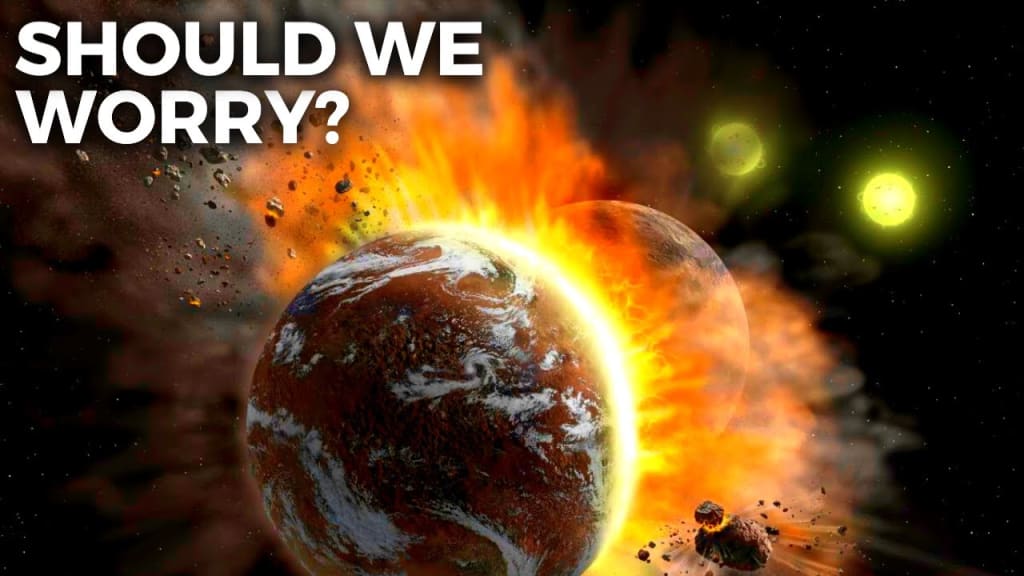
Our solar system sits perfectly on one of the Milky Way’s spiral arms amidst billions of glowing galaxies from where it travels around the galactic center. So impeccable is its design that every part of it, from the planets to the stars, works in seamless harmony. But now, that peace is about to be interrupted, and Earth could be destroyed in a ball of ice.
For centuries, science, philosophy, and religions have developed several theories about how our planet will end. A Christian theory says evil people will be destroyed in a great war called Armageddon while God’s servants will remain. The Aztecs believe that the end of the world will start with the Sun going out gradually, and humans will freeze to death after the Sun goes out in an endless solar eclipse. One thing is inevitable; the world will end somehow, and the culprit may not be global warming; instead, a star from our galaxy.
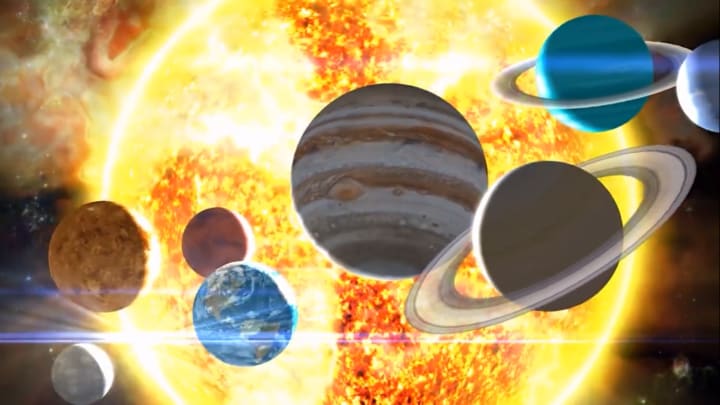
The eight planets, the sun, and one dwarf planet that form our solar system are held together by gravity. They orbit around the sun a million miles per second, never falling out of line and thus maintaining the balance of things. But as perfect as it seems, there is a weak link in our solar system, Neptune. What happens if one of the billion stars in the galaxy finds its way into Neptune’s path and alters its orbit? What is the fate of our planet?
Four of the eight planets in our solar system are giants, Jupiter, Saturn, Uranus, and Neptune. Jupiter and Saturn are gas giants composed mainly of hydrogen and helium; the next two, Uranus and Neptune, are ice giants made of gases, ice, and rocks.
For as long as the solar system has existed, planetary bodies have spun around the Sun thanks to never-failing gravity. But cosmologists and astronomers have come up with different theories about what will happen to the solar system if one of the planets is removed or changed its path. Jupiter, for instance, is the largest planet with a mass three times the combined mass of all the other planets and dominates gravitational interactions within the Solar System.
But even if it suddenly disappeared, there would be minimal impact on the movements of the other planets. The prominent effect on Earth would be an increase in the rate of impacts from asteroids and other space flotsam, and we wouldn't die if that happened. If Mars disappeared, it'd also be goodbye to those annoying asteroids it's constantly flinging towards the Earth and nothing more. Even if our sister planet Venus disappeared on us, we would only miss its shine and nothing more. This is because none of these planets can significantly alter the solar system's gravity and cannot harm us. But we can't say the same for the last planet in the system.
When the solar system formed 4.568 billion years ago from the gravitational collapse of a region within a large molecular cloud, Neptune's orbit was the farthest from the other giants, and its gravity bent the paths of innumerable frozen bodies inward toward the other giants. As Neptune flung frozen particles toward the Sun, its orbit shifted further. Its gravitational pull pushed the remaining icy objects into the range of locations scientists call the Kuiper Belt. In this region lies scattered discs, objects composed mainly of ice and rock. These icy bodies are similar to asteroids but way bigger; some have diameters between 500 and 1,500 km.
The average distance between Neptune and the Sun is 4.5 billion km, and it completes an orbit on average every 164.79 years. Its orbit strongly impacts the Kuiper belt, much like Jupiter's gravity dominates the asteroid belt. This is because the Sun's gravity is considerably less in these far extremes of the Solar System. Neptune's gravity destabilized certain regions of the Kuiper belt, creating gaps in its structure. Because the Kuiper Belt objects are not uniformly dispersed across space, scientists classified them based on the shape and size of their orbits.
This also led scientists to realize that there are multiple unique populations of KBOs whose orbits give hints about their history, and the population to which an object belongs has a lot to do with how it has interacted with Neptune's gravity throughout time.

The classical Kuiper belt appears to be a hybrid of two distinct populations. The first group, known as the "dynamically cold," has almost circular orbits with an orbital eccentricity of less than 0.1. The second group, the "dynamically hot," has orbits up to 30° more inclined to the ecliptic. The hot population is thought to have evolved around Neptune's initial orbit and dispersed throughout the large planets' migration. On the other hand, the cold population is believed to have originated in its current location since the loose binaries would be unlikely to survive contact with Neptune.
A large number of KBOs are in orbits strongly controlled by Neptune. They orbit in resonance with Neptune, which means their orbits follow a stable, repeating pattern. These resonant KBOs complete a set number of orbits in the time it takes Neptune to complete a set number of orbits.
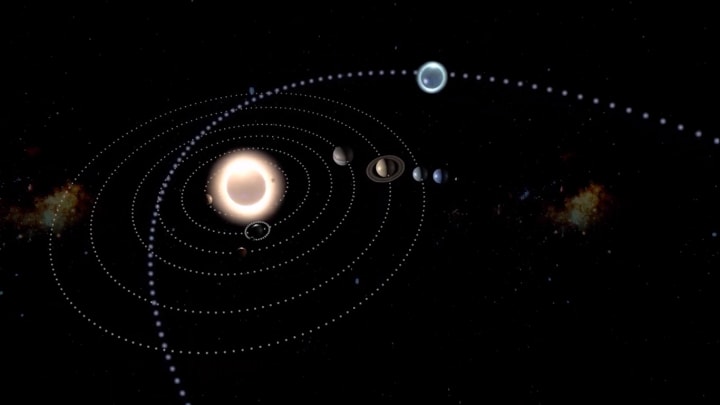
Neptune's gravity can force colliding KBO fragments into orbits that take them sunward, where Jupiter corrals them into short loops lasting 20 years or fewer. These are known as Jupiter-family comets. Because of their repeated travels into the inner solar system, most comets soon deplete their volatile ices and eventually become dormant, or dead, comets with little or no observable activity. So Neptune is a disaster waiting to happen.
Being the farthest planet from the Sun has its advantages and disadvantages. The advantage is Neptune's gravity controls the Kuiper belt; the disadvantage is its distance strips it of protection and, consequently, a weak link in the bigger scheme of things.
As you may know, our solar system is only a tiny part of the Milky Way galaxy and is at the mercy of whatever goes on there. Worse, Earth is the only friendly planet in the only system. For instance, an asteroid belt is lying between the orbits of Mars and Jupiter, containing rock, metal, and icy objects. Coupled with KBOs, these objects threaten our planet, but since every planet is still orbiting within its boundaries, no damage has been done to the Earth. But what would happen if an asteroid from Mars or a passing star took a long shot at the solar system?
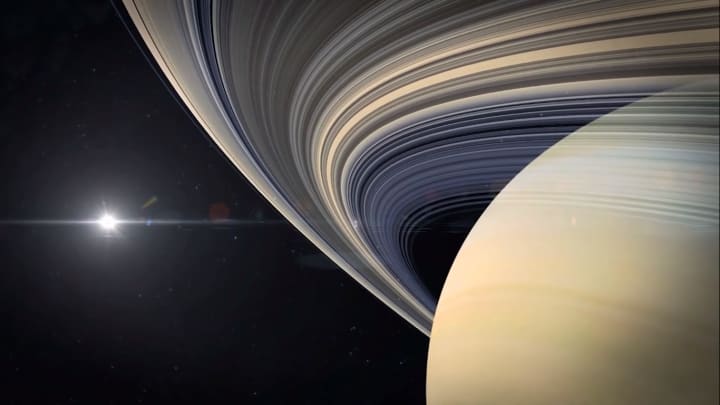
Garret Brown and Hanno Rein of the University of Toronto analyzed the potential of a star traveling by our solar system. They discovered that if the gravity of the foreign star alters the orbits of some of the planets even by 0.1 percent, it may cause havoc on the solar system. Neptune being the weak link, will feel the most impact. It will fall out of orbit, and chaos will hit the solar system. Considering how strong gravity can get, the impact will stretch to the rest of the system. And when each planet spins continually in its orbit, the stability of the entire solar system is jeopardized. This means the Kuiper belt will be disrupted, and balls of ice and dust could fly into Earth in no time. The scary part is the passing star will not have to be as large as the Sun to wreak havoc, and we wouldn't even notice it since the star wouldn't have to go very close to the Solar System.
From their calculations, there's a 1% chance that Mercury and Venus will crash into each other within about 5 billion years. So, if a star comes by and moves Neptune by this small amount, then instead of a 1% chance that Mercury will crash into Venus, it’s a 10% chance. The next question is, how soon will a star fly by the solar system? Astronomers have identified a huge star called Gliese 710 within 10,000 astronomical units of the solar system. Gliese 710, with half the mass of the Sun, is far bigger than Scholz's Star, which is just 15% the mass of the Sun. If such a body with intense gravity came close to the solar system, it'd spell doom.
But that's not all Neptune has up her sleeves. According to Dr. Whitmire, a professor in the Mathematics department at the University of Arkansas, there is a massive ninth planet in the Kuiper belt, beyond Neptune, that may have been responsible for the extinction of the dinosaurs. Dr. Whitmire claims that this giant planet rains comet showers every 27 million years, causing massive extinctions on Earth. If that planet turns out to be true, it'll mean that its orbit, as with other KBOs, depends on that of Neptune. A slight change in that planet's course could bring the apocalypse closer than we expected. But, the so-called "Planet Nine" still needs to be confirmed.
Whatever the case, a star isn't passing by our solar system tomorrow and will not until another billion years.
About the Creator
Sheko
Unlock Attraction Mastery with Sheko! Discover powerful strategies to exude confidence, stay curious, uphold your principles, and embrace abundance. Attract genuine love and admiration effortlessly. Join me and magnetize hearts!
Thailand Fertilizer Market Size and Forecast 2025–2033
Thailand Fertilizer Market Outlook The Thailand Fertilizer Market is experiencing a steady and structural transformation as the country strengthens its agricultural base to support food security, exports, and rural livelihoods. According to Renub Research, the market is expected to grow from US$ 1,071.08 million in 2024 to US$ 1,732.51 million by 2033, expanding at a CAGR of 5.50% during 2025–2033.
By Renub Research22 minutes ago in Earth
Trump Promised to Cut Energy Bills in Half. One Year Later, Has He Delivered?
One year ago, former President Donald Trump made headlines with a bold promise: he would slash Americans’ energy bills by 50%. The pledge was ambitious, aiming to address the dual challenges of rising utility costs and economic strain on households. As energy prices have continued to fluctuate over the past year, the question on everyone’s mind is simple: has Trump delivered on his promise?
By Muhammad Hassan3 days ago in Earth



Comments
There are no comments for this story
Be the first to respond and start the conversation.