
NASA Image Reveals Earth's Tallest Lightning.
Earth Tallest Lightning


NASA Image Reveals Earth's Tallest Lightning.
The recent capture of a rare atmospheric phenomenon known as a gigantic jet by the International Space Station (ISS) has once again sparked interest in the mysteries of Earth's upper atmosphere. This extraordinary form of lightning often called Earth's tallest lightning is a massive electrical discharge that occurs between powerful thunderstorms and the ionosphere reaching nearly 50 miles into the sky. Unlike conventional lightning that travels between clouds or from clouds to the ground gigantic jets extend upward piercing the atmosphere in a dramatic display of raw energy. These electrical events are rarely observed and even less frequently captured in photographs making this latest image a significant contribution to scientific understanding. Gigantic jets belong to a category of atmospheric discharges known as transient luminous events (TLEs). These phenomena include other unusual forms of lightning such as sprites blue jets and elves each with unique characteristics and behaviors. Gigantic jets however are particularly notable due to their immense scale and power. They have been described as electrical tendrils stretching toward space a stark contrast to the downward bolts of traditional thunderstorms. Though first documented in 2002 they remain an enigmatic aspect of atmospheric science with researchers still trying to determine the exact mechanisms behind their formation.
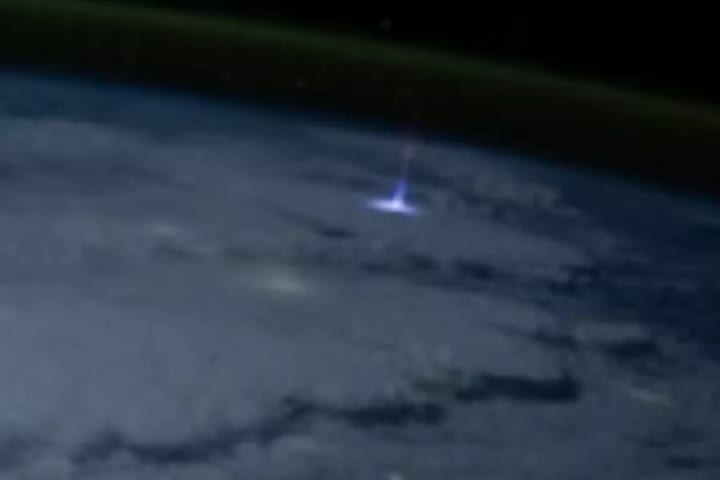
The latest image taken from the ISS on November 19 at 00:26 Eastern Time captures one of these enormous discharges in full force. The ISS was orbiting at an altitude of 223 nautical miles over North America when the event was recorded. The discovery of the image was made by Frankie Lucena a space enthusiast from Puerto Rico who was searching through NASA’s online archive known as the Gateway to Astronaut Photography of Earth. Lucena upon closely analyzing the images recognized the distinct structure of a gigantic jet and shared his findings with the scientific community. According to preliminary assessments this particular event occurred south of New Orleans over the Gulf of Mexico. Gigantic jets are often compared to blue jets another type of upper atmosphere lightning that shoots upward from thunderstorms. However while blue jets typically extend to about 25 miles above the Earth's surface gigantic jets can reach nearly double that altitude. The distinction between these phenomena is crucial for understanding atmospheric electricity and the processes that regulate electrical charges in different layers of the atmosphere. Scientists believe that gigantic jets serve as a means to neutralize charge imbalances between the storm systems and the upper atmosphere effectively acting as a massive electrical conduit between Earth and space.
Despite their dramatic nature gigantic jets are incredibly difficult to capture. Unlike traditional lightning which is observed frequently during thunderstorms these immense discharges are much rarer and occur above dense storm clouds making them nearly invisible from the ground. They last only milliseconds requiring precise timing and ideal conditions for successful observation. The few documented cases of gigantic jets have typically come from high altitude locations or specialized instruments capable of detecting transient luminous events. This makes the ISS an ideal platform for capturing such phenomena as it provides an unobstructed view of the Earth's atmosphere from above. The significance of the ISS image extends beyond just visual documentation. It offers scientists valuable data on the frequency location and structure of gigantic jets which can help refine models of atmospheric electricity. The study of these jets is important because they play a role in the global electrical circuit a complex system that governs the movement of electrical charges between the Earth's surface atmosphere and ionosphere. Understanding this circuit is crucial for developing better climate models, improving weather prediction and even safeguarding communication systems that rely on atmospheric stability.
While researchers have proposed several theories about how gigantic jets form there is still no definitive explanation. One prevailing hypothesis is that these jets occur when the electrical charge within a thunderstorm becomes so intense that it seeks a path of least resistance upward rather than downward. This may happen in storms where normal cloud to ground lightning is suppressed, forcing the energy to escape in an alternative direction. The exact atmospheric conditions that trigger such events however remain unclear. More observations and data collection are needed to determine why some thunderstorms produce gigantic jets while others do not. The recent ISS image adds to the growing body of evidence that suggests gigantic jets are more common than previously thought but they simply go unnoticed due to their fleeting nature and high altitude occurrence. Advancements in space based observation technology have made it easier to capture such events and with continued monitoring scientists hope to gain deeper insights into their behavior and impact on the Earth’s atmosphere. Future research may involve the deployment of specialized sensors on satellites or high altitude aircraft designed specifically to detect and analyze transient luminous events in real time. Beyond scientific curiosity understanding gigantic jets has practical implications. Electrical activity in the upper atmosphere can influence satellite operations radio communications and even aviation safety. Pilots flying at high altitudes have reported seeing unusual electrical discharges above storms though these events are not well documented. If gigantic jets occur more frequently than believed they could pose an unexpected challenge to aircraft navigation and space based technologies.
The capture of this gigantic jet also highlights the importance of citizen science in modern research. Frankie Lucena’s discovery showcases how dedicated space enthusiasts and amateur astronomers can contribute to scientific advancements by analyzing publicly available data. With the vast amount of imagery and data collected by NASA and other space agencies the potential for new discoveries remains immense. Engaging more people in the search for unusual atmospheric events can help accelerate research and lead to a better understanding of Earth's dynamic environment. As scientists continue to study these mysterious discharges one thing remains certain Earth’s atmosphere still holds many secrets waiting to be uncovered. Gigantic jets serve as a reminder that despite technological advancements nature continues to surprise and inspire us. With each new observation we move closer to unraveling the complexities of our planet’s electrical and atmospheric systems. The recent ISS image is not just a breathtaking glimpse of an extraordinary event but also a stepping stone toward a greater understanding of the forces that shape our world.
About the Creator
Adnan Rasheed
Author & Creator | Writing News , Science Fiction, and Worldwide Update| Digital Product Designer | Sharing life-changing strategies for success.
Keep reading
More stories from Adnan Rasheed and writers in Earth and other communities.
NASA’s Europa Clipper Uses Mars to Go the Distance.
NASA’s Europa Clipper Uses Mars to Go the Distance. NASA’s Europa Clipper is set to embark on a historic journey to explore Jupiter’s moon Europa one of the most intriguing celestial bodies in the solar system. This mission designed to determine whether Europa has conditions suitable for life relies on a strategic interplanetary route that includes multiple gravity assists. On March 1, 2025 the spacecraft will execute a critical maneuver by using Mars’ gravity to adjust its trajectory and fine tune its path toward the outer solar system. This technique a staple in NASA’s space exploration playbook allows the spacecraft to conserve fuel and optimize its travel time. Europa Clipper’s encounter with Mars is a planned gravity assist a maneuver where the spacecraft flies close to a planet to alter its trajectory using the planet’s gravitational pull. The upcoming flyby will bring the probe just 550 miles 884 kilometers above the Martian surface taking advantage of the Red Planet’s gravitational force to reshape its solar orbit. This interaction will slow down the spacecraft slightly refining its path in preparation for the next major assist a slingshot around Earth in December 2026. As Europa Clipper approaches Mars it will be moving at an impressive velocity of 15.2 miles per second 24.5 kilometers per second relative to the Sun. The planet’s gravity will act as a cosmic steering wheel bending the spacecraft’s path and adjusting its speed. After the flyby Europa Clipper will continue its voyage at a slightly reduced speed of 14 miles per second 22.5 kilometers per second positioning it for the next leg of its interplanetary journey.
By Adnan Rasheedabout a year ago in Earth
Human Revenge: A Hidden Cause Behind the Decline of Snow Leopards
High in the rugged mountains of Central and South Asia lives one of the world’s most mysterious and beautiful big cats—the snow leopard. Known for its thick grey-white fur, long tail, and incredible ability to blend into rocky landscapes, this elusive predator has fascinated scientists and wildlife lovers for decades. Yet despite its beauty and ecological importance, the snow leopard faces a growing threat: human revenge.
By Irshad Abbasi 2 days ago in Earth




Comments
There are no comments for this story
Be the first to respond and start the conversation.