
NASA’s Europa Clipper Uses Mars to Go the Distance.
Europa Clipper

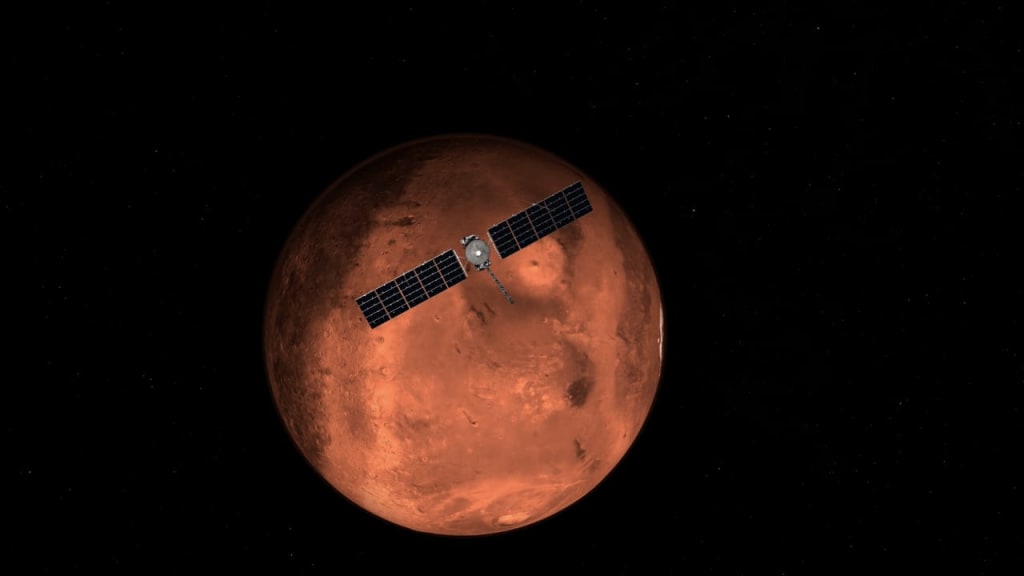
NASA’s Europa Clipper Uses Mars to Go the Distance.
NASA’s Europa Clipper is set to embark on a historic journey to explore Jupiter’s moon Europa one of the most intriguing celestial bodies in the solar system. This mission designed to determine whether Europa has conditions suitable for life relies on a strategic interplanetary route that includes multiple gravity assists. On March 1, 2025 the spacecraft will execute a critical maneuver by using Mars’ gravity to adjust its trajectory and fine tune its path toward the outer solar system. This technique a staple in NASA’s space exploration playbook allows the spacecraft to conserve fuel and optimize its travel time. Europa Clipper’s encounter with Mars is a planned gravity assist a maneuver where the spacecraft flies close to a planet to alter its trajectory using the planet’s gravitational pull. The upcoming flyby will bring the probe just 550 miles 884 kilometers above the Martian surface taking advantage of the Red Planet’s gravitational force to reshape its solar orbit. This interaction will slow down the spacecraft slightly refining its path in preparation for the next major assist a slingshot around Earth in December 2026. As Europa Clipper approaches Mars it will be moving at an impressive velocity of 15.2 miles per second 24.5 kilometers per second relative to the Sun. The planet’s gravity will act as a cosmic steering wheel bending the spacecraft’s path and adjusting its speed. After the flyby Europa Clipper will continue its voyage at a slightly reduced speed of 14 miles per second 22.5 kilometers per second positioning it for the next leg of its interplanetary journey.
This maneuver is essential for ensuring that the spacecraft reaches its destination in the most efficient manner possible. Without gravity assists Europa Clipper would require significantly more fuel to reach Jupiter adding substantial weight and cost to the mission. Instead by leveraging planetary flybys NASA engineers have designed a trajectory that minimizes fuel consumption while maximizing momentum. Gravity assists are a wellnestablished technique in space exploration dating back to missions like Voyager 1 and Voyager 2 which launched in 1977. These spacecraft used the gravitational pull of multiple planets to gain speed and alter their trajectories allowing them to visit the outer planets of the solar system in a relatively short period. Without these assists their missions would have taken much longer and required more fuel than was feasible. The same principles apply to Europa Clipper. The mission team at NASA’s Jet Propulsion Laboratory JPL has carefully calculated the spacecraft’s trajectory to take advantage of the existing dynamics of the solar system. By performing the Mars flyby the spacecraft will be set up for its next major assist: a gravity boost from Earth in December 2026. This Earth flyby will provide the final push needed to send Europa Clipper toward its ultimate destination the Jovian system.
Ben Bradley a mission planner at JPL likens the process to a game of billiards where each planetary encounter must be perfectly timed to achieve the desired trajectory. Everything has to line up the geometry of the solar system has to be just right to pull it off he explains. This careful planning ensures that Europa Clipper can reach Jupiter without unnecessary delays or excessive fuel consumption. Europa Clipper’s journey to Jupiter is not a direct one. Launched from Kennedy Space Center in Florida on October 14, 2024 aboard a SpaceX Falcon Heavy rocket the spacecraft is on a 1.8 billion mile 2.9 billion kilometer voyage that will take nearly six years to complete. The distance to Jupiter is about five times farther from the Sun than Earth making the journey one of the most complex interplanetary missions in recent history. Once Europa Clipper reaches Jupiter in April 2030 it will begin its primary mission to investigate Europa’s potential habitability. Scientists believe that beneath its icy crust Europa harbors a vast subsurface ocean that could contain the necessary conditions for life. The spacecraft is equipped with advanced scientific instruments including a powerful radar system to penetrate the ice and a thermal imager to detect heat variations on the moon’s surface.
The Mars gravity assist isn’t just about trajectory adjustments it also provides a valuable opportunity for mission scientists to test some of the spacecraft’s instruments in a real space environment. During the flyby Europa Clipper’s radar and thermal imager will be activated and tested. This allows engineers to assess their performance before the spacecraft reaches its primary target ensuring that all systems are functioning correctly. Given the high stakes of the Europa mission conducting these early tests is critical. By analyzing the data collected during the Mars flyby scientists can make any necessary adjustments to the instruments ensuring that they are fully operational when the spacecraft arrives at Europa. This proactive approach minimizes the risk of technical failures once the probe reaches the outer solar system where real time troubleshooting is significantly more challenging. Europa Clipper’s primary mission is to determine whether Europa’s subsurface ocean could support life. The moon has long fascinated scientists due to its potential for harboring liquid water beneath its thick ice shell. Observations from previous missions including Galileo and Hubble suggest that Europa may have plumes of water vapor erupting from its surface hinting at possible subsurface activity. The spacecraft will carry a suite of scientific instruments designed to investigate Europa’s composition geology and potential habitability. These include
Ice penetrating radar: To map the thickness of Europa’s ice shell and detect any subsurface water reservoirs.
Thermal imager: To identify temperature variations that could indicate active geological processes.
Mass spectrometer: To analyze the composition of Europa’s thin atmosphere and potential plumes.
Magnetometer: To measure the moon’s magnetic field and infer the depth and salinity of its ocean.
By gathering detailed data on Europa’s surface and subsurface the mission will help scientists determine whether the moon has the necessary ingredients for life. While Europa Clipper is not designed to detect life directly it will provide crucial insights that could inform future missions such as landers or probes specifically designed to search for biological signatures. Europa Clipper represents one of the most ambitious space missions of the decade. By leveraging the gravitational forces of Mars and Earth NASA has developed an efficient and cost effective way to transport the spacecraft to its destination. This approach refined over decades of space exploration highlights the ingenuity of mission planners and the importance of understanding celestial mechanics. The successful execution of the Mars flyby on March 1, 2025 will mark a significant milestone in the mission demonstrating the spacecraft’s ability to navigate deep space with precision. With each gravity assist Europa Clipper moves closer to its goal of unlocking the mysteries of Europa potentially bringing humanity one step closer to answering one of the most profound questions Are we alone in the universe.
About the Creator
Adnan Rasheed
Author & Creator | Writing News , Science Fiction, and Worldwide Update| Digital Product Designer | Sharing life-changing strategies for success.
Keep reading
More stories from Adnan Rasheed and writers in Earth and other communities.
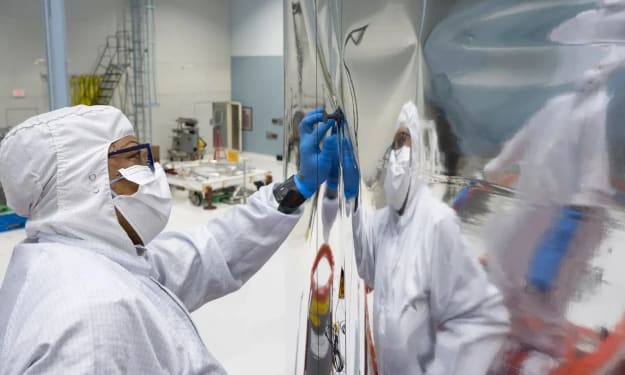
NASA installs 'bulletproof' sunshade on powerful Nancy Grace Roman Space Telescope.
NASA installs bulletproof sunshade on powerful Nancy Grace Roman Space Telescope. NASA's Nancy Grace Roman Space Telescope has achieved a significant milestone with the successful installation of its deployable sunshade a critical component designed to enhance the observatory's ability to capture faint infrared signals from the cosmos. This advancement brings the mission closer to its anticipated launch in 2027 promising to expand our understanding of the universe. The sunshade officially known as the Deployable Aperture Cover functions akin to a pair of blackout curtains effectively blocking unwanted light that could compromise the telescope's sensitive observations. Constructed from two layers of reinforced thermal blankets the design ensures that stray light is minimized thereby increasing the telescope's sensitivity to distant celestial objects. One of these layers is fortified with Kevlar the same material used in bulletproof vests providing robust protection against potential micrometeoroid impacts. This meticulous engineering ensures that even if one layer is perforated the staggered design reduces the likelihood of light penetrating both layers simultaneously maintaining the integrity of observations.
By Adnan Rasheedabout a year ago in Earth
A Green Solution to Urban Pollution
Air pollution has become one of the most serious environmental challenges facing modern cities. Rapid industrialization, increasing vehicle emissions, and expanding urban populations have significantly degraded air quality around the world. Polluted air not only harms ecosystems but also poses severe health risks to humans, contributing to respiratory diseases, heart conditions, and reduced life expectancy. Among the many strategies proposed to combat this problem, planting and preserving trees stands out as one of the most natural, cost-effective, and sustainable solutions.
By Irshad Abbasi 2 days ago in Earth


Comments
There are no comments for this story
Be the first to respond and start the conversation.