
Mushrooms and Their Connection to Human Evolution
Transformational Mystery
Mushrooms and Their Connection to Human Evolution
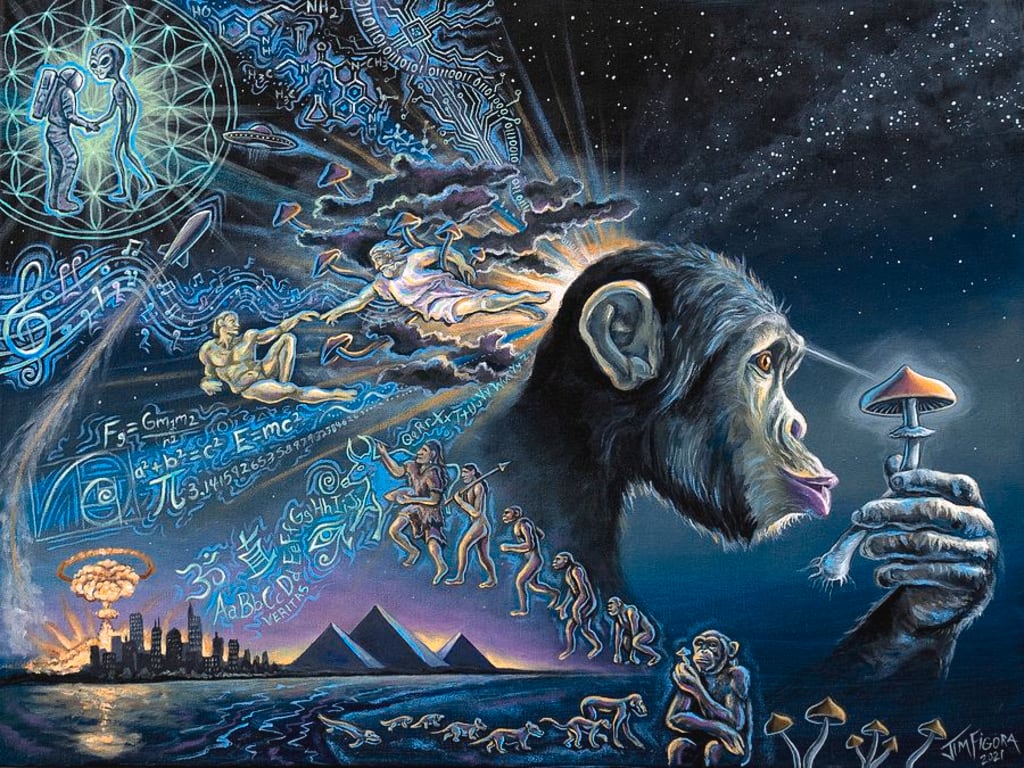
When you ponder the visual landscape of the natural world, animals and plants are probably the first things that come to mind. We see them daily, and their familiarity makes us feel connected. But what about mushrooms? These fascinating organisms pop up and disappear within a matter of days, and their ephemeral nature makes them mysterious and powerful. Some mushrooms can feed us, while others can kill, heal, or send us on spiritual journeys. It's no wonder humans have developed a fear of the unknown when it comes to these enigmatic fungi.
Interestingly enough, humans are not the only primates that consume mushrooms. A total of 23 primate species, including us, have a history of successful mushroom use. This speaks to a long-standing relationship between mushrooms and our primate evolutionary tree. In fact, we separated from fungi around 650 million years ago, making us descendants of these ancient organisms. This means that, in a way, we are all just fungal bodies talking to one another.
When it comes to the cellular level, human cells, animal cells, and fungal cells share remarkable similarities. We all exhale carbon dioxide and inhale oxygen, and many of the bacterial diseases that infect fungi also infect us. Fungi even provide us with our best antibiotics against bacteria, with penicillin being the most famous example.
As we trace the history of life on Earth, we find that fungi have been around for billions of years. The oldest multicellular organism in the fossil record is a fungus found in South Africa, dating back 2.4 billion years. Another ancient mushroom fossil was discovered in Brazil, estimated to be 1.4 billion years old. This means that mushrooms have maintained their form for over a billion years before we even developed ours. These ancient organisms are the true overlords of our ecosystem and may even possess a form of intelligence.
The Stoned Ape Hypothesis: A Quantum Leap in Human Consciousness?
Terence and Dennis McKenna, two prominent ethnobotanists, proposed the controversial "Stoned Ape Hypothesis." This idea suggests that the consumption of psychedelic mushrooms, specifically Psilocybe cubensis, played a crucial role in the rapid expansion of the human brain and the development of language, empathy, and courage among early hominids.
According to the hypothesis, as climate change caused the expansion of savannas, our primate ancestors ventured out of the forest canopies and came across these potent mushrooms growing on animal dung. Consuming these mushrooms would have led to an influx of sensory data and fractal patterns, activating neurogenesis (the growth of new neurons) and the formation of new neural pathways.
Over time, as our ancestors repeatedly consumed these mushrooms, they developed the ability to overcome fear responses, demonstrate courage, and exhibit empathy. These traits would have been essential for leaders of early human clans, helping to ensure survival and propel human evolution forward. The constant exposure to these mushrooms, along with the resulting "epigenetic neurogenesis," may have been the catalyst for the significant leap in human consciousness.
From Fungi to the Future: Bridging the Communication Gap
Today, we stand at a precipice, ready for the next quantum leap in human consciousness. As we continue to explore the mysterious world of mushrooms and their ancient wisdom, we may begin to bridge the communication gap between our fungal allies and ourselves. By doing so, we can harness their power to address some of the most pressing challenges facing our planet, from the loss of biodiversity to the ongoing climate crisis.
Although the Stoned Ape Hypothesis remains unproven, it provides a fascinating perspective on the deep connection between humans and fungi. Perhaps, as we learn to communicate with these ancient organisms, we will unlock new doors to understanding the universe and our place within it.
Ultimately, the mysterious world of mushrooms holds many secrets, some of which may be crucial for our continued survival on this planet. So, the next time you come across a mushroom in the wild, take a moment to appreciate its ancient wisdom and consider the possibility that it may hold the key to our future.
About the Creator
Keep reading
More stories from Kyle Burnette and writers in Earth and other communities.
Recent Bank Failures and Government Bailouts
Recent Bank Failures and Government Bailouts Two of the largest bank failures in history happened this week, sparking fear and concern among depositors and investors. Before delving into the reasons behind these collapses, let's first address a burning question: why is Jim Cramer so good at being so bad at his job?
By Kyle Burnette3 years ago in 01
Earth’s Hidden Fires
The Black Scar of the Sahara and Other Fires That Shouldn’t Exist From high above, the Sahara Desert looks like a golden ocean—endless waves of sand broken only by scattered blue and green oases. But hidden among the dunes is something startling: a massive black region covering nearly 17,000 square miles. It’s so large it’s visible from space, yet it rarely appears in movies or documentaries. At first glance, it almost looks unnatural, as if something catastrophic happened there.
By Lexi Wilburn4 days ago in Earth
What might an extraterrestrial invasion of Earth look like?
The author used artificial intelligence in the crafting of this article. Although Hollywood depicts visits by aliens as horrifying experiences where humans die or even are eaten alive, scientists and philosophers say that’s probably not what an invasion would like.
By David Heitz4 days ago in Earth




Comments
There are no comments for this story
Be the first to respond and start the conversation.