
What might an extraterrestrial invasion of Earth look like?
Academics describe various theories

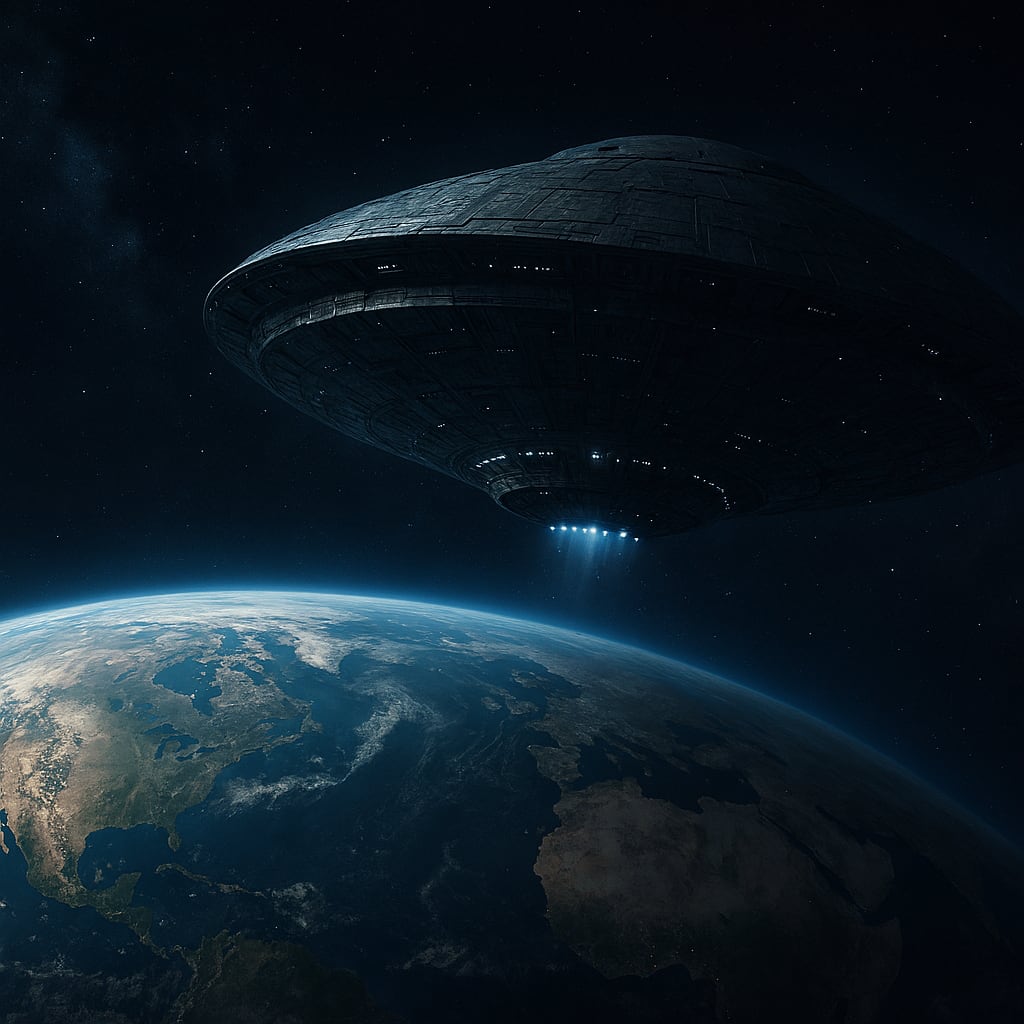
The author used artificial intelligence in the crafting of this article.
Although Hollywood depicts visits by aliens as horrifying experiences where humans die or even are eaten alive, scientists and philosophers say that’s probably not what an invasion would like.
The Search for Extraterrestrial Intelligence, or SETI, is “a non-profit research organization, located in the Silicon Valley close to the NASA Ames Research Center,” according to its website. “Our mission is to lead humanity's quest to understand the origins and prevalence of life and intelligence in the universe and share that knowledge with the world.”
SETI is pessimistic that aliens will visit us. “Given the difficulty (and cost) of interstellar travel, it seems reasonable that any aliens would need a good motivation to undertake it,” according to its website. “Coming here to embroil themselves in the affairs of humankind seems highly improbable. That’s because the evidence of our existence – in the form of radar, radio and television signals – has washed over only a few thousand nearby star systems; systems that are close enough that anyone picking up the transmissions would have time enough to come visit and be here now, even if they can travel at nearly the speed of light. Consequently, we can say that no alien societies are likely to have any knowledge of human affairs, let alone be motivated to visit.”
Visits might be by machines
Other scholars say it’s difficult for humans to imagine alien motivations because they likely wouldn’t resemble a human’s. Some scholars, such as Harvard physicist Ari Loeb, argue in academic literature that advanced civilizations may transition into machine or hybrid forms. If so, their motivations might be:
Information‑seeking rather than experience‑seeking
Optimization rather than exploration
Self‑replication rather than curiosity
In this view, a visit to Earth might be:
A routine data‑harvesting operation
A maintenance check on long‑running probes
Another theory is the “Evolutionary Drive” hypothesis. Some evolutionary theorists propose that intelligence might evolve toward:
Maximizing complexity.
Maximizing survival of information.
Maximizing replication of itself
A visit could be:
An attempt to seed new life.
An attempt to steer Earth’s biosphere toward greater complexity
Avi Loeb reports on Medium that according to Dyson, if the visitors are not biological but self‑replicating probes, then their “motives” might be:
Mapping star systems
Cataloging biospheres
Replicating using local materials
Monitoring for technological emergence
A probe might “visit” Earth simply because:
Earth is on its route
Earth has life
Earth has resources
Earth is a node in a larger network
An attempt to seed new life?
A visit could be:
An attempt to seed new life.
An attempt to steer Earth’s biosphere toward greater complexity
Because visitation is considered unproven, scientists don’t usually speculate about alien motives in the same way science‑fiction writers or UFO researchers do.
But that doesn’t mean they never do. Harvard scientist Tim Lomas created the Extraterrestrial Hypothesis. So why do some scientists discuss alien motivations? Because certain scientific fields must consider them.
What SETI researchers think about
SETI researchers think about why aliens might send signals, what their communication strategies could be, whether they’d avoid contact and whether they’d explore the galaxy. Astrobiologists and philosophers of science explore convergent evolution of intelligence, universal behaviors of advanced species and ethical frameworks for interstellar contact. Physicists and technologists consider whether probes are more likely than biological visitors and whether self‑replicating machines would explore the galaxy
So, while mainstream scientists don’t assume aliens are visiting Earth, they do engage with the question of motivations in a theoretical, model‑building way. William C. Lane (2025) argues that dismissing extraterrestrial visitation because “no alien would hide” is flawed—aliens may have motives or constraints we cannot imagine.
This line of thought encourages openness to radically different forms of intention, behavior, or communication such as the “zoo” or “quarantine” hypothesis, which is described in a Universe Today article. A well‑known idea in some circles is the notion that Earth might be intentionally isolated from direct contact to allow natural cultural development. Some researchers propose that advanced civilizations might monitor planets where intelligent life is developing, especially if that life is approaching a technological threshold (e.g., nuclear capability, spaceflight).
Probably not coming for water
Popular culture often imagines aliens coming for water, minerals, or energy. Most scientists consider this unlikely because resources like water, metals, and energy are far more abundant and easier to access in space (asteroids, comets, gas giants). Still, the idea appears in speculative discussions because it cannot be ruled out entirely.
Others believe extraterrestrials may visit as part of diplomatic or cultural outreach. A minority of scholars argue that if extraterrestrials are benevolent or cooperative, they might seek contact for cultural exchange or interstellar diplomacy. This is rarely treated as a primary hypothesis because it assumes a great deal about alien psychology and ethics.
The non‑linear time” hypothesis
Some physicists and philosophers speculate that advanced civilizations might not experience time the way we do. If so, their motivations could be maintaining timelines, observing key branching points, and interacting with civilizations only at specific epochs
A visit might be:
A temporal survey
A correction
A synchronization event
This is one of the most radical attempts to imagine non‑human motivation because it removes linear cause‑and‑effect entirely.
The incomprehensible utility function
Nick Bostrom outlines in his book “Superintelligence” that alien motivations might be:
Internally coherent
Externally incomprehensible
Examples:
Maximizing a physical constant
Minimizing entropy in a region
Preserving a pattern we don’t recognize
Interacting with Earth because it satisfies a constraint we can’t perceive
The “Symbolic or Aesthetic” hypothesis
The website “Hypotheses” describes the Aesthetic Hypothesis. Some philosophers suggest that alien behavior might be driven by:
Aesthetic principles
Symbolic logic
Ritualized behavior
Non‑utilitarian goals
A visit might be:
A performance
A ritual
A symbolic act
A gesture in a cultural system we cannot decode
This is one of the few models that treat aliens as having culture without assuming their culture resembles ours.
So, what do scientists think a visit would be like?
If it ever happened, the most scientifically grounded scenarios are:
Probe-based reconnaissance
Long-term monitoring
Non-interventionist observation
Accidental detection
Contact initiated for reasons unrelated to us
None of these resemble “Independence Day,” the 1990s blockbuster movie. Scientists do not believe an extraterrestrial visit would be a doomsday scenario.
Someday we’ll know more
The idea that aliens would destroy Earth or eat humans is a narrative invention, not a scientific expectation. In fact, for all intents and purposes, most scientists believe extraterrestrials have never visited Earth and their odds of doing so are unlikely.
In an excerpt on Literary Hub from the book “Aliens: Leading Scientists in the Search for Extraterrestrial Life,” Lewis Dartnell writes. “The fact that Earth’s oxygen-rich atmosphere has apparently attracted no one’s attention may simply be because life is so rare that there is not a single other civilization in the galaxy with us to have their attention drawn. Or perhaps planets with an oxygen-rich atmosphere are so staggeringly common that the Earth just doesn’t stand out among the masses. In the first possibility we are solitary and lonely intelligent beings in the galaxy; in the second, life is absolutely rife in the cosmos. Both, to me, are equally profound realizations. And the most exciting aspect is that within your and my lifetime we will have launched our atmosphere-reading space telescopes, and the science of astrobiology will have been able to tell which one is right.”
About the Creator
David Heitz
I am a journalist with 38 years' experience. I write for Potent, Vocal's cannabis blog, and Psyche, where I share stories of living with schizoaffective disorder bipolar one. I have lived in a penthouse and also experienced homelessness.
Keep reading
More stories from David Heitz and writers in Earth and other communities.
Exclusive: Amazon Plans Thousands More Corporate Job Cuts Next Week, Sources Say
Amazon, one of the world’s largest e-commerce and technology companies, is reportedly planning to announce thousands of additional corporate job cuts next week, according to sources familiar with the matter. This latest round of layoffs is part of a broader trend of corporate restructuring at the company, which has seen waves of job reductions in recent months.
By Muhammad Hassan7 days ago in Earth



Comments
There are no comments for this story
Be the first to respond and start the conversation.