
Moldova at the Crossroads: A Struggle for Identity and Democracy at Russia's Gates
What happens when a nation's dreams of democracy clash with the specter of foreign influence and deep-seated corruption?

Moldova in Europe. Author: TUBS. Creative Commons Attribution-Share Alike 3.0 Unported license. Wikimedia Commons. Moldova is a small country, bordering Romania and Ukraine. History has placed it at a very critical juncture. With the war in Ukraine gaining momentum and the threat of Russian aggression growing larger and larger, the stakes simply cannot get any higher for Moldova.
The President, Maia Sandu, is an advocate for a pro-European agenda. She has to deal with challenges on many fronts in her endeavors to lead Moldova along a path toward stability and democratic governance.
With a pending referendum on accession to the EU, the fragile political landscape nourishes deep-seated issues of corruption, societal cleavages, and widespread influence wielded by pro-Russian sentiment. This paper puts together recent developments in Moldova with regard to its upcoming elections and referendum against the backdrop of complex political dynamics defining this Eastern European state.
A Pro-European Agenda Under Attack
President Maia Sandu: A Ray of Hope or a Target?
Since her election in 2020, President Maia Sandu came to be regarded as a pro-European reformer in a country mired in the legacy of corruption and political instability.
Her administration has been working toward bringing Moldova closer to European institutions, striving for EU membership as a keystone of national policy, something constantly undermined by strong internal and external forces.
This struggle has just been epitomized in the recent presidential elections, with Sandu facing unprecedented challenges from pro-Russian factions who are determined to destabilize her government.
In the run-up to the elections, Sandu expressed deep concern over massive electoral manipulation, claiming as many as 300,000 votes had been bought by criminal groups in league with foreign forces. "We are facing an unprecedented attack against free democracy in our country," Sandu said, requesting an investigation of these claims.
Such accusations underpin not only the bitter political competition in Moldova but also a greater geopolitical competition between pro-European and pro-Russian forces in Eastern Europe.
The Threat of Russian Influence
This trend provides the background against which Sandu's presidency is developing, after four months that have passed in atmospheres of diffuse insecurity, not least because of the aggressive Russian posture in the region.
Moldova-aspiring to EU membership-is in fact considered a real blocking factor to Russian interests throughout Eastern Europe.
Russian authorities have lost no occasion to point out that for them, the possible accession of Moldova to the European Union would be a declared threat, therefore carrying the consequent risk of destabilization.
The Moldovan government has accused the government of Russia of meddling in internal affairs, which it called a threat to national sovereignty and stability.
But the fact that pro-Russian oligarchs, such as Ilan Șor-who engineered a $1 billion bank fraud-are involved in the political landscape further complicates it. Though sentenced to 15 years of imprisonment, Șor continued pulling strings from abroad and orchestrated efforts to undermine Sandu's administration and instigate pro-Russian feelings among the electorate.
The Gagauz Region: A Hotbed of Pro-Russian Sentiment
It is the autonomy of the Gagauz region, in southern Moldova, that presents one of the most important internal challenges to Sandu's administration.
Mostly composed of Turkish-speaking Orthodox Christians, the people have always been close to Russia. Local officials-like Evghenia Guțul-continue unabashedly to call for better relations with Moscow.
But local media in Gagauzia are saturated with Kremlin propaganda, thus nurturing pro-Russian sentiments. The permeating influence promoted a counter-narrative that works against attempts at consolidating one single Moldovan identity. And as the leaders of Gagauz continue to insist on greater self-government, even in opposition to pro-European initiatives from the central government, the task before Sandu becomes bleakly outlined.
Transnistria: A Geopolitical Flashpoint
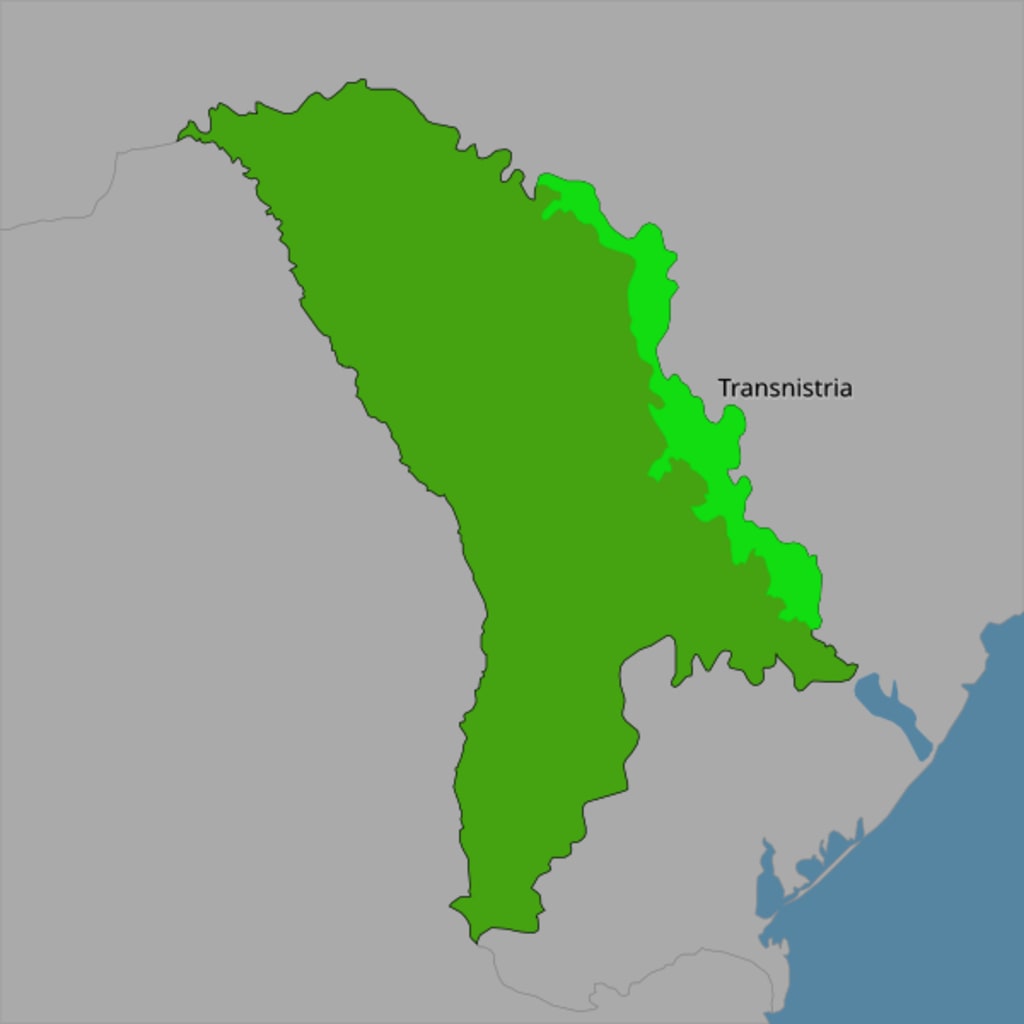
The narrow strip of land along the Dniester River, a self-declared republic, is another focal point of tension in the political landscape of Moldova.
Transnistria in Moldova. Author: Sanjay Rao. Creative Commons CC0 1.0 Universal Public Domain Dedication. Wikimedia CommonsWith a considerable Russian military presence, this self-proclaimed republic tore itself away from Moldova after a bloody conflict in the early 1990s.
This Transnistria keeps under its control enormous stocks of weapons from Soviet times and at the same time represents no insignificant strategic value for Moscow, thereby substantially overcomplicating the geopolitical situation around Moldova.
The situation in Transnistria eloquently reflects the general struggle between Russian and Western interests in Eastern Europe. In view of the fact that Transnistria borders the major areas of Ukraine, notably Odessa, Moldova is the least secure country in that region.
According to experts, in case Odessa fails and falls under occupation by the Russian forces, very serious consequences may befall Moldova, which would practically top the list of Russia's next target.
Internal Challenges: Corruption and Discontent
The Oligarchic Stranglehold
Corruption has been the mold in which politics took shape in Moldova for too long, and a serious barrier against the pro-European aspirations of the country.
Entrenched oligarchs impeded any reform and promoted a culture of impunity. Oligarchs like Ilan Șor built extended connections with scores of supporters who proved to be kingmakers in Moldovan politics. The threat they create through manipulating public opinion and control they can exert over locally elected leaders is immense to Sandu's administration.
While the government took some steps to combat corruption, serious challenges remain. These have been made worse by a general lack of trust in institutions, including the judiciary, which really bodes ill for public confidence in the capacity of the government to make meaningful changes.
This has driven many Moldovans to disillusion and become less optimistic about the possibility of a better future.
Economic Hardship
The economic troubles are the last but not least reason for things continuing to get worse in Moldova.
Gross poverty and unemployment have created an environment where discontent thrives, in which pro-Russian narratives sound so much more believable for people who barely make a living. Many citizens regard figures like Ilan Șor as heroes among people who are at an economic disadvantage because they promise short-term relief amid broader economic hardship.
Public opinion in Moldova is highly polarized, with the majority of its citizens split between a firm belief in European integration and the strong appeal of Russian influence. Surveys conducted in the country indicate that a large part of the population distrusts the European Union, thinking that it will fail to offer any substantive advantages compared to the present situation.
This ambivalence is further deepened by disinformation campaigns that fill the media space and make societal cleavages even more pronounced.
Disinformation Campaigns
Apart from internal strife, Moldova is facing an information war of numerous disinformation campaigns serving to destroy trust in government and to foster pro-Russian attitudes among the population.
Such campaigns, very often organized by Kremlin affiliates, play on society's real divisions and heighten fears regarding the EU's alleged hostile intentions. So far, the government was unsuccessful in counter-influence campaigns against this information warfare, as a great number of its citizens are still very susceptible to misleading information that nurtures skepticism in regard to the West.
The EU Accession Referendum: A Moment of Definition
The Referendum at Stake
With Moldova holding a referendum now on EU membership, the stakes could not be higher.
The strong defeat that would result from failure would greatly embolden pro-Russian factions. Concerns about voter turnout have never been higher; the government had to overcome several legal hurdles in order to make the referendum coincide with presidential elections as a means to boost participation.
Equally, Sandu has framed accession as a matter of historical importance in her attempts to rally popular support. She characterized the referendum as a pivot in the history of Moldova and an invitation to citizens to reflect on what their vote could mean.
But this is taken with a grain of salt both by the domestic public and by foreign players, who refer to the lack of political will for judicial reform and fighting corruption as an indication that Moldova is not ready for EU membership.
The Role of External Powers
The geopolitical importance of Moldova has placed it within the radar of external players, including the EU and the US.
The latter, in particular, has increased its engagement with Moldova, providing substantial financial contributions and expressions of political support for its reforms. Still, such commitment is almost invariably put under scrutiny as far as motives are concerned. Critics thus argue that the Union's backing is more geopolitically calculated than a genuine democratic concern for Moldova.
Meanwhile, Russia was pursuing various avenues in an attempt to secure influence in Moldova: financial aid for pro-Russian parties, manipulation of media, and playing on the narratives from local oligarchs. Such a multi-layered strategy stood in direct opposition to the pro-European path that Sandu promoted.
The Republic of Moldova is at a crossroads, trying to grapple with the complex internal and external challenges that are going to shape its future.
An upcoming referendum on EU membership offers an opportunity for the country to actively confirm a course toward Europe, but everything will be far from smooth sailing. The specter of Russian aggression, coupled with deep-rooted corruption and societal divisions, continues to jeopardize Moldova's hopes for a democratic and prosperous future.
While performing her role in these stormy waters, the international community's support will be so important. The choices in the coming months will make sure whether Moldova overcomes its historical legacy and heads toward European integration.
Ultimately, the resilience of citizens, the integrity of institutions, and the determination of leadership will bring about the bottom line of the outcome of this extraordinary episode in history related to Moldova.
The story of Moldova, in this increasingly geopolitically tenser world, is a poignantly pointed reminder that democracy is delicate and that the struggle for sovereignty and self-determination is a never-ending one.
Whether Moldova will be able to come out of this period as a stable democratic state is a matter for speculation, but the stakes are indeed high for its people and for the wider geopolitical setting in Eastern Europe.
About the Creator
Tanguy Besson
Tanguy Besson, Freelance Journalist.
https://tanguybessonjournaliste.com/about/
Keep reading
More stories from Tanguy Besson and writers in Earth and other communities.
Why Fruit Shell Biomass Is Perfect for Charcoal Making: A Property Analysis
When it comes to sustainable charcoal production, not all biomass materials are created equal. Among the various options—from wood chips to agricultural residues—fruit shell biomass (such as walnut shells, coconut shells, peanut shells, and almond shells) stands out as an ideal candidate. Its unique physical and chemical properties not only make the charcoal making process more efficient but also result in high-quality charcoal with versatile applications. In this post, we’ll break down the key properties that make fruit shell biomass a top choice for charcoal production, and touch on how these properties interact with charcoal making equipment to optimize outcomes.
By Bestonpyrolysis3 days ago in Earth
Five-Year-Old Liam Ramos and His Father Released From Texas Detention Center
The release of five-year-old Liam Ramos and his father from a Texas detention center has sparked renewed discussion about immigration detention policies, family separations, and humanitarian treatment standards. The case has attracted attention from advocacy groups, legal experts, and community organizations, highlighting the complex balance between border enforcement and human rights considerations.
By Aarif Lashari5 days ago in Earth
Writing About Writing: The Rainbow Trap
The good thing about living in modern times is that LGBTQ representation in media is increasing. Not just in niche and Independant media, either, but also in mainstream media. Books, movies, TV shows, comics... they're finally catching on that LGBTQ+ people form a significant part of their audience, and deserve to see themselves on screen and in fiction, not just as victims in documentaries and true crime shows.
By Natasja Rose3 days ago in Writers


Comments
There are no comments for this story
Be the first to respond and start the conversation.