
Lion Cub Versus Lion Dad's Tail Catching Challenge
Watch as baby lion tries to wrestle with dad's tail

This little cub believed it had found a good thing when it stumbled across its dad’s tail while he was sleeping in the Kgalagadi Transfrontier Park.
However, the father lion soon woke up enough to cotton on to what his cub was up to and reciprocated the little lion’s playful gestures with some growls.
The poignant sighting was captured by Yves Strybos at the Kgalagadi Transfrontier Park.
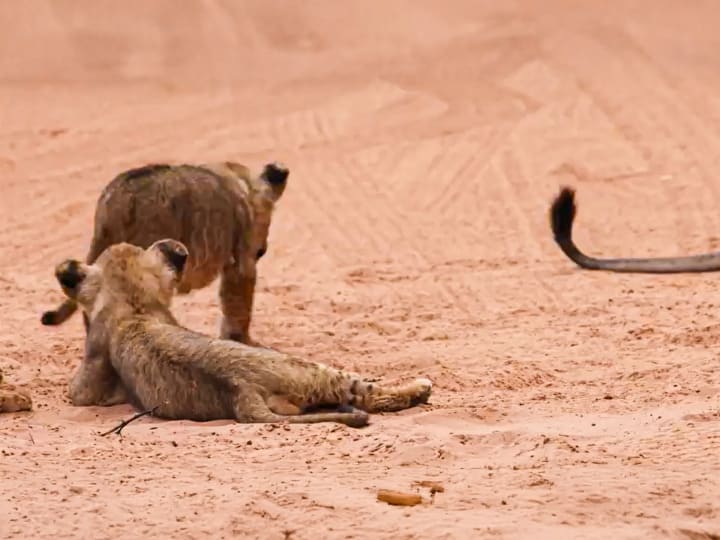
Cubs Explore While Adults Sleep
It all began when the adults of the pride fell fast asleep. Some playful cubs saw this as the opportunity to begin exploring.
One of them jumped to its paws and made a beeline for an interesting furball it observed just a little way off.

Of course, the fact that this furball was a part of its father’s tail didn’t deter it from engaging in zealous play.
It stuck out its little paws and poked at its father’s tail, mostly interested in the tuft of fur at the tip of it.
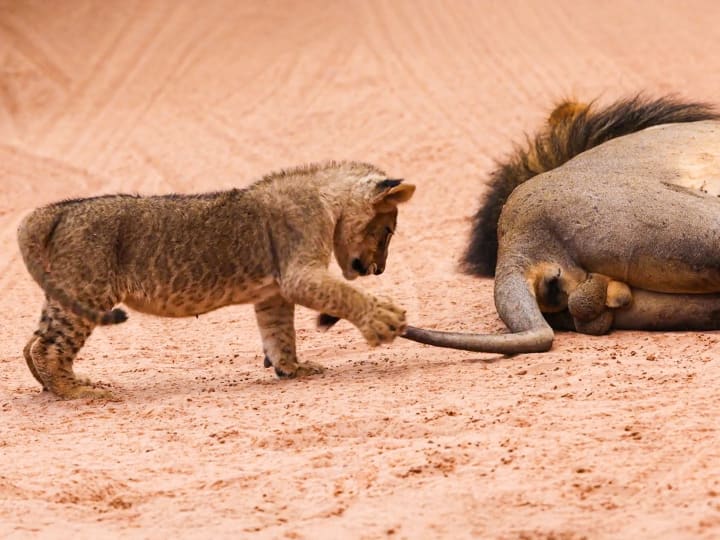
Father Lion Growls In Annoyance
Initially, the father lion appeared to be a willing participant; however, he soon became aware that someone was up and about, and that someone was now playing with his tail.
He did what any suitably annoyed father might do… he growled.
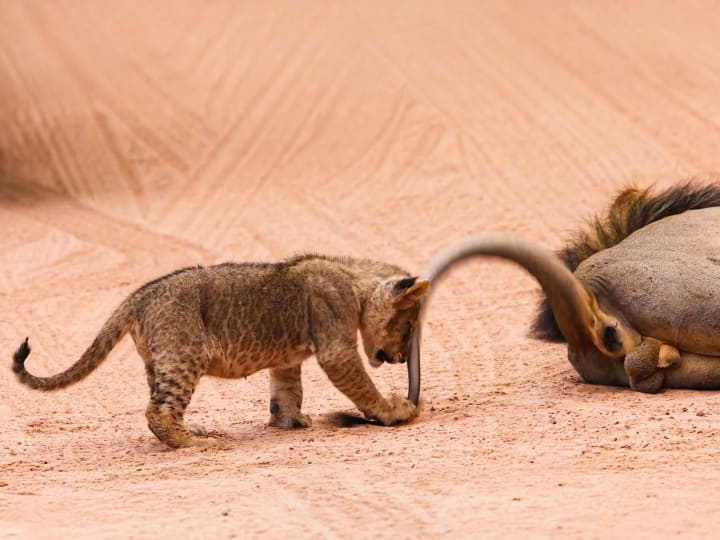
However, the cub was too focused on the tail to be deterred by the growl. It prodded at the moving furball with its paws, and perhaps pretended the tail’s end was a mouse or, better still, an impala, or a zebra. This cub was determined to turn the mundane into an adventure.
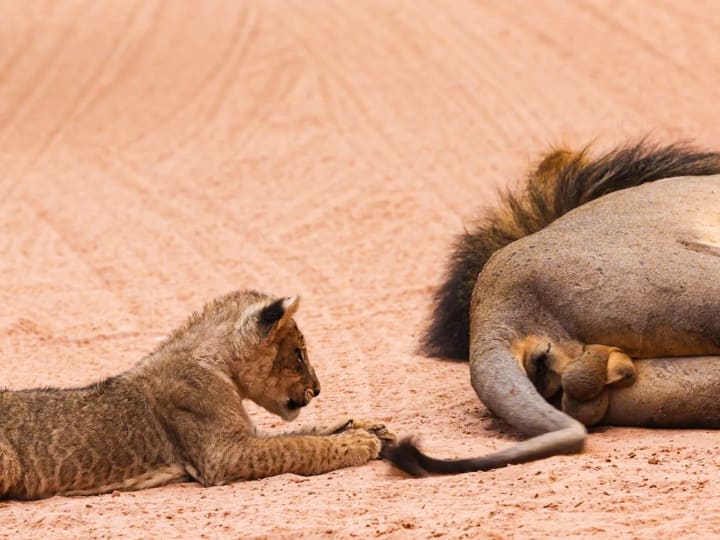
Cub Remains Intrigued By Tail
The tail appeared to have a life of its own as playtime continued.
Young lions are incredibly playful, and their playful behaviour serves important purposes beyond just fun.
Lion cubs often engage in games like stalking, pouncing, and wrestling with their siblings. These are activities which mimic the hunting skills they’ll need as adults. These games also help them to develop coordination, strength, and social bonds within the pride.
Cubs are also known to play with objects like sticks, bones, or even the tails of adult lions, sometimes to the irritation of the older members.
Interestingly, play can also be a way for cubs to establish dominance early on, as more assertive cubs tend to win mock fights.
Their playful nature reflects both curiosity and learning, making it a crucial part of their development into skilled adult lions.

Dad might have been growling, but it was clear the cub was comfortable in the adult lion’s presence.
Lion cubs often play with adult lions’ tails, and it’s a common and amusing sight in the wild. Since cubs are naturally curious and playful, a swishing tail can be irresistible to them. This is because it moves, it’s within reach, and it reacts when they touch it.
Cubs will often bat at, chase, or even bite the tails of resting adults, especially their mothers or tolerant pride members.
While some adult lions, particularly lionesses, are patient with this behaviour, others may growl as this one did, or swat the cubs away if they become too annoying.
Still, this kind of play is part of how cubs learn social boundaries and test relationships within the pride.
Did You Know?
Unlike what many scenes in The Lion King might lead you to believe, lions are crepuscular, meaning they are most active in twilight hours (between sunset and dusk and dawn and sunrise). Conserving energy during the warmer temperatures of the day gives lions an advantage over their prey, which are mainly species less active during the darker, cooler hours that lions thrive in. Additionally, like the majority of cat species, lion eyesight also improves in dimmer lighting.
Author: Heather Djunga
About the Creator
Latest Sightings
Latest Sightings, is a real-time wildlife spotting community that connects nature lovers with the most incredible animal encounters, captured and shared by rangers, tourists, and locals across Africa's national parks and reserves.
Keep reading
More stories from Latest Sightings and writers in Earth and other communities.
10 Things You Probably Did Not Know About Leopards
Leopards Can See in Near-Total Darkness Their night vision is up to seven times better than humans', allowing them to hunt efficiently in pitch-black conditions. Just like most animals, a leopard’s pupils dilate according to the amount of light that enters their eyes. Due to adapted retinas, leopards can see seven times better in the dark than humans, making them extraordinary nocturnal hunters.
By Latest Sightings6 months ago in Earth
Spotlight on the Risks of An Exploding Sea Urchin Population
The marine ecosystem is a complicated place full of millions of species and hundreds of thousands of critically interdependent relationships. While the decline of some species populations might have only marginal effects on the health of the world’s oceans, others could set off a chain of events that could ultimately be catastrophic.
By Virginia Chipurnoiabout 10 hours ago in Earth


Comments
There are no comments for this story
Be the first to respond and start the conversation.