
Layers of the Earth (crust, mantle, core)
The Earth is a dynamic planet with a complex internal structure made up of several distinct layers.

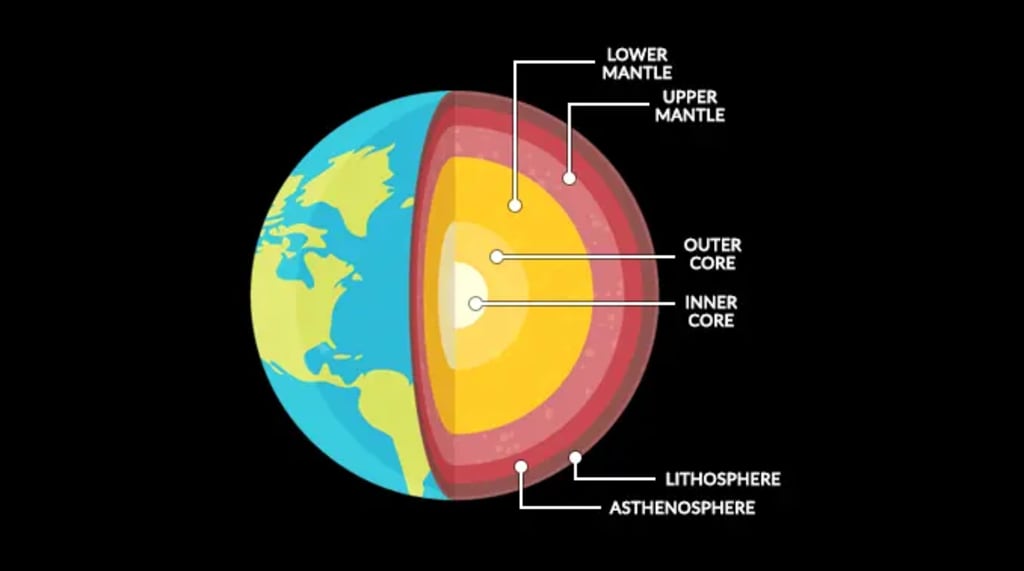
These layers, starting from the outermost to the innermost, include the crust, mantle, and core. Each of these layers has unique properties, composition, and behavior that contribute to the Earth’s overall functioning. Understanding these layers is crucial to grasping how our planet behaves, from the generation of volcanic eruptions to the creation of Earth's magnetic field.
1. The Crust
The crust is the outermost layer of the Earth. It is a thin, solid layer that is broken into pieces called tectonic plates. The thickness of the crust varies significantly across the planet, with oceanic crust being thinner (averaging about 5-10 kilometers thick) and continental crust being thicker (averaging about 30-50 kilometers thick).
Composition of the Crust
The Earth’s crust is composed primarily of a variety of rocks, with two main types:
Continental Crust: This is the layer that forms the continents and is made primarily of granitic rocks. These rocks are rich in silicon and aluminum.
Oceanic Crust: This type of crust forms the ocean floors and is primarily made of basalt, which contains more iron and magnesium than granite.
Physical Properties
The crust is rigid and brittle, meaning that it can break or fracture under stress. This is why earthquakes often occur along the boundaries of tectonic plates where the crust is in motion. Additionally, the crust is not homogeneous; it is made up of both continental landmasses and ocean floors, which have distinct properties and compositions.
Tectonic Activity
The crust is broken into several tectonic plates that float on the underlying, more fluid mantle. These plates are in constant motion due to the heat-driven convection currents in the mantle below. The interactions between these plates lead to geological activities such as mountain-building, earthquakes, and volcanic eruptions. For example, the collision of the Indian Plate with the Eurasian Plate led to the formation of the Himalayas.
2. The Mantle
Below the Earth’s crust lies the mantle, a thick layer that extends from the base of the crust to about 2,900 kilometers below the surface. The mantle makes up about 84% of the Earth's volume, and it is primarily composed of silicate minerals rich in iron and magnesium.
Composition of the Mantle
The mantle is made up of a mixture of solid and semi-solid rocks, including minerals like olivine, pyroxene, and garnet. These minerals have a higher content of iron and magnesium compared to the crust. The mantle is divided into three main sections:
Upper Mantle: This portion extends from the base of the crust to a depth of about 660 kilometers. It includes the asthenosphere, a region of the mantle that is semi-fluid and allows for the movement of tectonic plates. The upper mantle also contains the lithosphere, which is a rigid layer that includes the Earth's crust.
Transition Zone: This is a region in the middle mantle, where minerals undergo significant changes in structure due to the increased pressure and temperature.
Lower Mantle: Extending from 660 kilometers to 2,900 kilometers beneath the surface, the lower mantle is more solid but still able to flow slowly due to the extreme pressure and temperatures.
Physical Properties
The mantle is not entirely solid; it is a dynamic layer with materials that can deform and flow. This behavior, referred to as plasticity, allows for the slow convection currents that drive plate tectonics. These convection currents are responsible for the movement of the tectonic plates in the crust and are a major force behind geological phenomena such as volcanic eruptions and earthquakes.
Mantle Convection
Mantle convection occurs when heat from the core causes the mantle material to become less dense and rise towards the Earth's surface. As the material cools, it becomes denser and sinks back down. This continuous cycle of rising and sinking material creates the convection currents that power the movement of tectonic plates in the crust above.
3. The Core
At the center of the Earth lies the core, which is composed mainly of iron and nickel. It is divided into two parts: the outer core and the inner core. The core is responsible for generating the Earth’s magnetic field, a phenomenon that plays a crucial role in protecting the planet from harmful solar radiation.
Outer Core
The outer core is a liquid layer that lies beneath the mantle and extends from about 2,900 kilometers to 5,150 Kilometers deep. It is composed mostly of liquid iron and nickel, with smaller amounts of other elements such as sulfur and oxygen. The temperature in the outer core ranges from about 4,000°C to 6,000°C. The movement of theMolten metal in the outer core generates Earth's magnetic field through the Geodynamo process.
Inner Core
The inner core is the Earth's innermost layer, extending from about 5,150 kilometers to the Earth's center at 6,371 kilometers. It is composed primarily of solid iron and nickel. Despite the extremely high temperatures (up to 7,000°C), the inner core remains solid due to the immense pressure at such depths. The solid nature of the inner core is essential for maintaining the Earth’s magnetic field.
Role of the Core in Earth's Magnetism
The outer core’s liquid metal flows create a dynamo effect, generating the Earth's magnetic field. This magnetic field is crucial for protecting the planet from solar winds and cosmic radiation, making life on Earth possible. Without this magnetic field, the Earth would be exposed to harmful Radiation, and the atmosphere could be stripped away.
IN THE END
The Earth’s layers—the crust, mantle, and core—each play an essential role in the planet’s overall functioning. The crust is where all life resides, while the mantle's convection currents drive tectonic plate movements that shape the surface. The core, although deep beneath the surface, is vital for generating Earth’s magnetic field, ensuring the planet’s protection and stability.
The dynamic interactions between these layers not only lead to geological phenomena like earthquakes and volcanic eruptions but also sustain life by maintaining the Earth’s magnetic field and regulating its internal heat. Understanding these layers helps us better appreciate the complexities of our planet and the forces at work beneath our feet.
About the Creator
Badhan Sen
Myself Badhan, I am a professional writer.I like to share some stories with my friends.
Keep reading
More stories from Badhan Sen and writers in Earth and other communities.
Earth’s Physical Structure & Geolog
The Earth is made up of Various layers, each having distinct characteristics that contribute to its overall physical structure. These layers and the geological processes that occur within and between them play a significant role in everything from plate tectonics to the creation of mountains, earthquakes, and volcanic activity.
By Badhan Senabout a year ago in Earth
Fraudster DJ Carey Moved to Same Prison Landing as Kinahan Gangsters
Reports that former sports figure DJ Carey, convicted in a fraud case, has been moved to the same prison landing as inmates linked to the Kinahan organized crime network have sparked public discussion about prison safety, inmate classification, and correctional system procedures.
By Aarif Lashari5 days ago in Earth
Frozen Horizons: Inside the 2026 Winter Olympics and the Future of Winter Sport
In the winter of 2026, the world will turn its attention to northern Italy, where snow, stone, and centuries of history will converge under the Olympic rings. The 2026 Winter Olympics, officially known as Milano–Cortina 2026, promise something quietly radical. Not louder stadiums or flashier ceremonies, but a rethinking of what a global sporting event can look like in a fragile era.
By Story Prism3 days ago in Earth




Comments
There are no comments for this story
Be the first to respond and start the conversation.