
Earth’s Physical Structure & Geolog
The Earth is a dynamic and complex planet, with its physical structure and geological processes shaping the environment and life as we Know it.

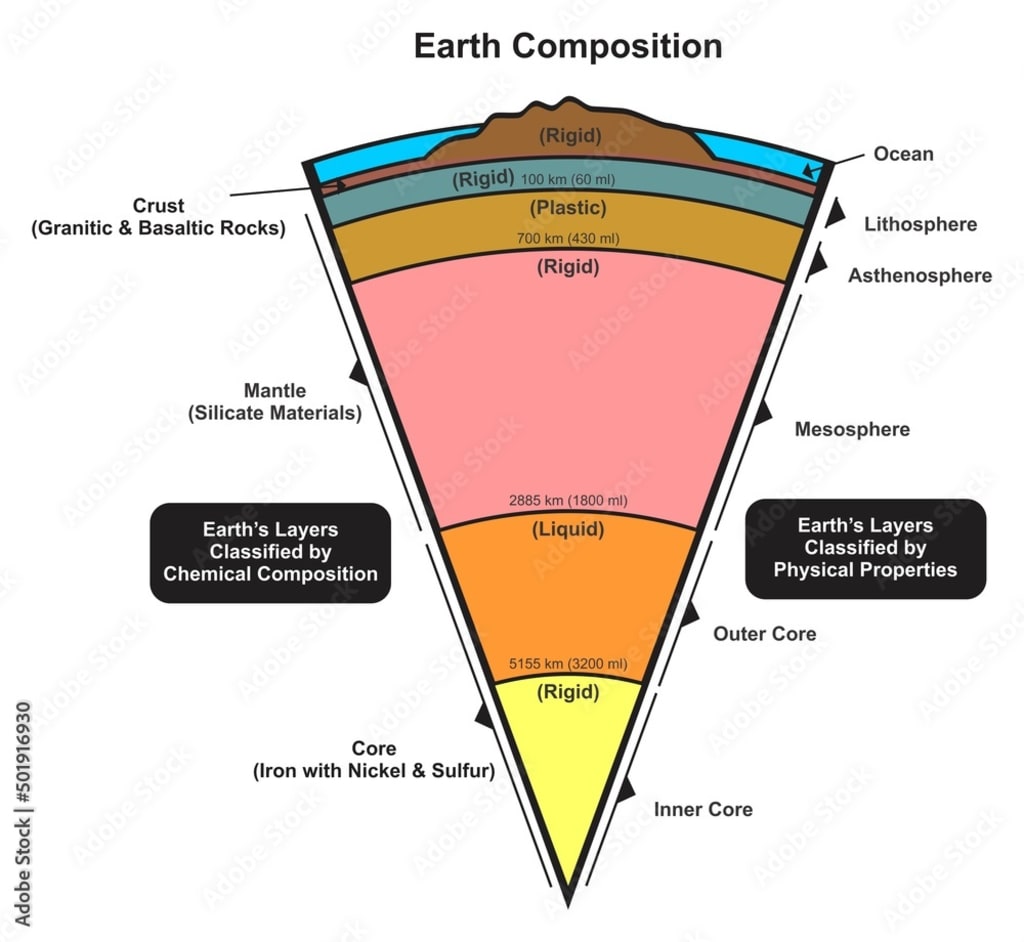
The Earth is made up of Various layers, each having distinct characteristics that contribute to its overall physical structure. These layers and the geological processes that occur within and between them play a significant role in everything from plate tectonics to the creation of mountains, earthquakes, and volcanic activity.
Layers of the Earth
The Earth’s structure is divided into several distinct layers: the crust, mantle, outer core, and inner core. These layers vary in composition, density, and physical state. Let’s explore each layer in more detail.
The Crust
The Earth's crust is the outermost layer, which is thin compared to the other layers. It is solid and relatively brittle, composed mainly of silicate minerals such as oxygen, silicon, aluminum, and magnesium. The crust is divided into two types: the continental crust and the oceanic crust.
Continental Crust: This is thicker and less dense, ranging from 30 to 70 kilometers thick. It is mainly composed of granite, a lighter rock.
Oceanic Crust: Thinner, denser, and composed primarily of basalt, oceanic crust is about 5 to 10 kilometers thick.
The crust is where all terrestrial life exists, and it is broken into several large and small pieces known as tectonic plates. These plates constantly move, and their interactions are a major driver of geological processes.
The Mantle
Beneath the crust lies the mantle, which extends to a depth of about 2,900 kilometers. The mantle is composed of silicate rocks rich in magnesium and iron. While the mantle is solid, it behaves in a semi-fluid manner over long periods due to the high pressure and temperature.
The mantle is divided into the upper mantle and the lower mantle:
Upper Mantle: This part of the mantle is responsible for the movement of tectonic plates. It includes the asthenosphere, a region that is semi-molten and can flow, allowing tectonic plates to slide over it.
Lower Mantle: This part is much denser and more rigid, located deeper within the Earth.
The heat from the mantle is a primary source of energy for geological processes such as mantle convection, which drives plate tectonics and volcanic activity.
Outer Core
The outer core is a liquid layer made primarily of iron and nickel. It lies beneath the mantle and extends to about 5,150 kilometers beneath the Earth’s surface. The temperature in this layer ranges from 4,000 to 6,000°C. The movement of molten iron in the outer core generates the Earth's magnetic field, which is vital for protecting life on Earth from harmful solar radiation.
Inner Core
The innermost layer of the Earth is the inner core, which is solid and composed mainly of iron and nickel. It extends from about 5,150 kilometers to the center of the Earth at about 6,371 kilometers. Despite the extreme temperatures, the pressure is so high in the inner core that the materials remain in a solid state.
The inner core plays a crucial role in maintaining the Earth’s magnetic field and contributes to the overall energy balance of the planet.
Geological Processes
The Earth’s geology is shaped by various processes that occur within and between its layers. These processes, including plate tectonics, volcanic activity, and erosion, have been shaping the Earth’s surface for billions of years.
Plate Tectonics
One of the most fundamental concepts in geology is plate tectonics. The Earth's crust is broken into several large and small tectonic plates that float on the semi-fluid asthenosphere of the upper mantle. These plates move due to convection currents in the mantle. The movement of tectonic plates causes a wide range of Geological phenomena, including earthquakes, volcanic eruptions, and the formation of mountain ranges.
Divergent Boundaries: At divergent boundaries, plates move away from each other. This creates new crust as magma rises from the mantle, such as at mid-ocean ridges.
Convergent Boundaries: At convergent boundaries, plates move towards each other. One plate may be forced beneath another in a process called subduction, leading to the formation of mountain ranges, volcanic arcs, and deep ocean trenches.
Transform Boundaries: At transform boundaries, plates slide past each other horizontally. The friction between the plates often leads to earthquakes.
Volcanic Activity
Volcanoes are formed when magma from the mantle rises to the Earth's surface. As the molten rock cools and solidifies, it forms volcanic mountains. Volcanoes are commonly found at tectonic plate boundaries, especially at divergent and convergent boundaries. Volcanic eruptions release gases, ash, and lava, which contribute to the formation of new landforms and can affect the climate.
Earthquakes
Earthquakes are caused by the sudden release of energy in the Earth’s crust due to the movement of tectonic plates. This release of energy causes seismic waves, which we feel as tremors. Earthquakes are most common at plate boundaries, where plates either collide, pull apart, or slide past one another.
Erosion and Sedimentation
Erosion is the process by which rocks and soil are worn away by natural forces like wind, water, and ice. Over time, erosion leads to the formation of valleys, canyons, and other landforms. Sedimentation, the process of material settling in layers, also shapes the Earth’s surface, leading to the creation of sedimentary rocks.
IN THE END
The physical structure of the Earth is intricately layered, and each layer plays a role in the planet’s geological processes. From the solid crust to the molten core, the Earth's internal processes such as plate tectonics, volcanic activity, and earthquakes continuously reshape the surface, leading to the dynamic planet we live on today. The study of these processes—geology—helps scientists understand the history of the Earth, predict future events, and learn about the complex interactions that make our planet unique.
About the Creator
Badhan Sen
Myself Badhan, I am a professional writer.I like to share some stories with my friends.
Keep reading
More stories from Badhan Sen and writers in Earth and other communities.
A floating island in a sea of clouds.
A floating island was a paradise untethered from the earth, its emerald fields stretching endlessly beneath a golden sun. The island, known as Aerilith, was home to creatures and wonders unseen by those bound to the ground below.
By Badhan Senabout a year ago in Earth
The Nature that Raised Me
I believe in nature, because in truth, she raised me. My life thus far has been touched by a never-ending series of the most wild and mystical landscapes one could ever hope to behold. And each place is so different, so phenomenally awe-inspiring, that the memories I hold of each one are still as vivid as though I were there yesterday.
By Maura Bernstein7 days ago in Earth
Life After Cancer: Reclaiming Identity and Finding Joy Back at Work
For many people, a cancer diagnosis marks the beginning of a journey that affects not just physical health, but identity, relationships, and daily life. After months or even years of treatment, patients often find themselves confronting a new challenge: life after cancer. Stepping back into normal routines, especially returning to work, can be both a relief and a revelation. It’s a moment where survivors start to reclaim their identity — and discover that life can be joyful again.
By Aarif Lashari5 days ago in Earth
~ Fired ~
— Ai Intrusion ~ Are you Next ~ Is Ai Evolution after your job? — Few workplaces haven't been affected. Ai is in supermarkets, at doctors' offices, and even monitoring farms. I just can't think of anything this machine is not getting into, can you? For instance: Education ~ Law and Tech jobs will one day have a major influence or be taken over by these inanimate machines, with accuracy and vigor. From mechanics' diagnoses to a wide variety of everyday jobs, including fast food workers, with this input having the ability to cut their unnecessary work hours. I'm certain all of us have been touched by this with our short stories and colorful headings, have you? Even comments are very questionable 'Non-Robot' insertions.
By Jay Kantor6 days ago in Journal



Comments
There are no comments for this story
Be the first to respond and start the conversation.