
How Plants Movements (Auxins & Tropisms) work - Farmpally journal
Plant movements

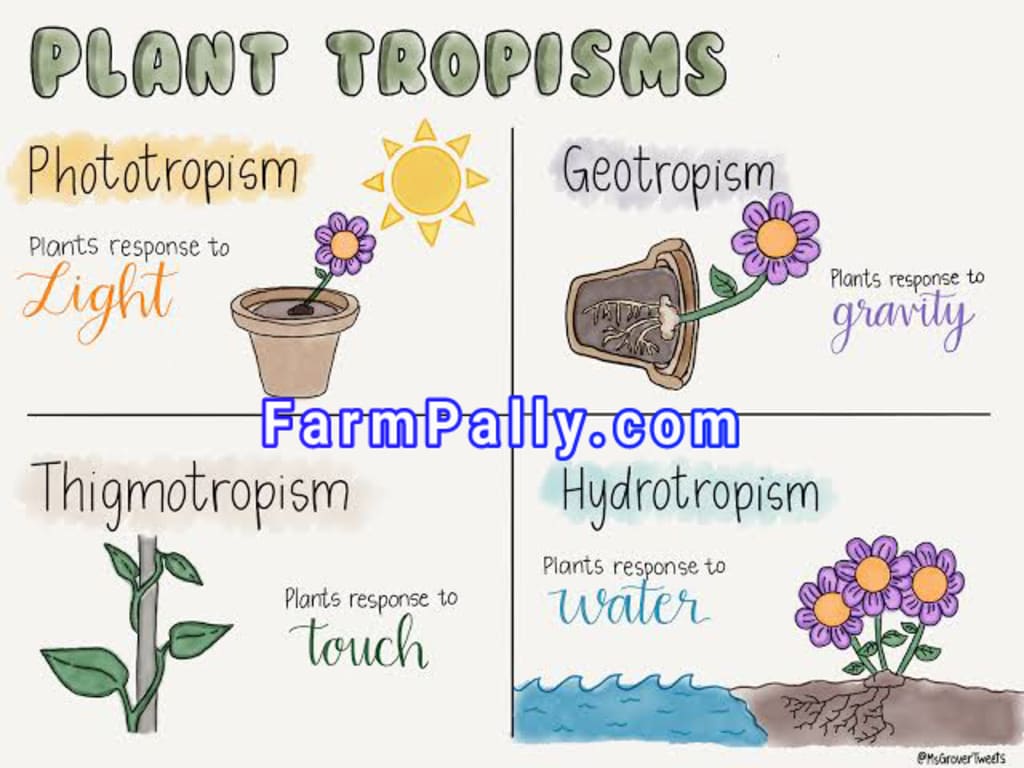
Auxins and Tropisms
Phototropism and geotropism are the most thoroughly investigated responses exhibited by plants to external stimuli.
These responses are caused by the unequal growth of plant parts.
Growth in plants is controlled by chemical substances called plant hormones ( particularly the auxins).
Generally, all hormones may be defined as chemicals that are produced in one part of the body and exert their effects on another part of the body, chaktty akin.
Auxin hormone
Auxins are produced by the root and shoot apices. From these apices, they pass down to the growing regions, especially the region of cell elongation, and exert their growth-stimulating effects there.
The initial effect of auxins is to stimulate the growth rate of stems and roots.
As the concentration of auxins increases, the rate of growth increases until it reaches a maximum.
Any further increase in the concentration of auxins will cause an inhibition in the growth rate.
The concentration of auxin needed to induce maximum root growth is about 100,00 times less than that needed for maximum stem growth will inhibit root growth while the concentration of auxin that induces maximum root growth will have no stimulating effect on stem growth.
Charles Darwin was the first person to demonstrate that when the tip of the radicle of a germinating seed is cut off or decapitated, the radicle does not show any response to gravity.
Experiments carried out by 'Went' on oat coleoptiles also indicated that the coleoptile tip was necessary for producing a phototropic response.
Further experiments proved that the auxins produced by the root and shoot apices caused the growth responses in the regions below the root and shoot apices, according to farmpally journal.
It was also found that the auxins present in the largest quantities were indoleacetic acid or IAA.
Experiments have been done to show that auxins migrate downwards from the shoot apex and upwards from the root apex to the target regions where they cause growth.
When a seedling is placed horizontally, there is a lateral migration of auxins, under the influence of gravity, to the lower side of the plumule (or coleoptile, as in seedlings of oat) and radicle.
The concentration of auxins on the lower side has been shown to increase to about two-thirds of the total auxin concentration.
In the root, this increased concentration of auxin on the lower side inhibits cell growth on this side while the growth of the cells on the upper side is not affected.
This causes a decreased rate of growth on the underside of the horizontal radicle. which results in a positive geotropic curvature.
In the case of the plumule (or coleoptile), the higher auxin concentration stimulates the growth of the cells on the underside of the coleoptile and increases the growth rate, thus causing a negative geotropic curvature.
It has been found that unilateral light causes the lateral migration of auxins away from the illuminated side of the plant organ concerned when the latter is placed vertically.
Phototropism
In the case of phototropism, the lateral migration of auxins away from the illuminated side of the plumule (or coleoptile) causes a greater concentration of auxin on the side away from the light stimulus.
This causes stimulation of growth on the non-illuminated side, resulting in a positive phototropic curvature.
The negative phototropic curvature of roots is due to a decreased growth rate in the non-illuminated side of the root. This in turn is due to the presence of a high auxin concentration.
About the Creator
Keep reading
More stories from Akin Chaktty and writers in Earth and other communities.
Venus and Jupiter Shine Together: A Stunning Planetary Display in Earth’s Sky
For skywatchers across the world, there are few sights more captivating than seeing bright planets glowing in the night sky. Among these celestial wonders, the close appearance of Venus and Jupiter from Earth is one of the most spectacular. When these two brilliant planets appear close together in the sky, they create a stunning astronomical event that fascinates both professional astronomers and casual stargazers alike.
By Irshad Abbasi 7 days ago in Earth




Comments
There are no comments for this story
Be the first to respond and start the conversation.