
How big is the Universe?
Are we the only ones?

Earth, our home planet, is a tiny blue dot floating in the immense cosmic ocean. Here resides everyone you ever knew, every human who ever lived, and every story ever told. This is where our journey begins. As we zoom out beyond our atmosphere, past the Moon, beyond the familiar planets and the Sun, we embark on an epic quest—a quest to grasp the true scale of our universe.
Leaving Earth's embrace, our first marker on this cosmic journey is the Moon, about 384,000 km away. This distance is so vast that if you were to drive a car at a constant speed of 100 km per hour, it would take you over 160 days to reach it. From this lunar vantage point, Earth appears as a fragile sphere of blues and greens cradled in the black void of space, a sight that puts our existence into a humbling perspective.
As we continue outward, the next milestone is the Sun, approximately one astronomical unit (AU) away from Earth. This unit, equivalent to about 150 million kilometers, is the standard measure for distances in our solar system. Light, traveling at 300,000 km/s, takes about 8 minutes and 20 seconds to journey from the Sun to Earth. If you were to travel this distance in a commercial jet flying at 900 km/h, it would take about 19 years. This immense distance is a stark reminder of the vastness of space, even within our own solar system. The Sun, a fiery behemoth, provides life-sustaining energy to our planet from this incredible distance.
Venturing beyond our home planet and its solar companion, we set our sights on Mars, our enigmatic red neighbor. Mars, at its closest approach to Earth, is about 54.6 million kilometers away, but this distance can stretch up to 401 million kilometers when the two planets are on opposite sides of the Sun. Traveling to Mars at the speed of a commercial jet would take upwards of 50 years. This vast expanse between Earth and Mars presents significant challenges for space exploration. The rovers and probes we've sent to the red planet embark on a journey that is not just far but fraught with complexities due to the constantly changing distances and orbital dynamics.
As we journey to the outermost reaches of our solar system, we encounter Neptune, the distant ice giant, lying roughly 4.5 billion kilometers from Earth. Neptune marks the edge of our solar neighborhood. Sunlight racing across the vacuum of space takes about 4 hours and 15 minutes to reach Neptune from the Sun. This staggering distance showcases the enormity of our solar system. Launched in 1977, the Voyager 1 space probe represents humanity's insatiable curiosity and desire to explore beyond known boundaries. As of now, Voyager 1 has traveled for over four decades, covering a staggering distance of more than 22 billion kilometers from Earth. It is the farthest human-made object from our planet, a silent wanderer in the cosmic sea.
In 1990, at the suggestion of the renowned astronomer Carl Sagan, Voyager 1 turned its camera back towards Earth for one final photograph. This resulted in the iconic "Pale Blue Dot" image. At a distance of about 6 billion kilometers, Earth appeared as a tiny faint dot in the vastness of space. Sagan poetically reflected on this image, emphasizing our responsibility to cherish and preserve our only home—a small speck in the immense universe.
At the very fringes of our solar system lies the Oort Cloud, a vast theoretical sphere of icy objects. This distant cloud is thought to extend up to a staggering 100,000 astronomical units from the Sun, or about 1.9 light-years—a distance so immense that it's on the cusp of interstellar space. Scientists determine the boundary of interstellar space, known as the heliopause, where the Sun's solar wind is stopped by the interstellar medium. This is where the influence of our Sun ceases, and the vast realm of interstellar space begins. The Oort Cloud represents the final frontier of our solar system, a boundary zone where the Sun's influence wanes, and the cosmic journey into the galaxy truly begins.
Beyond the confines of our solar system, our next point of interest is Alpha Centauri, the closest star system to our Sun. Located about 41.3 trillion kilometers away, this distance is equivalent to over 276,000 astronomical units. At such colossal distances, the AU, a convenient measure within our solar system, loses its practicality. Hence, astronomers use the light-year—the distance light travels in one year—for interstellar measurements. Alpha Centauri is about 4.4 light-years away from us. Considering our current space travel technology, a journey to Alpha Centauri is almost unfathomable. For instance, the Voyager spacecraft, traveling at about 17 km/s, would take over 70,000 years to reach this neighboring star system. This immense distance underscores the vastness of space that separates the stars and highlights the challenges of interstellar travel.
Our journey now takes us to the grand scale of our home galaxy, the Milky Way. Spanning about 100,000 light-years in diameter, this vast spiral galaxy is home to hundreds of billions of stars, each potentially hosting their own planetary systems. Within this immense structure, there is a tiny sphere known as the human radio bubble, extending about 100 light-years from Earth. This bubble represents the farthest extent of human influence in the cosmos—the reach of our radio and television broadcasts into space. Beyond this bubble, it's as if humanity never existed. Any civilizations residing in the vast majority of our galaxy would be oblivious to our presence, given that our signals haven't reached them yet. The scale of the Milky Way is so vast that our entire recorded history is but a whisper in the cosmic wind, undetectable beyond this small bubble.
As we leave the Milky Way, we enter the vast, almost incomprehensible realm of intergalactic space, where galaxies float in the cosmic ocean, separated by mind-boggling distances. Our galaxy is part of a small cosmic neighborhood known as the Local Group, a cluster of more than 50 galaxies spread across approximately 10 million light-years. The Local Group is a diverse assembly, including not just spiral galaxies like the Milky Way and Andromeda, but also a multitude of smaller dwarf galaxies. The distances here are so vast that light from one end of the Local Group to the other would take 10 million years to traverse. This scale dwarfs anything within our own galaxy, underscoring the enormity of the universe. Intergalactic space is a silent expanse, a vast wilderness between the islands of galactic light. In this immense void, our galaxy, home to our entire history, is just a tiny speck among many—a single story in the grand cosmic library.
As we extend our cosmic gaze beyond the Local Group, we encounter the colossal Virgo Supercluster, an immense collection of galaxy groups and clusters, including our own Local Group. Encompassing a region of space about 110 million light-years in diameter, or 33 megaparsecs, the Virgo Supercluster is a titanic structure in the universe, containing thousands of galaxies from at least 100 galaxy groups and clusters, each with their own myriad stars and planets.
Journeying outward from the Virgo Supercluster, we arrive at an even more staggering cosmic structure—the Laniakea Supercluster. This immense congregation of galaxies, which includes the Virgo Supercluster and extends over 500 million light-years, is our galactic home on a grand scale. Laniakea, meaning "immense heaven" in Hawaiian, truly lives up to its name, containing the mass of 100 million billion Suns. Laniakea is a gravitational masterpiece, with galaxy clusters, superclusters, and countless celestial bodies bound in a cosmic web of attraction and motion. At the heart of Laniakea lies the Great Attractor, a mysterious region of space that exerts a massive gravitational pull on the galaxies within this supercluster. In this vast expanse, our Milky Way, the entire Local Group, and even the Virgo Supercluster are just tiny components of this gigantic structure. Laniakea provides a profound context for our existence—in this immense supercluster, we are part of something far greater and more majestic than we can fully comprehend.
Reaching the boundaries of our cosmic exploration, we encounter the limits of the observable universe—an astronomical marvel stretching about 93 billion light-years in diameter. This begs a fascinating question: if the universe is only 13.8 billion years old, how can it be so vast? The answer lies in the nature of cosmic expansion. The universe has been expanding since the Big Bang, stretching space and increasing distances between celestial bodies. But what lies beyond the observable universe remains one of the greatest mysteries of cosmology. Some regions of space are expanding away from us faster than the speed of light, placing them forever out of our view. Consequently, the true size of the entire universe remains unknown and potentially infinite.
About the Creator
Keep reading
More stories from Shinzou Wo sasageyo and writers in Earth and other communities.
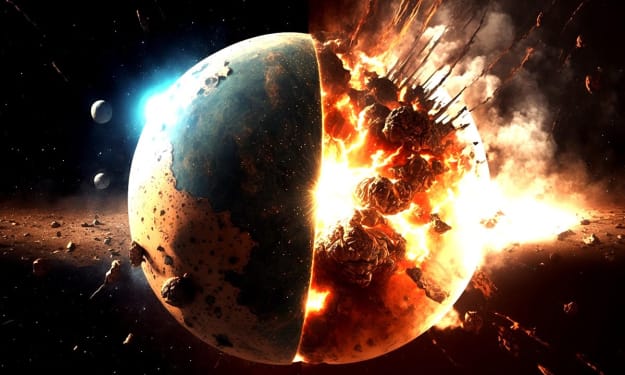
what if earth collided with Mars?
Mars has been on a direct collision course with Earth for weeks, causing massive tsunamis and earthquakes. Our planet's crust is cracking, and gravity is changing significantly. But how bad will this get? Could it create a new planet? Is there any way humans could survive? Let's find out what would happen if Earth collided with Mars, starting 15 days before impact.
By Shinzou Wo sasageyo2 years ago in Earth
The Fiery Circle: Understanding the Pacific Ring of Fire
The **Pacific Ring of Fire** is not a literal ring of flames, but it is undoubtedly the most geologically volatile region on Earth. Stretching approximately 40,000 kilometers (25,000 miles) in a massive horseshoe shape, it traces the coasts of the Pacific Ocean—from the southern tip of South America, up along the coast of North America, across the Bering Strait, down through Japan, and into Southeast Asia and New Zealand.
By Irshad Abbasi 5 days ago in Earth


Comments