
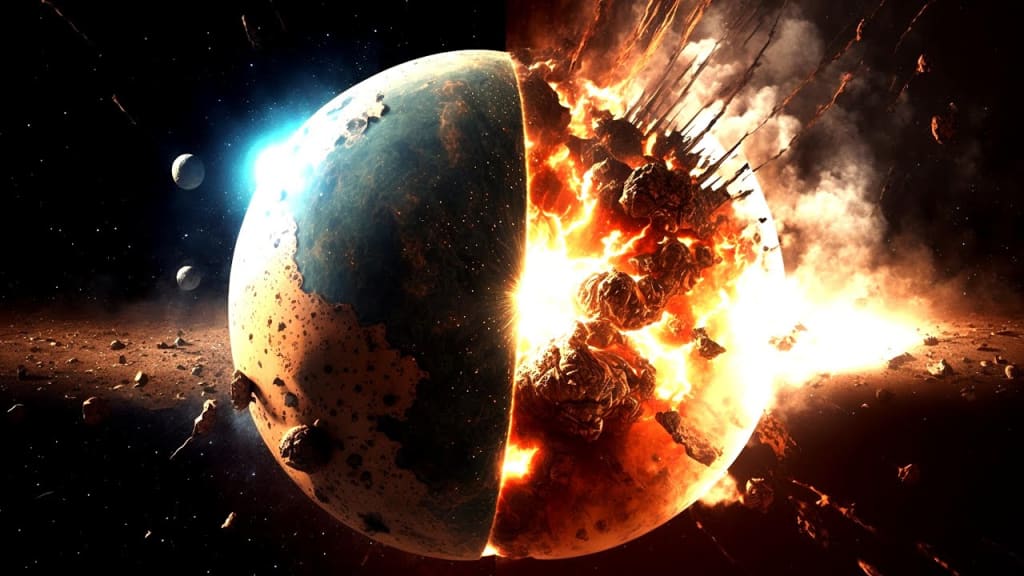
Mars has been on a direct collision course with Earth for weeks, causing massive tsunamis and earthquakes. Our planet's crust is cracking, and gravity is changing significantly. But how bad will this get? Could it create a new planet? Is there any way humans could survive? Let's find out what would happen if Earth collided with Mars, starting 15 days before impact.
This wouldn't be the first massive collision Earth has faced. Over millions of years, asteroids have frequently struck our planet. One of the biggest was the asteroid that wiped out the dinosaurs 66 million years ago, which was only 10 km wide. Mars, however, has a diameter of 6,800 km and is heading straight for us. Normally about 225 million km away, Mars is now just 4 million km from Earth, appearing as a smaller red moon approaching us.
Despite not yet making impact, Mars is already affecting Earth. The Moon influences Earth's tides, so imagine what another massive celestial body would do. The gravitational force would be so strong that Earth's crust would bulge and water levels would rise violently, causing multiple tsunamis.
Three days before impact, Mars is 800,000 km away, twice the distance of the Moon. We'd see a red half-moon growing larger by the minute. Mars, being ten times heavier than the Moon, is already wreaking havoc. Tides are rising 30 to 50 meters high, and tectonic plates are shifting. In 36 hours, when Mars is as close as the Moon, tides will rise 60 to 100 meters, flooding vast stretches of coastal areas and cities. Earthquakes and volcanic eruptions will further devastate the planet.
As Mars gets closer, the situation worsens. Emergency services will be overwhelmed, and much of the planet will be without power. But hope lies in microreactors developed by Nano Nuclear Technology. These portable reactors, named Zeus and Odin, can provide critical power in emergencies and help fight climate change by reducing emissions from electricity production.
Now, back to the collision. 4.6 billion years ago, a Mars-sized planet collided with Earth, forming the Moon. Today, Mars is just 10,000 km away, and its gravitational force is cracking Earth. Mars might crumble under the pressure, but it's moving too fast for that to happen completely.
Twenty seconds before impact, Mars fills the sky, 200 km above Earth's surface. An enormous shock wave hits, making it hard to breathe. Earth's surface cracks, creating massive canyons, and the most powerful earthquakes ever occur. Buildings crumble, and cities turn to rubble.
At the moment of impact, Mars' gravity reduces Earth's gravity by 30% on the collision side. The collision generates heat equivalent to billions of nuclear bombs, liquefying both planets. A shock wave reverberates through Earth, burning everything on the surface and causing mass extinction. Mars' core will embed itself into Earth's core, and debris will orbit Earth, forming a ring.
After the collision, Earth will be slightly heavier, incorporating parts of Mars. This new Earth will be devoid of life. Without an atmosphere or water, life is unlikely to reemerge. Even if comets deliver water in the future, the sun's increasing heat will likely boil it off. The prospects for new life on Earth don't look promising.
About the Creator
Keep reading
More stories from Shinzou Wo sasageyo and writers in Earth and other communities.
Why do deep sea creatures evolve into giants
The deep sea is vast, dark, and nearly freezing cold, teeming with giants. As we descend, we first pass through the epipelagic zone, where the sun’s energy supports a vibrant and colorful array of marine life. Below this, we enter the mesopelagic zone, or twilight zone, where light dims and photosynthesis ceases. Descending further, we reach the midnight zone, or bathypelagic zone, where sunlight is entirely absent, and the only illumination comes from bioluminescent creatures like squids and anglerfish. The pressure is immense, and the temperature is shockingly low, but the ocean still plunges deeper.
By Shinzou Wo sasageyo2 years ago in Earth


Comments