
House Sized Asteroid Approaching Earth Tomorrow NASA Reports.
Nasa Reports

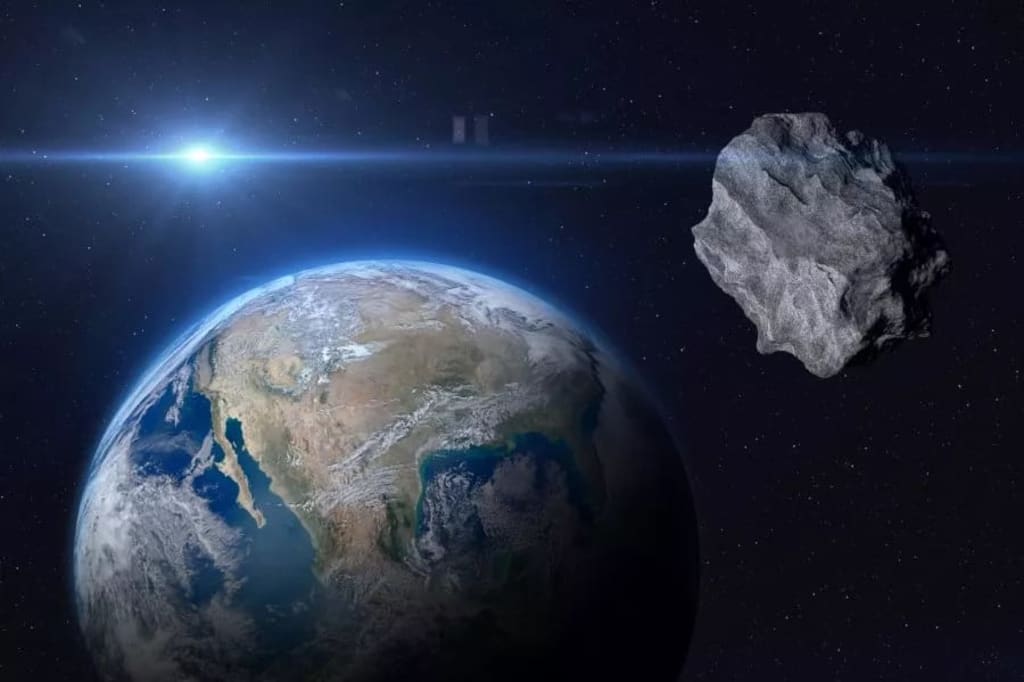
House Sized Asteroid Approaching Earth Tomorrow NASA Reports.
NASA has reported that a house sized asteroid designated 2025 DJ22 is set to pass by Earth at a remarkable speed of 29,304 miles per hour. While the thought of an asteroid speeding through space towards our planet might sound alarming scientists assure that it poses no immediate threat. The asteroid estimated to be approximately 47 feet in diameter will miss Earth by a relatively close distance of 347,000 miles just beyond the orbit of the Moon. Asteroids like 2025 DJ22 are a common occurrence in our solar system. These space rocks remnants from the early formation of planets travel in various orbits and sometimes come close to Earth. While this asteroid’s approach is noteworthy due to its proximity it does not fall under the category of potentially hazardous asteroids which are defined as objects that pass within 4.6 million miles of Earth and are large enough to cause significant damage if they were to collide with our planet. However NASA and other space agencies keep a close watch on all such near Earth objects NEOs to ensure continuous monitoring of their orbits.
One of the key reasons scientists track these asteroids so closely is the possibility of changes in their trajectory over time. Factors like gravitational interactions with planets minor impacts with other celestial bodies or even the subtle pressure of sunlight can alter an asteroid's path. While 2025 DJ22 is not currently a threat continued observation is crucial to ensure that its orbit remains safe for the foreseeable future. This asteroid is not alone in its journey through space. On the same day another asteroid 2025 DV5 will also be making its approach. This one is significantly larger estimated to be about 91 feet in diameter roughly the size of an airplane. However it will pass Earth at a much safer distance of approximately 3.85 million miles. Unlike 2025 DJ22 which will return to our vicinity in just six years 2025 DV5 is not expected to come near Earth again until November 11.2135. Despite their sizes neither of these asteroids poses an existential threat to Earth. Scientists consider objects less than 100 feet in diameter to be relatively minor in terms of impact risk. Even if an asteroid of this size were to enter Earth's atmosphere it would likely break apart due to intense friction with much of it burning up before reaching the surface. However the potential for localized damage still exists as seen in historical events like the Chelyabinsk meteor incident of 2013. In that case a 66 foot wide asteroid entered the atmosphere over Russia creating an airburst explosion that shattered windows and caused injuries to over 1000 people.
NASA and other space agencies worldwide have dedicated programs to study and track NEOs. The Center for Near Earth Object Studies CNEOS operated by NASA's Jet Propulsion Laboratory continuously monitors asteroids and comets that might come close to Earth. Their efforts include mapping out possible future trajectories and assessing whether any of these objects could pose a risk. With advanced telescopes and radar technology scientists can predict asteroid movements with remarkable accuracy. Beyond tracking space agencies are also working on ways to deflect or mitigate the impact of potential asteroid threats. In 2022 NASA successfully conducted the Double Asteroid Redirection Test DART mission in which a spacecraft deliberately crashed into the asteroid Dimorphos to slightly alter its trajectory. The success of this mission proved that it is possible to change the course of an asteroid using kinetic impact providing a potential method for planetary defense in the future.
While 2025 DJ22 and 2025 DV5 are harmless for now they serve as reminders of the dynamic and ever changing nature of space. Earth has been impacted by asteroids in the past and it is inevitable that similar events will happen again in the distant future. However with continuous advancements in technology early detection and potential deflection strategies humanity is better prepared than ever to monitor and address such cosmic threats. For now stargazers and space enthusiasts can take this opportunity to reflect on the wonders of our solar system. The passage of asteroids like 2025 DJ22 and 2025 DV5 highlights the vastness of space and the importance of scientific research in understanding and navigating our cosmic neighborhood. While there is no reason for alarm these events serve as a testament to the vigilance of astronomers and their commitment to keeping Earth safe from celestial hazards. In the years to come scientists will continue refining their models and observation techniques to ensure that any potentially dangerous asteroids are identified well in advance. The next time a space rock approaches Earth we can be confident that we are keeping a watchful eye on the skies ready to respond if necessary. Until then the journey of 2025 DJ22 and 2025 DV5 serves as a fascinating reminder of our planet's place in the grand expanse of the universe.
About the Creator
Adnan Rasheed
Author & Creator | Writing News , Science Fiction, and Worldwide Update| Digital Product Designer | Sharing life-changing strategies for success.
Keep reading
More stories from Adnan Rasheed and writers in Earth and other communities.
NASA Image Reveals Earth's Tallest Lightning.
NASA Image Reveals Earth's Tallest Lightning. The recent capture of a rare atmospheric phenomenon known as a gigantic jet by the International Space Station (ISS) has once again sparked interest in the mysteries of Earth's upper atmosphere. This extraordinary form of lightning often called Earth's tallest lightning is a massive electrical discharge that occurs between powerful thunderstorms and the ionosphere reaching nearly 50 miles into the sky. Unlike conventional lightning that travels between clouds or from clouds to the ground gigantic jets extend upward piercing the atmosphere in a dramatic display of raw energy. These electrical events are rarely observed and even less frequently captured in photographs making this latest image a significant contribution to scientific understanding. Gigantic jets belong to a category of atmospheric discharges known as transient luminous events (TLEs). These phenomena include other unusual forms of lightning such as sprites blue jets and elves each with unique characteristics and behaviors. Gigantic jets however are particularly notable due to their immense scale and power. They have been described as electrical tendrils stretching toward space a stark contrast to the downward bolts of traditional thunderstorms. Though first documented in 2002 they remain an enigmatic aspect of atmospheric science with researchers still trying to determine the exact mechanisms behind their formation.
By Adnan Rasheedabout a year ago in Earth
Seven Earth-Sized Planets Discovered Beyond Our Solar System
In one of the most exciting breakthroughs in modern astronomy, scientists have discovered a system of seven Earth-sized planets orbiting a distant star. This extraordinary finding has captured global attention because several of these planets exist in the “habitable zone,” where conditions may allow liquid water to exist. The discovery not only expands our understanding of planetary systems but also strengthens the possibility that life might exist beyond our solar system.
By Irshad Abbasi a day ago in Earth



Comments
There are no comments for this story
Be the first to respond and start the conversation.