
Exploring the Earth's Shifting Landscapes
From Pangaea to the Pacific Ring of Fire, How the Movement of Continents and Mantle Convection Shape Our Planet

Introduction
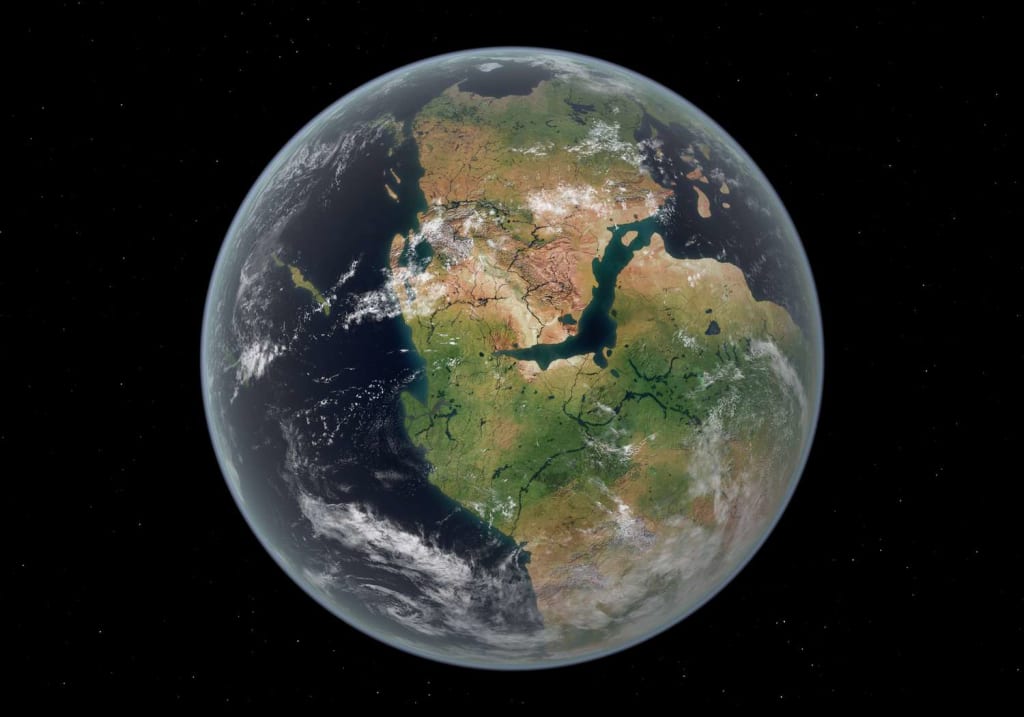
Continental drift is a theory that describes the movement of continents across the Earth's surface. The theory suggests that the continents were once joined together in a supercontinent called Pangaea, and over millions of years, they slowly drifted apart to their current positions. This theory was proposed by the German scientist Alfred Wegener in 1912 and was later supported by scientific evidence.
The Evidence for Continental Drift
One of the most compelling pieces of evidence for continental drift is the similarity of rock formations and mountain ranges found on different continents. For example, the Appalachian Mountains in North America are very similar to the Scottish Highlands in Europe. The rock formations in these regions match up perfectly, suggesting that they were once part of the same landmass.
Another piece of evidence comes from the fossils of plants and animals found on different continents. For example, fossils of a freshwater reptile called Mesosaurus have been found in both South America and Africa. These reptiles could not have swum across the ocean, so their presence on both continents suggests that the continents were once joined together.
The discovery of magnetic stripes on the ocean floor also supports the theory of continental drift. When molten rock cools and solidifies, it records the Earth's magnetic field at the time. By studying the magnetic stripes on the ocean floor, scientists can determine the age of the rocks and the direction of the Earth's magnetic field at the time the rocks were formed. This information can then be used to reconstruct the movement of the continents.
The Theory of Plate Tectonics
The theory of plate tectonics explains the mechanism behind continental drift. According to this theory, the Earth's lithosphere (the outermost layer of the Earth) is divided into several large plates that move relative to each other. These plates can be either continental or oceanic.
The boundary between two plates is called a plate boundary. There are three types of plate boundaries: divergent, convergent, and transform. Divergent boundaries are where two plates move away from each other, while convergent boundaries are where two plates collide. Transform boundaries are where two plates slide past each other.
When two continental plates collide, neither can sink beneath the other, so they buckle and fold to create mountains. This is what happened when the Indian Plate collided with the Eurasian Plate to create the Himalayan Mountains.
When an oceanic plate collides with a continental plate, the denser oceanic plate sinks beneath the lighter continental plate in a process called subduction. This creates a subduction zone where the oceanic plate is forced deep into the Earth's mantle. The subducting plate melts and causes volcanic eruptions and earthquakes. This is what happens along the Pacific Ring of Fire, where the Pacific Plate is subducting beneath the North American, South American, and Eurasian Plates.
The Role of Mantle Convection
The movement of the plates is driven by convection currents in the Earth's mantle. The mantle is the layer beneath the Earth's crust and is made up of hot, molten rock. Convection currents are created when heat from the Earth's core causes the molten rock in the mantle to rise. As the rock cools, it sinks back down to the core, creating a circular pattern of movement.
This movement of the mantle creates the force that drives the movement of the plates. The convection currents push the plates away from each other at divergent boundaries and pull them together at convergent boundaries.
The Formation of Pangaea
The supercontinent Pangaea began to form about 300 million years ago during the late Paleozoic era. The continents at that time were still moving, but they were slowly coming together. By 250 million years ago, the continents had merged into a single landmass.
Pangaea remained intact for about 100 million years before it began to break apart. The process of breaking up Pangaea was not sudden, but rather a slow and gradual process that took millions of years.
The break-up of Pangaea began about 200 million years ago during the Mesozoic era. The supercontinent began to split along a rift in the middle, which created the Atlantic Ocean. This rift is still spreading today, and the Atlantic Ocean is getting wider each year.
As the continents drifted apart, they formed new oceans and collided with other continents. This process created the familiar shape of the world's continents that we see today.
Impacts of Continental Drift
The movement of the continents has had a profound impact on the Earth's climate, geography, and life forms. When the continents were joined together in Pangaea, there was a single, large ocean surrounding them called Panthalassa. This ocean was much deeper and colder than the current oceans, and it had a significant impact on the climate of the Earth.
As the continents drifted apart, they created new ocean basins that were shallower and warmer than Panthalassa. This change in the ocean's depth and temperature had a significant impact on the Earth's climate. The warm, shallow oceans allowed for the growth of coral reefs and provided habitats for many different types of marine life.
The movement of the continents also had a significant impact on the Earth's landforms. The creation of new mountain ranges and the opening of new ocean basins changed the topography of the Earth's surface. These changes, in turn, influenced the distribution of plant and animal species, leading to the evolution of new species and the extinction of others.
Continental drift has also played a role in the formation of natural resources such as oil, gas, and coal. These resources were formed from the remains of ancient plants and animals that lived in the shallow seas that formed around the continents.
Conclusion
The theory of continental drift has been one of the most important scientific discoveries of the last century. It has helped us understand how the Earth's surface has changed over millions of years and has provided us with insight into the processes that shape our planet.
While the idea of continents drifting across the Earth's surface may seem far-fetched, the evidence supporting this theory is overwhelming. By understanding the processes that drive continental drift, we can better understand the complex interactions between the Earth's lithosphere, mantle, and core. This understanding is essential for predicting and mitigating natural disasters such as earthquakes and volcanic eruptions.
Continental drift continues to be an area of active research, and scientists are constantly uncovering new insights into this fascinating topic. As our knowledge of the Earth's history and geology continues to expand, we can expect to gain a deeper understanding of the processes that shape our planet and our place in it.
About the Creator
Keerthana Thirumalairaj
An Independent Solitude girl, who recently found the interests in writings and converts Facts and imaginations into writings.
Keep reading
More stories from Keerthana Thirumalairaj and writers in Earth and other communities.
The Fascinating Evolution of Life on Earth
Introduction The evolution of life on Earth is a complex and fascinating topic that has captivated the imagination of scientists and non-scientists alike for centuries. The story of how life arose and diversified on our planet over billions of years is one of the greatest mysteries of all time, and it has been the subject of much scientific research and debate.
By Keerthana Thirumalairaj3 years ago in Earth
Honey, I Shrunk the Datacentres: Is Small the New Big?
When most people think of datacentres, they picture sprawling warehouses full of servers, humming fans, and mountains of cabling. These massive facilities power everything from Netflix streams to artificial intelligence, but they also consume enormous amounts of energy and space. Now, a new trend is emerging: micro-datacentres. Tiny, modular, and often portable, these “datacentre in a box” solutions are challenging the old assumption that bigger is always better. Could small really be the new big in the world of computing? What Are Micro-Datacentres? Micro-datacentres are compact computing hubs designed to perform the same essential functions as traditional datacentres but in a fraction of the space. Think of them as miniaturized cloud factories — smaller, energy-efficient, and often placed closer to the users they serve. Key characteristics include: Compact size: Often no larger than a shipping container or even a cabinet. Energy efficiency: Use less power by focusing on localized computing needs. Modularity: Can be scaled horizontally by adding more units rather than expanding a single huge facility. Edge computing readiness: Positioned closer to where data is generated, reducing latency for IoT devices, AI applications, and streaming services. In short, micro-datacentres take the power of traditional computing and shrink it to fit modern, flexible infrastructure demands. Why Companies Are Embracing Smaller Datacentres There are several reasons the tech world is warming up to smaller datacentres: Energy and Cost Savings – Traditional datacentres consume massive amounts of electricity, sometimes as much as a small town. Micro-datacentres use less power and generate less heat, reducing both energy bills and cooling costs. Local Speed and Low Latency – For applications like AI, gaming, and streaming, milliseconds matter. By placing computing resources closer to users, micro-datacentres reduce latency and improve performance. Flexibility and Rapid Deployment – Big datacentres take years to build. Micro-datacentres can be deployed in weeks, allowing companies to respond quickly to spikes in demand or to expand into new regions. Resilience and Redundancy – Smaller, distributed units reduce the risk of a single point of failure. If one micro-datacentre goes down, others can pick up the load. Sustainability Goals – With energy efficiency at their core, micro-datacentres are often paired with renewable energy, making them an attractive option for companies seeking greener operations. From Data Warehouses to Data Cabinets Historically, the datacentre arms race has been about size. Companies like Amazon, Google, and Microsoft built massive facilities housing hundreds of thousands of servers. These centers achieved economies of scale but came with high energy use, long construction timelines, and heavy regulatory scrutiny. Micro-datacentres, on the other hand, flip the script: instead of one mega-facility, you deploy many smaller units closer to users. This is sometimes called edge computing, and it’s particularly useful for AI applications, smart cities, and the Internet of Things (IoT). Imagine self-driving cars, smart traffic lights, or factory robots. These devices generate enormous amounts of data that can’t be efficiently sent to a distant datacentre for processing. A nearby micro-datacentre solves the problem in real-time, enabling faster decisions and smoother operations. Real-World Examples Several companies are already experimenting with smaller datacentres: Google’s Edge Nodes: Google has deployed compact datacentres in regional locations to speed up cloud services. Microsoft Azure Stack Edge: A modular datacentre solution that brings cloud computing capabilities closer to businesses. Amazon Web Services (AWS) Snowcone: A portable computing and storage unit that can operate in remote or temporary locations. Even municipalities and hospitals are exploring micro-datacentres for localized applications like traffic management, healthcare data storage, and emergency services. Challenges of Going Small While micro-datacentres have many advantages, they’re not without challenges: Limited capacity: They can’t match the raw scale of traditional datacentres, so some large-scale AI training tasks still require mega-facilities. Security concerns: Smaller units distributed across many locations require robust cybersecurity protocols. Maintenance and monitoring: Managing multiple small units can be more complex than running a centralized datacentre. Energy trade-offs: If not designed efficiently, multiple micro-datacentres can sometimes use more energy than a single optimized large facility. Despite these challenges, many experts argue that the benefits — speed, flexibility, and reduced environmental impact — outweigh the downsides for many applications. Why “Small” Could Be the Future The rise of micro-datacentres signals a broader shift in how we think about computing infrastructure. Instead of centralized, monolithic powerhouses, the future may look like a network of small, smart, and sustainable units. This trend aligns with several larger tech movements: Edge computing – Computing closer to the user or device. Green technology – Reducing energy consumption and carbon footprints. AI proliferation – Handling massive data loads locally to enable faster processing. For companies, governments, and communities, the message is clear: smaller doesn’t mean weaker — it can mean smarter, faster, and more adaptable. Conclusion: Small but Mighty Micro-datacentres may not replace all mega-facilities, but they are carving out an essential niche in the computing ecosystem. They offer speed, flexibility, and sustainability that large datacentres can’t always provide, particularly for localized applications and edge computing. As technology evolves and energy concerns intensify, these “datacentres in a box” could become a core component of how we process, store, and access data in the 21st century. So the next time someone asks if small is the new big, the answer might just be yes — at least when it comes to datacentres.
By Muhammad Hassan4 days ago in Earth


Comments
There are no comments for this story
Be the first to respond and start the conversation.