
Earth’s Magnetic Field: How It Protects Life from Solar Radiation
Earth

Earth’s Magnetic Field: How It Protects Life from Solar Radiation
Imagine Earth without its magnetic field — a planet exposed to the full fury of the Sun’s radiation, a place where life as we know it could hardly survive. From shielding our atmosphere to creating the spectacular auroras, the Earth's magnetic field plays a silent yet critical role in maintaining the delicate balance necessary for life. But what exactly is this invisible shield? How does it work, and why should we care about it today more than ever?
Let’s dive into one of the most fascinating and underappreciated aspects of our planet — Earth's magnetic field — and discover how it protects us from cosmic chaos.
The Invisible Force Field
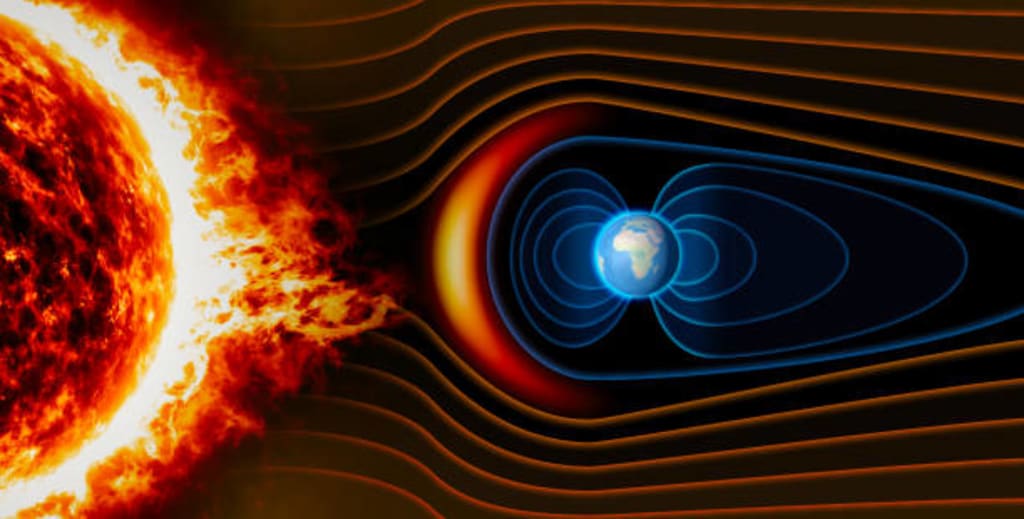
The Earth's magnetic field, often called the geomagnetic field, extends from the Earth's interior out into space. It is generated by the movement of molten iron and nickel in the Earth's outer core through a process known as the geodynamo. Picture a gigantic bar magnet tilted about 11 degrees from the Earth's rotational axis — that's a simple (but not perfectly accurate) way to visualize it.
The magnetic field has two main parts:
- The internal field, generated by the geodynamo deep within the Earth.
- The external field, influenced by the solar wind — streams of charged particles emanating from the Sun.
Together, these two components create a dynamic, constantly shifting magnetic environment. Without this invisible force field, the Earth would be as barren and lifeless as Mars.
Solar Radiation: A Double-Edged Sword
The Sun is vital for life, providing the energy necessary for photosynthesis, weather patterns, and warmth. But it's also a dangerous neighbor. The Sun constantly emits:
- Ultraviolet (UV) radiation, which can damage living tissues and DNA.
- Solar wind, a stream of charged particles (mostly electrons and protons).
- Coronal Mass Ejections (CMEs), massive bursts of solar plasma that can carry billions of tons of material traveling millions of kilometers per hour.
Without protection, the energy from these phenomena could strip away our atmosphere and expose all living organisms to harmful radiation. That's where the magnetic field steps in — our cosmic bodyguard.
How Earth's Magnetic Field Shields Us
The magnetic field protects us in several fascinating ways:
1. Deflecting Charged Particles
Charged particles from the Sun encounter the Earth's magnetic field and are either deflected away or trapped. They spiral along magnetic field lines and are funneled toward the poles, where they eventually interact with the atmosphere, creating the beautiful auroras (more on that later).
Without this deflection, these particles would bomb the Earth's surface directly, causing widespread damage to ecosystems and infrastructure.
2. Preserving the Atmosphere
One of the most critical roles of the magnetic field is preserving Earth's atmosphere. Without it, solar wind could gradually erode the upper atmosphere, as it likely did on Mars. Over millions of years, this process could strip away vital gases like oxygen and nitrogen, making Earth inhospitable.
3. Absorbing Cosmic Rays
In addition to solar radiation, the Earth is constantly bombarded by cosmic rays — high-energy particles from distant stars and galaxies. The magnetic field helps deflect many of these rays, reducing the amount that reaches the surface.
Cosmic rays can be harmful, increasing cancer risks and causing mutations. By filtering these out, the magnetic field acts as a protective blanket for life on Earth.
The Spectacular Side Effect: Auroras
When some charged particles do slip past the magnetic field at the poles, they collide with atoms in the Earth's upper atmosphere. These collisions excite the atoms, causing them to emit light. The result? Stunning natural light shows known as auroras — the Aurora Borealis in the Northern Hemisphere and the Aurora Australis in the Southern Hemisphere.
- Colors in the aurora vary depending on which gases are involved:
- Oxygen at high altitudes produces red.
- Oxygen at lower altitudes gives off green — the most common color.
- Nitrogen produces blue or purple hues.
Besides being breathtakingly beautiful, auroras are a visual reminder of the magnetic field’s active, protective work.
A Field in Constant Motion
Although the magnetic field feels stable to us, it is far from fixed. The magnetic poles (north and south) are continually moving — a phenomenon called geomagnetic secular variation. In fact, the magnetic north pole has been drifting rapidly across the Arctic Ocean from Canada toward Russia at a pace of about 50-60 kilometers per year!
Even more dramatically, the Earth’s magnetic field has reversed many times over geological history, with north and south poles swapping places. These events, called geomagnetic reversals, occur roughly every few hundred thousand years, though not on a predictable schedule. The last major reversal, known as the Brunhes-Matuyama reversal, occurred about 780,000 years ago.
During a reversal, the magnetic field weakens significantly, possibly to as little as 10% of its normal strength, which could make the Earth more vulnerable to radiation for thousands of years. However, life has persisted through countless reversals, suggesting that the magnetic field, even in a weakened state, continues to offer some level of protection.
Modern Concerns: What Happens if It Weakens?
In recent years, scientists have observed that the Earth's magnetic field is weakening, especially over a region called the South Atlantic Anomaly — a vast zone stretching from South America to southern Africa where the field strength is particularly low.
This weakening could have several implications:
- Increased radiation exposure for satellites and astronauts.
- Possible disruptions to navigation systems, which rely on magnetic fields.
- Greater vulnerability of power grids and communications during strong solar storms.
However, it's important not to panic. Even with significant weakening, Earth’s atmosphere still provides considerable protection. Scientists are closely monitoring the field's behavior using satellites like ESA’s Swarm mission, providing vital data to help us prepare for any future changes.
Magnetic Field Beyond Earth: A Key to Habitability?
Our understanding of Earth’s magnetic field has broader implications in the search for extraterrestrial life. When astronomers look for habitable exoplanets, one key factor they consider is whether the planet might have a magnetic field.
A strong magnetic field could shield a planet’s atmosphere and surface from harmful radiation, just as it does on Earth. Without one, even a planet in the so-called "Goldilocks Zone" (not too hot, not too cold) might be barren or hostile to life.
Mars is a sobering example: it once had flowing water and a thicker atmosphere but lost its global magnetic field billions of years ago. As a result, the solar wind stripped much of its atmosphere away, turning it into the dry, cold desert world we see today.
Thus, a magnetic field might be as crucial for life as liquid water and the right chemical ingredients.
Final Thoughts: The Silent Guardian
The Earth's magnetic field is an unsung hero — invisible, intangible, yet profoundly vital. It shields us from deadly solar and cosmic radiation, preserves our atmosphere, and enables life to flourish. It even paints the sky with ethereal colors, reminding us of its constant, unseen vigilance.
As we venture further into space, build more satellite infrastructure, and deepen our search for life beyond Earth, understanding the dynamics of magnetic fields becomes more crucial than ever. They are not just scientific curiosities; they are the silent guardians of habitability.
The next time you glance up at the night sky or witness the shimmering lights of an aurora, take a moment to appreciate the protective shield that makes our existence possible — a shield forged in the heart of the Earth, reaching out into the cosmic storm to keep us safe.
About the Creator
Jeno Treshan
Story writer Jeno Treshan creates captivating tales filled with adventure, emotion, and imagination. A true lover of words, Jeno weaves unforgettable stories that transport readers to far-off lands.
Keep reading
More stories from Jeno Treshan and writers in Earth and other communities.
The Origins of Earth: How Our Planet Formed 4.5 Billion Years Ago
The Origins of Earth: How Our Planet Formed 4.5 Billion Years Ago Today, when we walk barefoot on soft grass or gaze up at towering mountains, it's easy to forget how dramatically different our planet once was. Earth’s journey from a chaotic swirl of dust and gas to the vibrant, life-filled world we know today is a story of violence, patience, and remarkable transformation. Travel back with me to about 4.5 billion years ago, and let’s explore the origins of our home.
By Jeno Treshan 11 months ago in Earth
The Ongoing Search for Water on Mars
For decades, scientists have been fascinated by the possibility of water on Mars. Known for its dry, dusty landscape and reddish appearance, Mars was once thought to be a completely barren world. However, modern discoveries have revealed that the planet may have once had abundant water—and scientists are still searching for evidence of it today.
By Irshad Abbasi 4 days ago in Earth


Comments
There are no comments for this story
Be the first to respond and start the conversation.