
Earth’s magnetic field and dynamo theory
The Earth's magnetic field is one of the most fascinating and important phenomena in our planet’s behavior.

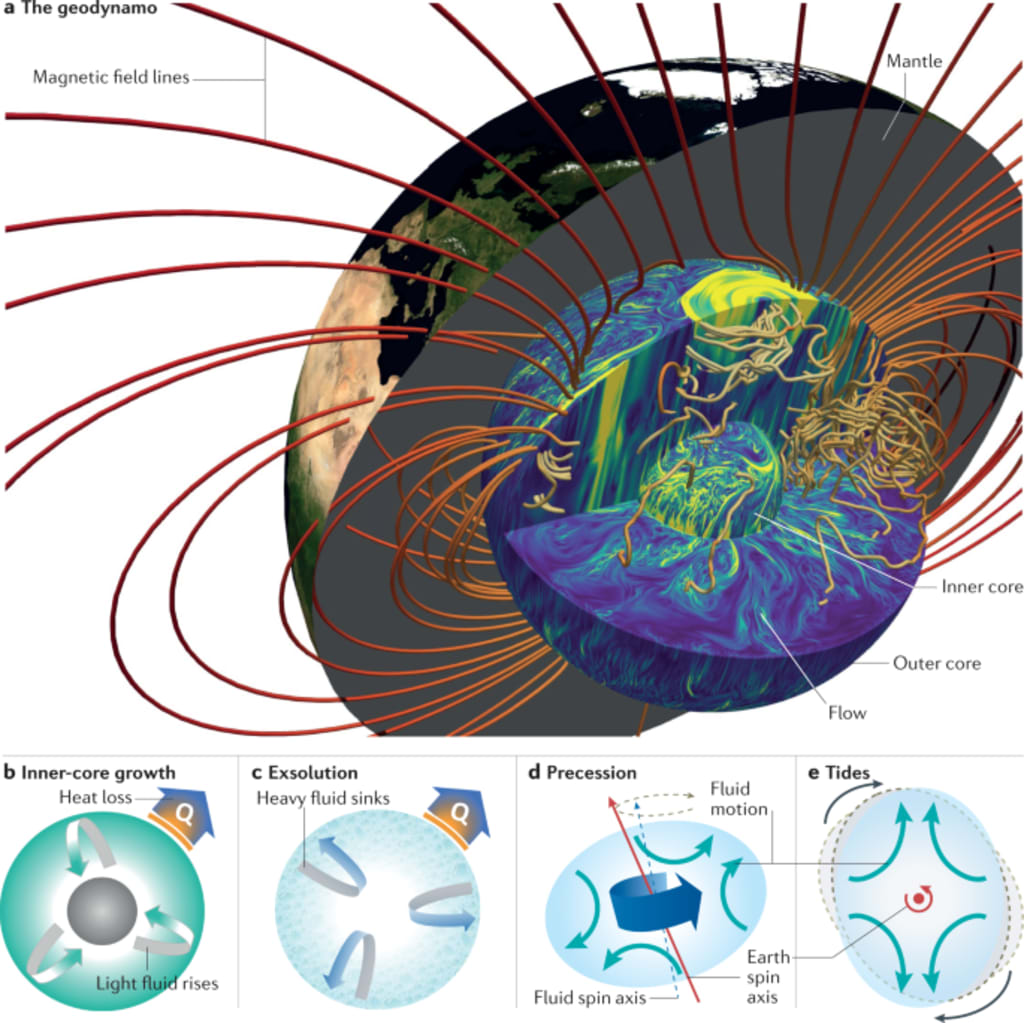
The Earth's magnetic is essential for life, as it helps shield the Earth from harmful solar radiation and cosmic rays. Without it, life on Earth would be significantly more exposed to space weather. Understanding the Earth's magnetic field requires looking at both its nature and the dynamo theory, which is the most widely accepted explanation of its origin.
The Earth's Magnetic Field
The Earth's magnetic field is a protective barrier around the planet that is generated by the motion of molten iron and other metals in the Earth's outer core. It extends from the Earth's interior out into space, where it meets the solar wind, the stream of charged particles emitted by the Sun.
The magnetic field has two primary features:
Magnetic Poles: Like a bar magnet, the Earth has a magnetic north and south pole, but they don’t align exactly with the geographic poles. These magnetic poles are not fixed and move over time.
Magnetic Lines of Force: The field is composed of invisible lines of magnetic force that stretch from the magnetic north pole to the magnetic south pole. These lines are strongest at the poles and weaker at the equator.
The Earth’s magnetic field is also responsible for phenomena such as the auroras (the Northern and Southern Lights), which occur when solar wind particles interact with the Earth’s magnetic field.
The Dynamo Theory
The origin of the Earth's magnetic field was a subject of much debate until the mid-20th century. The Dynamo Theory, proposed in the early 20th century, offers the most widely accepted explanation. According to this theory, the Earth's magnetic field is generated by the motion of electrically conductive materials, primarily iron and nickel, in the outer core of the Earth.
The dynamo process relies on the principles of electromagnetism, specifically the generation of electrical currents within a conducting material. The theory can be broken down into several key steps:
Convection and Heat Flow
The outer core of the Earth is primarily composed of molten iron and nickel. Heat from the decay of radioactive elements in the Earth's mantle, as well as residual heat from the planet's formation, causes the molten metals in the outer core to move in convection currents. These currents flow from hotter regions at the bottom of the outer core to cooler regions near the mantle. The movement of these materials is crucial in driving the dynamo mechanism.
The Coriolis Effect
Because the Earth is rotating, the convection currents in the molten iron are influenced by the Coriolis effect, which causes the motion of fluids to be deflected to the right in the Northern Hemisphere and to the left in the Southern Hemisphere. This causes the swirling convection currents to align in cylindrical patterns, which is important for generating the magnetic field.
Generation of Electrical Currents
As the molten iron and nickel move, they cut through the Earth's magnetic field, generating electric currents. According to Faraday’s Law of Induction, the movement of conducting materials through a magnetic field induces electric currents. These electrical currents, in turn, create their own magnetic field. This is the fundamental process of the dynamo effect.
Self-Excitation
The dynamo process is self-sustaining. Once electrical currents are generated in the molten outer core, they produce a magnetic field. This magnetic field reinforces the motion of the molten metals, which continues to generate more electrical currents, and the process repeats. Essentially, the motion of the molten metals sustains the magnetic field, keeping it strong and active over time.
The Role of the Inner Core
The Earth's inner core is solid, and while it does not directly participate in the convection currents, it plays a stabilizing role in the overall dynamo process. The boundary between the liquid outer core and the solid inner core is a key factor in sustaining the magnetic field. As the liquid outer core circulates, it interacts with the inner core, helping to organize and stabilize the magnetic field.
The Magnetic Field’s Fluctuations and Reversals
The Earth's magnetic field is not static. It fluctuates over time, and its strength and configuration can change. One of the most striking phenomena related to the Earth's magnetic field is geomagnetic reversal, a process where the magnetic poles flip, switching places. These reversals happen irregularly, with periods of several hundred thousand years between events.
Geomagnetic reversals are not fully understood, but they are believed to be related to the changes in the dynamics of the outer core, such as shifts in the flow patterns of the molten iron. These reversals have been recorded in the Earth's rock formations, providing evidence that the Earth’s magnetic field has flipped many times throughout the planet’s history.
IN THE END
The Earth's magnetic field is a vital part of the planet’s environment, protecting life from harmful radiation and cosmic rays. The dynamo theory, which explains the generation of the magnetic field, highlights the role of convection currents in the molten outer core and the generation of electrical currents that create the field. While the dynamo theory provides a solid explanation for the origin of the Earth's magnetic field, many details are still under study, especially regarding geomagnetic reversals and the precise dynamics of the core. Nevertheless, the Earth's magnetic field remains an essential force that continues to influence our planet in fundamental ways.
About the Creator
Badhan Sen
Myself Badhan, I am a professional writer.I like to share some stories with my friends.
Keep reading
More stories from Badhan Sen and writers in Earth and other communities.
Soil composition and erosion
Soil is the uppermost layer of the Earth's crust, composed of a mixture of organic matter, minerals, gases, liquids, and living organisms. The composition of soil and its susceptibility to erosion are fundamental to the health of ecosystems, agricultural productivity, and the stability of landscapes. Understanding soil composition and the processes of soil erosion is critical for maintaining soil quality and ensuring sustainable land use practices.
By Badhan Senabout a year ago in Earth
Tributes Pour In for Beloved Actress Catherine O’Hara
Tributes are pouring in from fans, fellow actors, and filmmakers celebrating the career and influence of Catherine O’Hara, one of the most beloved figures in film and television comedy. Known for her unforgettable roles, sharp wit, and emotional range, O’Hara has built a legacy that spans decades and generations of audiences.
By Aarif Lashari7 days ago in Earth


Comments (1)
Great theory! Fantastic work!