
Earth on Edge: The Unfolding Crisis of Climate Chaos in 2025
From Heatwaves to Floods, How the Climate Emergency Is Reshaping Our Planet — and Our Future
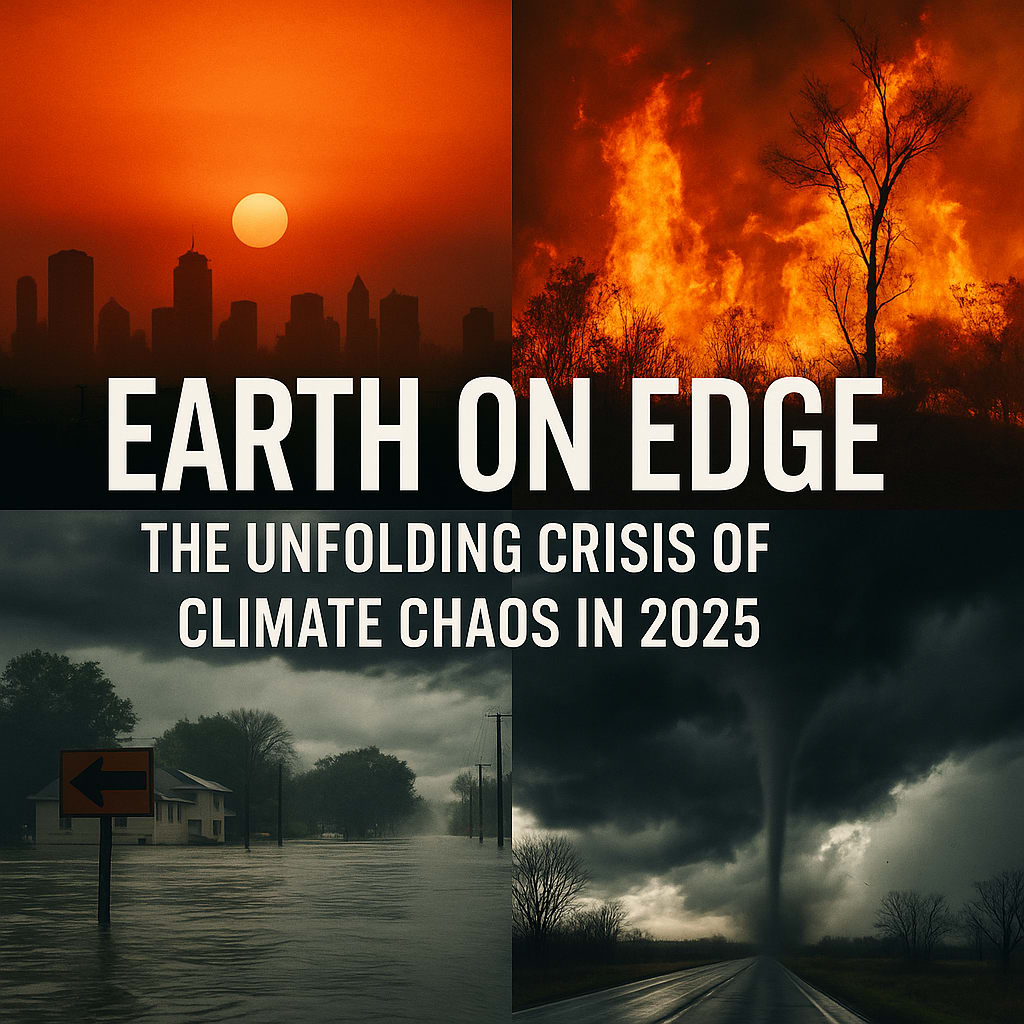
In 2025, the warnings of climate scientists are no longer theoretical. They’re tangible, visible, and devastating. From scorching heatwaves in Southern Europe to unrelenting floods in South Asia, the world is witnessing a surge in extreme weather events that are pushing entire ecosystems—and societies—to the brink.
We are no longer talking about preventing climate change. We are now confronting the reality of living within it. The planet is not warming gradually — it is unraveling rapidly. This is climate chaos, and we are not prepared.
A Year of Climate Extremes
The year 2025 has already been marked by an unrelenting series of natural disasters. Countries across the globe are dealing with record-breaking heat, uncontrollable wildfires, disastrous floods, and prolonged droughts — often all at once.
Southern Europe saw temperatures rise above 50°C (122°F), shattering previous records and sending hospitals into crisis mode as thousands were treated for heatstroke.
Canada and the Western United States are battling some of the worst wildfires in modern history, with smoke clouds drifting across entire continents.
Pakistan, India, and Bangladesh have endured monsoon seasons so intense that entire towns were swallowed by floodwaters within hours.
Sub-Saharan Africa continues to grapple with multi-year droughts, placing tens of millions at risk of hunger and forced migration.
These events are no longer anomalies. They're becoming the norm — part of a rapidly accelerating climate pattern that is changing life on Earth.
What’s Causing This Crisis?
At the root of it all is one undeniable reality: the Earth’s atmosphere is warming due to human activity.
For decades, carbon emissions from burning fossil fuels like coal, oil, and natural gas have been trapping heat in the atmosphere. This warming effect intensifies natural weather patterns, leading to more frequent and more severe storms, floods, droughts, and heatwaves.
But carbon dioxide isn’t the only problem. Methane, a greenhouse gas 80 times more powerful than CO₂ over a 20-year period, is being released in large quantities through agriculture, landfill sites, and the thawing of permafrost.
Meanwhile, deforestation continues to strip the planet of its natural ability to absorb carbon. Cities are growing larger and hotter. Oceans are warming and acidifying. The delicate balance of Earth’s climate system is breaking — and it's happening faster than expected.
Who Is Paying the Price?
While climate change affects all of us, it does not affect us all equally.
Developing countries, particularly in the Global South, are being hit hardest. They face the greatest risks from climate-related disasters despite contributing the least to the problem.
Small island nations like Tuvalu and the Maldives are quite literally disappearing under rising seas.
Farming communities in regions such as East Africa and South Asia are losing their crops and livelihoods to shifting weather patterns.
Urban poor populations are living in unprotected areas, with limited access to cooling, clean water, or disaster relief.
Indigenous communities, who have long protected natural ecosystems, are being displaced by extraction projects and environmental collapse.
At its core, climate change is not just an environmental issue — it’s a human rights and social justice crisis.
The Global Response: Progress, But Not Enough
There have been global efforts to slow the crisis, but progress has been uneven and insufficient.
The 2025 UN Climate Summit in Copenhagen produced renewed pledges from major nations to reduce emissions. Countries like Germany, Canada, and Chile have begun phasing out coal and expanding green infrastructure. China and India are investing heavily in solar and wind power.
But many of the world’s largest polluters, including the United States and several Gulf nations, have continued to delay meaningful reforms or fund new fossil fuel projects.
Youth-led movements have remained strong, with climate activists staging global protests demanding climate justice, systemic reform, and accountability. But their cries are too often drowned out by corporate lobbying and political gridlock.
Despite all the warnings, global greenhouse gas emissions rose again in 2024, making 2025 yet another year of missed targets.
Tipping Points Ahead
Scientists warn that we are approaching — or may have already passed — critical tipping points in the Earth’s climate system.
These include:
Melting of polar ice caps, which accelerates sea-level rise
Dieback of the Amazon rainforest, reducing global oxygen production and increasing carbon in the atmosphere
Loss of Arctic permafrost, releasing vast quantities of methane
Collapse of ocean currents like the Atlantic Meridional Overturning Circulation (AMOC), disrupting weather globally
Crossing these thresholds could lead to irreversible changes, with feedback loops that make climate change even harder to stop.
What Needs to Change — Urgently
There is still time to act — but it requires global cooperation, political courage, and individual responsibility. Here’s what must happen:
1. Immediate Emission Reductions
Governments must drastically cut emissions — especially from energy, transportation, and industry. This includes ending subsidies for fossil fuels, taxing carbon pollution, and investing in renewables.
2. Massive Investment in Green Technology
Solar, wind, battery storage, and carbon capture must be expanded and made accessible to developing countries. Innovation is essential, but speed is critical.
3. Protect Forests and Ecosystems
Rainforests, wetlands, and oceans act as carbon sinks. Protecting them is one of the fastest ways to cool the planet.
4. Climate Justice and Global Aid
Rich countries must fund climate adaptation efforts in poorer nations — not as charity, but as a responsibility.
5. Adaptation and Preparedness
We must prepare for what is already happening: build resilient infrastructure, improve emergency responses, and educate communities about climate risks.
A Choice Between Collapse and Hope
The future is not yet written. While the signs are dire, there is still a chance to slow, adapt to, and survive the unfolding climate crisis. But the window is closing quickly.
We must stop thinking of climate change as someone else’s problem, or something that will happen decades from now. It is here. It is now. And it is urgent.
Every fraction of a degree matters. Every tree saved, every policy passed, every voice raised — it all counts.
We stand on the edge. Whether we fall — or fight — will define this generation.
About the Creator
Idea hive
Article writer and enthusiast sharing insight and knowledge on nature, human behavior, technology, health and wellness, business, culture and society and personal development.
At Least 22 Dead as Crane Collapses Onto Train in Thailand
Thailand has been plunged into mourning after a devastating accident in which a construction crane collapsed onto a moving passenger train, killing at least 22 people and injuring dozens more. The incident, described by officials as one of the deadliest infrastructure-related accidents in recent years, has raised urgent questions about construction safety, urban development, and oversight in the country.
By Aarif Lashari6 days ago in Earth


Comments
There are no comments for this story
Be the first to respond and start the conversation.