

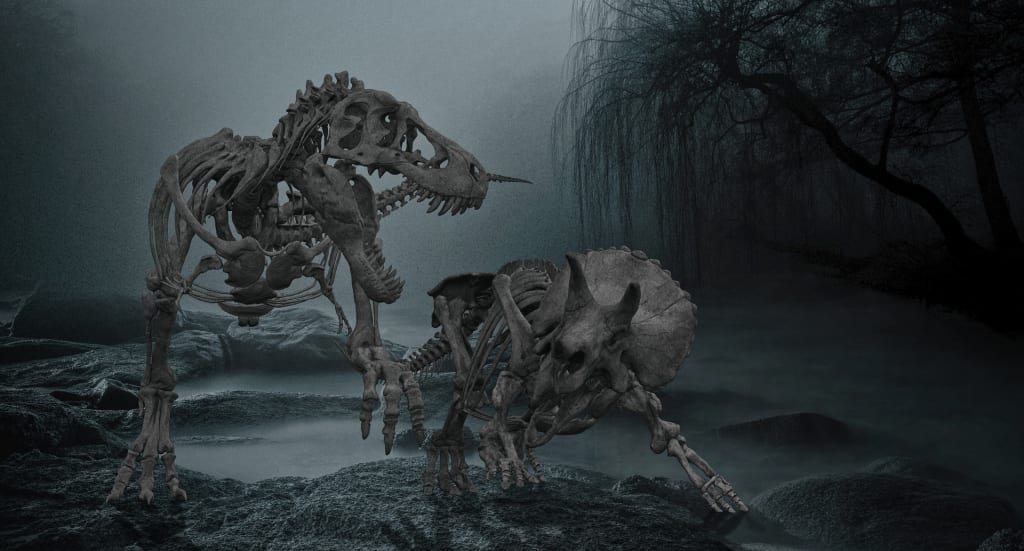
A long time ago, the continents came together to form one large supercontinent called Pangea. It was not the first time these continents came together, but it is the first time that life as we know it was formed and grew. Almost all categories of animal life lived on the land of Pangea or swam around the one ocean of Panthalassa. They were just in different forms and had many more variations then what we see today. It was a much different world then we have now with no polar caps or large mountain ranges. There was one central mountain range but the only thing that separated the land masses was the environment. The atmosphere had almost 20% more carbon dioxide and warmer temperatures. There were vast jungles in some areas and milder conifer forests in others, but it was more about where the humidity and moisture were. There were also animals similar to what we have to today but in different sizes. Let me explain…
Due to the right climate, the largest animal group was made up of Dinosauromorphs from the reptilian and bird groups of the animal family. They were the predecessors of the dinosaurs but were more simply built and suited to the land of Pangea. They didn’t need certain things to survive because they were at the top of the food chain and all other animals were a lot smaller. This proved to be a problem as the land began to change from humid jungles to a more semiarid landscape. It was a time when the predominant plant life was changing from a jungle atmosphere to including more conifers and the beginning of flowering plants. Then the land began to move again.
The land masses are always moving. It is subtle, but evident even today. During the time of the dinosaurs, it created volcanic activity across the continent and added to the elevated CO2 levels. This created one of the worst extinction events even though it was more subtle. It’s estimated that the world lost ninety percent of the animals at that time. The dinosaurs and mammals that we know today did survive, but over a period of 10-15 million years the dinosauromorphs died out. Certain species of sea creatures were lost permanently. The dinosaurs remained because the event opened up new areas of the environment that they were more suited for. The first mammals developed as well but stayed in the background.
The first true mammals began to appear 225 million years ago and long after the dinosauromorphs disappeared. However, the dinosaurs that emerged from the Permian extinction were still at the top of the food chain. Long-necked sauropods grazed on the top of the trees while hungry theropods sought to dominate the land below. Unless one was heavily armored like the ankylosaurus, it was rough being at the lower end of the food chain. That is where the mammals started to develop. The first mammals were found to be nocturnal and eat insects. It might have been easier to come out at night and grab a snack from the insect life passing by. It’s strange to think of the little Rodentia (rodents) family developing along the Proboscidea (elephants), but that’s what happened during the development period.
The dinosaurs preferred a drier environment and didn’t need as much rain, but most of their tracks are found along ancient waterways. Mammals needed more water and were found in more humid environments.
When Pangea began to break up, it also broke up the environmental boundaries between these two groups. Gondwana broke away from the equator and began to slide south. Laurasia began to move north breaking up more than the Central mountain range. It created islands out of Europe and shrank the dinosaurs to where grazing sauropods were the size of cows and theropods were the size of Geese. It makes one wonder if that would have been the fate of the dinosaur if the asteroid would have never hit. They might have just faded away. Meanwhile, it forced the mammals to change their habits as well.
They kept the most important factor and lived underground.
It wasn’t much of a competition with brains and brawn, but the simple life of the mammal may have been what saved it from the coming asteroid. The dinosaurs crashed through the jungles and dominated the plains but in the end, it may have been their size that was their downfall. Not much of anything survived the impact that rattled the earth’s mantle and sent out Tsunami shock waves. Sulphur dominated the atmosphere and tiny fiery particles fell from the skies burning anything it fell on.
Even if the mammals were underground, it would be years before anything green sprouted up. After years of dominating the food chain, the dinosaurs disappeared in a few days and the little mammals that survived grew into the large groups we see today. We still have some of the dinosaur family left from crocodiles to the birds in the backyard, but it’s the mammals’ cycle. Makes one wonder what cycle of life will happen next. We already had giant insects!
About the Creator
Jennifer Allen
Hello. I like writing about interesting and unique facts about science and history like four-tusked Mastodons and droughts from the Bronze Age. Check out my website at historyscorner.weebly.com
Keep reading
More stories from Jennifer Allen and writers in Earth and other communities.
Dinosaurs of Antarctica
Standing on the ice of Antarctica, it is hard to imagine a land full of dinosaurs. Almost 200 million years ago, the land was a lot different. There were no polar caps as we know them, but there were still periods of low light in the winter months. It was colder than the sections of Pangea near the Equator, but not covered in ice and snow as we see it today. There was most lush vegetation but mostly near the shores. It was definitely not a warm jungle, but more like Easter Island with dinosaurs. The weather was mild, but cooler in the interior regions. The oldest dinosaur bones were found in the inner mountain range.
By Jennifer Allen3 years ago in Earth
The Growing Need for Air Purification and Air Purifiers Today
Introduction Air is the most basic necessity for life, yet it is often the most overlooked factor when discussing health, productivity, and quality of living. While people pay close attention to the food they eat and the water they drink, the air they breathe — especially indoors — rarely receives the same level of scrutiny. In today’s world, however, this mindset is rapidly changing. Rising pollution levels, climate change, urbanisation, industrial growth, and the lingering effects of global health crises have brought air quality to the forefront of public awareness.
By Hafsa Usmani3 days ago in Earth
mRNA Helped End the Pandemic. Now It Shows Promise Against Skin Cancer
When the first COVID-19 vaccines rolled out in 2020, mRNA technology became a household name. It trains the body’s cells to recognize a virus, rather than introducing the virus itself — a breakthrough that helped curb one of the deadliest pandemics in history. Now, researchers are discovering that mRNA could be even more transformative in fighting cancer, particularly melanoma, a highly aggressive form of skin cancer.
By Aarif Lashari3 days ago in Earth



Comments
There are no comments for this story
Be the first to respond and start the conversation.