

I. Introduction
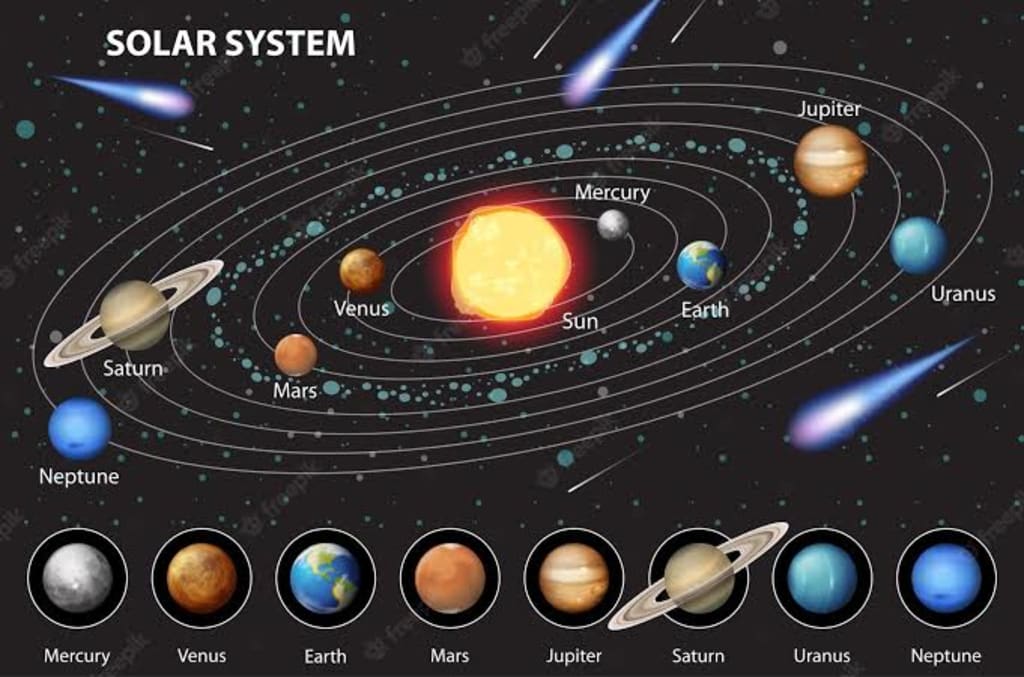
The solar system is the collection of celestial bodies that orbit around the sun. This includes the sun itself, the eight planets and their moons, dwarf planets, comets, asteroids, and other small bodies.
The solar system is made up of four types of celestial bodies: the sun, the planets, the dwarf planets, and small bodies (comets, asteroids, and other small bodies).
II. The Sun
The sun is a star that is located at the center of the solar system. It is a medium-sized star and is primarily composed of hydrogen and helium. It is responsible for providing the energy that sustains life on Earth.
The sun plays a crucial role in the formation of the solar system. It is believed that the sun and the solar system formed from a cloud of gas and dust that collapsed under its own gravity. This collapse caused the material to heat up and form the sun, while the remaining material formed the planets and other celestial bodies.
III. The Planets
The solar system has eight planets: Mercury, Venus, Earth, Mars, Jupiter, Saturn, Uranus, and Neptune.
Mercury is the closest planet to the sun and is small and rocky. Venus is the hottest planet and is covered in thick clouds. Earth is the third planet and is the only known planet to support life. Mars is the fourth planet and is known as the "Red Planet" because of its reddish appearance. Jupiter is the largest planet in the solar system and is made mostly of gas. Saturn is the second largest planet and is known for its rings. Uranus is the third largest planet and is tilted on its axis. Neptune is the fourth largest planet and is known for its strong winds.
IV. The Dwarf Planets
Dwarf planets are celestial bodies that orbit the sun and have enough mass to have a nearly spherical shape, but they have not cleared the neighborhood around their orbit.
The five known dwarf planets in the solar system are Ceres, Pluto, Haumea, Makemake, and Eris. Ceres is the largest object in the asteroid belt and is classified as a dwarf planet. Pluto was reclassified as a dwarf planet in 2006. Haumea, Makemake, and Eris are also classified as dwarf planets.
V. The Moons
The solar system has more than 200 moons, with the most moons orbiting Jupiter and Saturn.
The most notable moons include Earth's Moon, Jupiter's four largest moons (Io, Europa, Ganymede, and Callisto), and Saturn's largest moon, Titan. Earth's Moon is the largest relative to the size of its host planet, and it has been studied extensively for its impact on tides and the potential for future colonization. Jupiter's moons are notable for their potential to support life, with the subsurface oceans of Europa and Ganymede being of particular interest. Titan is notable for its dense atmosphere and the potential for similar processes that shaped Earth to have occurred there.
VI. The Asteroid Belt
The asteroid belt is a region of the solar system that lies between the orbits of Mars and Jupiter.
It is composed of a large number of small, irregularly shaped bodies made of rock and metal. The asteroid belt is believed to be the remains of a planet that failed to form due to the gravitational influence of Jupiter.
VII. The Kuiper Belt and Oort Cloud
The Kuiper Belt is a region of the solar system beyond the orbit of Neptune that is home to many small, icy bodies, including Pluto.
The Oort Cloud is a region of the solar system
The term "solar system" was first used by the ancient Greeks, specifically by the philosopher Anaximander in the 6th century BCE. He was the first to propose that the sun, moon, and planets all revolved around the Earth. However, the concept of the solar system as we understand it today, with the sun at the center and the planets orbiting around it, was first proposed by the Polish astronomer Nicolaus Copernicus in the 16th century. He published his ideas in a book called "De revolutionibus orbium coelestium" (On the Revolutions of the Celestial Spheres), which is considered the starting point of modern astronomy and the scientific revolution.
About the Creator
Keep reading
More stories from Giridharan and writers in Earth and other communities.
History of Earth
I. Introduction A. Definition of Earth: Earth is the third planet from the sun and the only known planet to support life. It is a terrestrial planet, meaning it is primarily composed of rock or metal. Earth has a diameter of about 12,742 km and is the fifth densest planet in the solar system.
By Giridharan3 years ago in Earth
The Most Unusual Animals
Beefalo are the result of domestic cattle crossed with bison. They are hardy animals that produce leaner, healthier meat. Beefalo have become resilient creatures able to thrive in harsh conditions where regular cattle would struggle. They require less water and feed and resist disease better.
By Rasma Raistersa day ago in Earth
Cassie and Johnny
I’m the kind of dame you notice. I’m no femme fatale, but you can’t ignore me, at least not until I warn you about what’s coming, then everybody ignores me. Hell, they usually blame me afterwards and give Johnny all the credit for saving the day, but my Johnny couldn’t save a seat at the movies without my help. Sure, he’s brawny, but brainy? Not so much. Like that time I asked him to spot me five bucks, and he said he didn’t see it anywhere on me, and believe you me, he looked but good.
By Harper Lewis4 days ago in Critique



Comments
There are no comments for this story
Be the first to respond and start the conversation.