

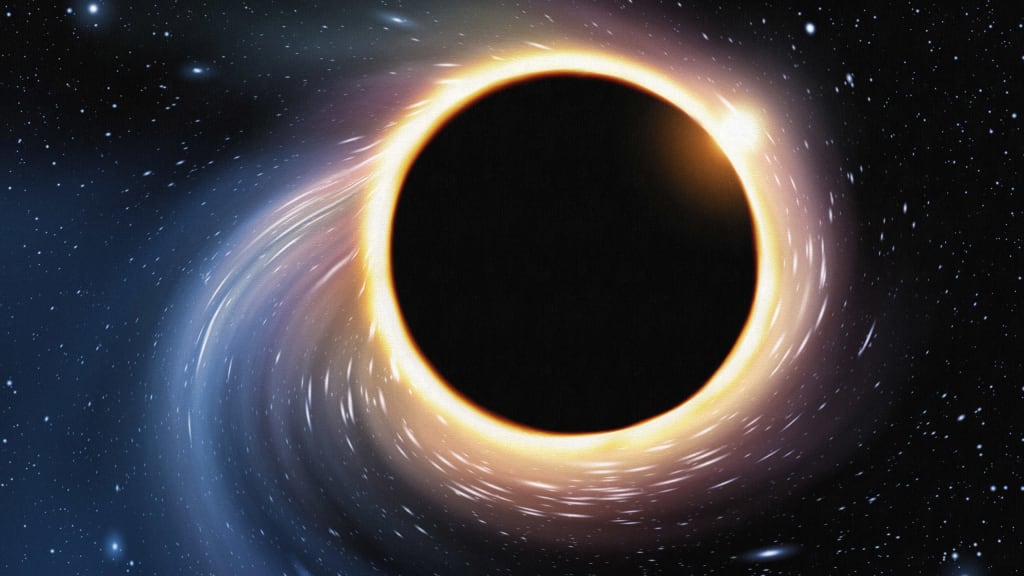
Black holes are one of the most fascinating and mysterious objects in the universe. They are incredibly dense regions of space where the gravitational pull is so strong that nothing, not even light, can escape. In this article, we will explore what black holes are, how they form, and their effects on the surrounding space.
What Are Black Holes?
Black holes are regions of space where the gravitational pull is so strong that nothing can escape, not even light. They are formed from the remnants of massive stars that have run out of fuel and collapsed under their own gravity. There are two main types of black holes: stellar black holes and supermassive black holes.
Stellar black holes are formed from the collapse of a single massive star. They are typically between 3 and 20 times the mass of the sun and are found scattered throughout our galaxy.
Supermassive black holes, on the other hand, are much larger and are found at the centers of most galaxies, including our own Milky Way. They are thought to be formed from the merger of multiple smaller black holes and can have masses of millions or even billions of times that of the sun.
How Do Black Holes Form?
Black holes are formed when a massive star runs out of fuel and can no longer support its own weight. The core of the star collapses under its own gravity, creating a singularity - a point of infinite density and zero volume. The singularity is surrounded by a region called the event horizon, which marks the boundary beyond which nothing can escape the black hole's gravitational pull.
The size of the event horizon depends on the mass of the black hole. A smaller black hole will have a smaller event horizon, while a larger black hole will have a larger event horizon. For example, a black hole with the mass of the sun would have an event horizon about 3 kilometers in radius.
Effects of Black Holes
Black holes have several effects on the surrounding space. One of the most dramatic effects is the distortion of space-time. The gravitational pull of a black hole is so strong that it warps space and time around it, causing nearby objects to follow curved paths. This effect, known as gravitational lensing, can cause distant objects to appear distorted or magnified.
Another effect of black holes is the accretion disk. When matter falls into a black hole, it forms a disk-like structure around the black hole called an accretion disk. The matter in the accretion disk is heated to very high temperatures, producing bright X-ray and gamma-ray radiation that can be detected by telescopes.
Black holes can also have a powerful impact on the surrounding space. The intense gravitational pull of a black hole can cause nearby stars and planets to be pulled out of their orbits, and can even tear apart entire stars.
Conclusion
Black holes are fascinating and mysterious objects that have captivated scientists and the public alike for decades. They are formed from the remnants of massive stars that have collapsed under their own gravity and have a gravitational pull so strong that nothing can escape. Black holes distort space-time, create accretion disks, and can have a powerful impact on the surrounding space. Although they are still not fully understood, black holes continue to be the subject of intense study and research, providing valuable insights into the nature of the universe.
About the Creator
voltagee
IF THE ELECTRICITY FLOW IS INCREASING, KNOW THAT I AM NERVOUS
Man Shot and Killed During Minneapolis Immigration Crackdown Graduated from Preble High School
A man shot and killed during an immigration enforcement operation in Minneapolis has been identified as a graduate of Preble High School, a detail that has added a deeply personal dimension to an already controversial crackdown. As authorities continue to investigate the circumstances surrounding the fatal shooting, community members, former classmates, and civil rights advocates are demanding transparency, accountability, and a broader review of how immigration enforcement actions are being carried out.
By Salaar Jamali6 days ago in Earth
Hunt for the Names of Mysterious Dwarf Planets
Far beyond the familiar planets of our solar system lies a cold, dark region filled with icy bodies, ancient debris, and mysterious worlds yet to be fully understood. Among these distant objects are dwarf planets, many of which orbit on the fringes of our solar system in regions like the Kuiper Belt and beyond. While some, such as Pluto, have captured public imagination for decades, many others remain unnamed, sparking a fascinating hunt among astronomers to discover, study, and ultimately name these elusive celestial bodies.
By Aarif Lashari3 days ago in Earth



Comments