

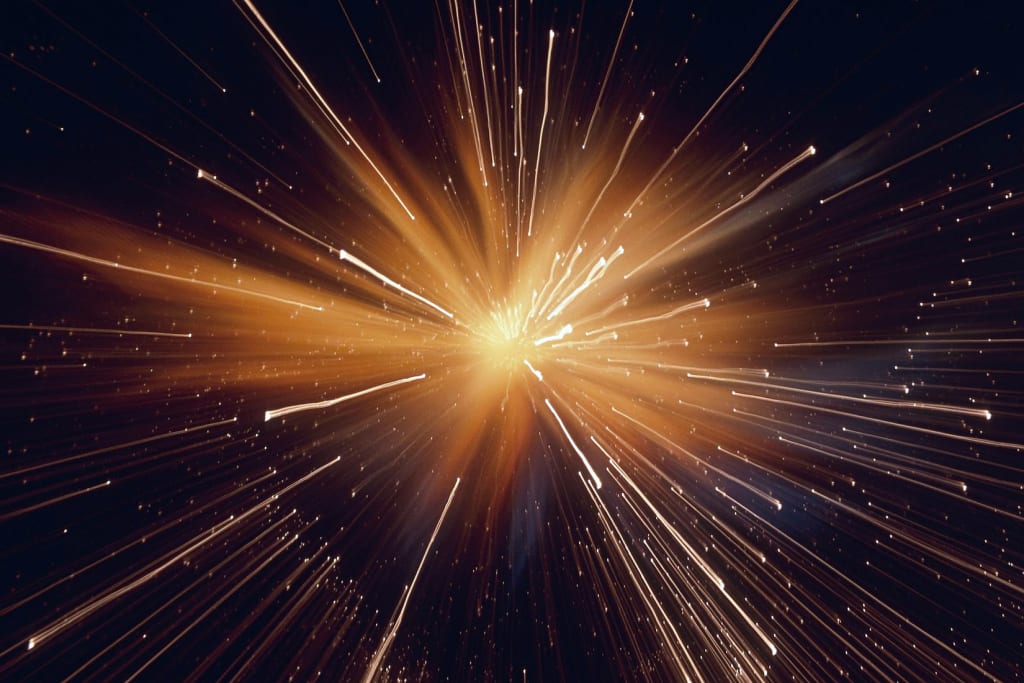
The Big Bang is the leading scientific theory about the origin and evolution of the universe. It proposes that the universe began as a singularity - a point of infinite density and temperature - and has been expanding and cooling ever since. In this article, we will explore the Big Bang theory, its evidence, and its implications for our understanding of the universe.
The Big Bang Theory
The Big Bang theory was first proposed in the 1920s by Georges Lemaître, a Belgian astronomer and Catholic priest. Lemaître's theory was based on the observation that distant galaxies appeared to be moving away from us, suggesting that the universe was expanding. He proposed that if the universe was expanding, then it must have been much smaller and hotter in the past, eventually leading to the idea of the singularity.
The modern version of the Big Bang theory was developed in the 1960s by a team of scientists led by George Gamow, Ralph Alpher, and Robert Herman. They predicted that if the universe had a hot and dense beginning, then it should be filled with radiation left over from the Big Bang. This radiation, known as the cosmic microwave background radiation, was discovered in 1965 by Arno Penzias and Robert Wilson, providing strong evidence for the Big Bang theory.
Evidence for the Big Bang
In addition to the cosmic microwave background radiation, there are several other pieces of evidence that support the Big Bang theory. These include the abundance of light elements, the large-scale structure of the universe, and the observed acceleration of the universe's expansion.
The abundance of light elements, such as hydrogen and helium, is consistent with the predictions of the Big Bang theory. According to the theory, these elements were produced during the first few minutes of the universe's existence, when the temperature was high enough for nuclear fusion to occur.
The large-scale structure of the universe, as revealed by surveys of galaxies and other objects, is also consistent with the Big Bang theory. The distribution of galaxies is clumpy and uneven, with galaxies forming into large clusters and superclusters. This pattern is thought to have arisen from small fluctuations in the density of matter in the early universe, which were amplified by the universe's expansion.
Finally, the observed acceleration of the universe's expansion, as revealed by measurements of distant supernovae, is also consistent with the Big Bang theory. This acceleration is thought to be driven by a mysterious force called dark energy, which makes up about 70% of the universe's total energy density.
Implications of the Big Bang
The Big Bang theory has had profound implications for our understanding of the universe. It has helped us to explain the origin and evolution of the universe, as well as the formation of galaxies, stars, and planets. It has also led to the discovery of new phenomena, such as dark matter and dark energy, which are thought to make up most of the universe's total energy density.
One of the most exciting implications of the Big Bang theory is the idea of cosmic inflation. This theory proposes that the universe underwent a brief period of extremely rapid expansion, known as inflation, shortly after the Big Bang. This rapid expansion would have smoothed out any irregularities in the universe's density, explaining the large-scale structure of the universe we observe today.
Another implication of the Big Bang theory is that the universe is finite in age. According to the theory, the universe began about 13.8 billion years ago, and has been expanding and cooling ever since. This means that we can observe light from galaxies and other objects that are up to 13.8 billion years old, but we cannot observe anything that existed before the Big Bang.
About the Creator
voltagee
IF THE ELECTRICITY FLOW IS INCREASING, KNOW THAT I AM NERVOUS
Ukraine’s Two Largest Cities Under Russian Attack
Ukraine’s war reality took another grim turn as officials confirmed that Russia launched fresh attacks on Ukraine’s two largest cities, Kyiv and Kharkiv, leaving at least one person dead and several others injured. The strikes underscore how, even years into the conflict, urban centers and civilian life remain deeply vulnerable to escalating military operations.
By Muhammad Hassan7 days ago in Earth
One of Russia's Last 'Old Believers' Still Lives in Siberia
Deep in the vast, frozen expanse of Siberia, where snow stretches for miles and the nearest town is hours away by rickety roads, a remarkable story of faith and tradition quietly persists. In this isolated landscape, one of Russia's last surviving 'Old Believers' continues to live in a way that has changed little over centuries, preserving religious rituals, customs, and a unique worldview that stands apart from modern Russian life. The 'Old Believers', or старообрядцы (staroobryadtsy), split from the Russian Orthodox Church in the mid-17th century during reforms introduced by Patriarch Nikon. Rejecting changes in liturgy, ritual, and church hierarchy, they faced centuries of persecution, exile, and marginalization. Today, only a handful remain, mostly in isolated villages like this Siberian enclave, where tradition survives against all odds. Who Are the Old Believers? The Old Believers emerged in 1650s Russia as part of a resistance movement against the liturgical reforms of Patriarch Nikon. They rejected the standardization of prayers, rituals, and church practices, insisting that the “old ways” were sacred and unchangeable. For centuries, the Russian state and Orthodox Church persecuted them. Many fled to remote regions of Russia, including Siberia, the Russian Far East, and even parts of Alaska when it was Russian territory. Their communities became known for self-sufficiency, deep faith, and strict adherence to tradition. Even today, Old Believers are recognized by their distinctive attire, two-fingered crosses, and unique liturgical practices, which remain largely unchanged for over 350 years. A Life Preserved in Isolation The last few Old Believers living in Siberia lead lives that seem frozen in time. Villages are small and often inaccessible in winter, with residents relying on farming, hunting, and handcrafts for survival. Technology and modern conveniences are minimal; electricity and internet may reach some homes, but daily life revolves around the church, family, and the natural rhythms of the land. One Siberian villager, among the very last of his kind, continues to celebrate traditional festivals, maintain the old liturgical calendar, and teach his children prayers in Church Slavonic, a language nearly extinct in other parts of Russia. His home is filled with handmade icons, wooden crosses, and religious texts, many passed down for generations. Isolation has allowed Old Believers to preserve their beliefs intact, but it has also made life extremely challenging. Long winters, harsh landscapes, and limited access to medical care are daily realities. Yet these communities endure, held together by faith, family ties, and a profound respect for history. Why Siberia? Siberia’s harsh climate and remoteness have historically made it a refuge for those fleeing persecution. During the 17th and 18th centuries, the Russian Empire exiled dissenters, religious minorities, and political rebels to Siberia, believing that the harsh conditions would prevent them from influencing others. For the Old Believers, Siberia became not just a place of exile but a sanctuary. Here, far from the centralized control of the church and state, they could practice their faith freely. Even today, the geography continues to serve as a natural buffer, allowing remaining Old Believers to live according to ancient rituals and traditions largely undisturbed. Challenges of Modern Life Despite their seclusion, the last Old Believers face new pressures. Younger generations are increasingly tempted by urban life, education, and the internet. Migration to cities like Irkutsk or Novosibirsk means fewer young people remain in the villages, threatening the continuity of Old Believer culture. Furthermore, government modernization programs, infrastructure development, and global economic pressures have introduced modern conveniences that subtly erode traditional practices. While some embrace selective modernity — using tractors, mobile phones, or solar panels — the core religious and cultural rituals remain fiercely protected. The question many scholars and observers ask is whether these last communities can survive the 21st century intact, or whether globalization will eventually absorb them into mainstream Russian life. The Spiritual and Cultural Significance The remaining Old Believers are more than a curiosity; they are a living link to Russia’s religious history. Their existence provides insight into resistance, resilience, and the preservation of cultural identity. For historians, anthropologists, and religious scholars, these communities are invaluable. They demonstrate how faith can shape daily life, social structures, and even survival strategies in extreme environments. Their rituals, attire, and liturgy offer a unique perspective on pre-modern Russia, acting as a window into centuries-old spiritual practices. Lessons from the Last Old Believers The life of Siberia’s last Old Believers teaches several lessons: Faith and Tradition Endure: Even in the face of persecution, isolation, and modernization, cultural and religious identity can persist. Community Is Essential: Tight-knit families and communal practices help sustain traditions that might otherwise disappear. Balance Between Preservation and Adaptation: While embracing some modern tools, Old Believers maintain the core of their practices, demonstrating how selective adaptation can support cultural survival. Their story also challenges outsiders to reflect on the meaning of progress. In a world increasingly defined by technology and urbanization, the Old Believers remind us that there is value in slower, deliberate, and spiritually centered ways of life. A Fragile Future Today, with only a handful of Old Believers left in Siberia, the community is at a crossroads. Their survival depends on passing knowledge, traditions, and faith to the next generation, who may have the option to leave for the cities or even abroad. The Siberian landscape that once provided refuge may now feel isolating to younger members, but for those who remain, it is a sacred environment intertwined with belief and identity. In essence, the last Old Believers are not just preserving rituals; they are guardians of a centuries-old way of life that continues to defy time and modern pressures. Final Thoughts The story of Siberia’s last Old Believers is one of resilience, faith, and quiet defiance. They remind us that culture and religion can survive extreme adversity, and that in the most remote corners of the world, history continues to live through people’s daily lives. While the future remains uncertain, the existence of these last practitioners offers a profound testament to human endurance and the power of belief. In a rapidly changing world, the Old Believers’ commitment to their traditions shows that some values are not measured by speed or convenience but by steadfastness, patience, and devotion. Siberia, with its vast forests, frozen rivers, and endless skies, continues to harbor a story that spans centuries — and in the life of one of its last Old Believers, we see a bridge connecting Russia’s past to its uncertain but enduring present.
By Muhammad Hassan5 days ago in Earth


Comments