
Animal Entitlement to Life
Written for a college class in 2018.


Biologically speaking, life is an endless chemical balancing act. When a population of a plant or animal species fluctuates, at least one other species is directly disturbed, while many others become indirectly influenced. With this general truth in mind, one could logically conclude that all living beings share equal value in the planetary scheme. Each living being on Earth has its own niche in the biosphere, down to the smallest microorganisms. Our food chain quite literally is a circular cycle of life. Plants are eaten by animals which are eaten by larger animals. Feces from the animals helps fertilize the soil to grow more plants to sustain plant-eating life. It is a continuous system of locked interdependence. Yet, when it comes to the rights of animals in domesticated, commercial, scientific, or even natural wildlife settings, some humans attempt to argue the idea that they are not deserving of basic rights. In a society of intelligent beings that are evolving on various levels, it is time that humanity come to a consensus that all conscious living beings are entitled to pursue a life free from unwarranted cruelty and neglect.
A fundamental of socially acceptable morality in American culture today is the ability to empathize. We consider those without the capability of empathy sociopaths, and relatively dangerous to the general populace. With our expanding psychological education as a species, it’s no wonder that in the most recent years of humanity, we are discovering that not only do all human beings deserve basic rights regardless of sex or race, but all conscious living beings do as well. In his article in Encyclopedia Britannica, Wise says that “the fundamental principle of the modern animal rights movement is that many nonhuman animals have basic interests that deserve recognition, consideration, and protection” not just in a legal sense, but in a moral one also. Humanity has faced the cruel and unusual treatment of its species, by its species, since its beginning. However, we are slowly, but surely, coming to a greater understanding of our place in the universe and what it truly means to be a conscious, living being. Though we may be slow learners, better late than never! To make a lasting impact for the rights of animals, we will also need to make sure that the moral enlightenment of the value of all life translates into legal measures meant to ensure the safety and rights of all beings.
Perhaps one of the first steps towards equal rights for all living beings is the elimination of the exploitation of animals for entertainment industries. Circuses specifically are receiving a growing amount of public disapproval and legislative measures to counteract the harsh environments of circus life. Animal “actors” in circuses are often taken from their parents at a young age to psychologically isolate them from other animals and induce an unwanted bond with cruel animal owners. This man-made vulnerability creates an odd dynamic between the captive animal and their owners who may choose to sell them to abusive circus trainers. Animals will often be physically punished for disobedience, on top of the emotional abuse of being isolated and confined indefinitely. In an article for National Geographic, Hugo references PETA’s (People for the Ethical Treatment of Animals) reported footage of “days-old tiger cubs…separated from their mothers, monkeys [demonstrating] self-destructive behaviors such as chewing on their arms, and baby bears…chained by their necks to a wall, unable to sit for hours, to train them to walk on their hind legs” behind the scenes of most circuses in China. This kind of treatment is legal in China currently as there is no federal legislation concerning animal welfare. Yet, if humans were being treated this way, the uproar would be incessant and laws would be put into place very quickly. All living beings deserve an equal right to life, but why isn’t the social response more upset to these injustices and cruelties happening to animals regularly?
In recent years, we have seen a growing social rejection of testing beauty products on animals. Not only are the products themselves unnecessary, but people are beginning to see that experimentation on living beings is unethical. However, many people still remain silent when the issue of animal testing for scientific research is raised. On PETA’s website, they claim that in any given year, “more than 100 million animals—including mice, rats, frogs, dogs, cats, rabbits, hamsters, guinea pigs, monkeys, fish, and birds—are killed in U.S. laboratories” for a variety of reasons. Whether it be animals donated to classrooms for dissection, animals facing fatal allergic reactions to pharmaceuticals yet to be accepted by the FDA, or being psychologically traumatized, the fact that this absurdly large number is only a representation of the United States’ ethical bias against animal rights is astounding. The public response to the millions of lives being taken every year is seemingly insignificant when discussing animal lives, yet during World War II when Hitler began exterminating millions of innocent humans, the ethical dilemma of mass murder and experimentation was socially rejected. In an emotionally intelligent society, we must all begin to come to a consensus that excessively extinguishing lives for personal gain is fundamentally selfish and inhumane.
Presently, one of the direst issues concerning animals’ rights is the question of whether or not it is ethical to raise them in mass commercial settings strictly for consumption. In American society, we are under the illusion that raising an animal for consumption in the meat industry is just as ethical as domesticating an animal for companionship. But, given the hundreds of exposé documentaries on Netflix alone which reveal the brutal living conditions of most factory farms and the excessive violence administered by workers, it is abundantly clear that many moral lines are being blurred. Perhaps a majority of the population is unaware of the stark reality, but according to the ASPCA (American Society for the Prevention of Cruelty to Animals), “over 95% of farm animals in the U.S. are raised in factory farms, which focus on profit and efficiency at the expense of animal welfare,” which means that nearly all meat sold in American stores is not free-range or under any strict federal legislation to uphold ethical decency when dealing with living non-human beings. The extreme neglect is something that could be completely avoided, especially with the implementation of non-cruelty legislation for animals.
Additionally, wealthy Americans are encouraged to journey to other countries with rich and rare wildlife that has been sedated in order to make the killing of it an “enjoyable” vacation-like experience. The carcasses of animals such as rhinos, elephants, lions, and other African-native animals are displayed as “trophies” for the sociopathic participants that gain pleasure from the ego boost of taking a being’s life. This mindset starkly contrasts the widening global perspective of the desperate need for peace among living things. As long as we continue to condone unnecessary, violent behavior against innocent animals, we cannot expect ourselves to readily settle any inter-human disputes without violence. The unfair advantage taken by trophy hunters does not ethically agree with the idea that all conscious beings are created equally.
In spite of all the obviously undeserved cruelty animals suffer in today’s society, there are still some who would argue that animals do not deserve equal legal rights. They may range from morally apathetic to empathetic, yet choose to support those that wish to deny creating federal legislation that prohibits animal abuse or neglect. Perhaps this is because many people around the world still seem to hold beliefs similar to well-known philosopher, Rene Descartes, about the intelligence potential of animals. Descartes’ is respected for many different foundational blocks of modern day psychology and philosophy, yet his belief that animals are unconscious beings that are unable to feel pain or emotion is disproved in a multitude of ways every day. Surely it is easier to justify the mistreatment of an animal if you believe it to be unintelligent and even robotic-like. But Dawkins points out that “no great cognitive powers are needed to feel hunger or pain and it may be that the capacity to feel emotions is widespread in the animal kingdom” in American Zoologist. Indeed, even if animals lack complex cognitive abilities, emotions of pain, fear, desire, love, and comfort can still be felt, as with newborn humans. Furthermore, it has been proven that many types of animals do not lack the capability to think complexly. Koko, a gorilla who lived from 1971 to 2018, is a prime example that some animals possess an intelligence potential similar to humans. Koko lived prisoner in a zoo before being transferred to Stanford to become an experimental study of animal psychology. She was taught to communicate with ASL from a very young age. Many studies of the time and since then have come to similar understandings of primates in particular. A man named “Chevalier-Skolnikoff (1981) concluded that [gorillas] often progress through the first four stages of sensorimotor development slightly more rapidly than human infants typically do.” To be capable of complex linguistical thought that would be necessary to communicate using ASL (American Sign Language) is further proof that animals are intelligent enough to comprehend their own basic needs and recognize when they are not being met. This makes the urgency to end animal abuse much more pressing.
Just because something is legal doesn’t mean it is ethical. Segregation used to be legal. Denying women rights used to be legal. Yet, today, most of us probably couldn’t even imagine a world like that. This is what I hope for the future generations; to be unable to imagine a world where people debated whether or not animals were conscious and if all conscious beings deserved to be treated with equal respect. Animals may not have the same complex linguistics system that humans do, but some are capable of communicating through sign language, which shows at least a child-like potential for linguistic communication. But to argue that a being without the capacity to express their emotions is devoid of them is simply illogical in the first place. We know that many people in vegetative states are still able to comprehend much of the outside world and even potentially fully regain every normal capability. And even if animals lacked complex cognitive skills, they have the physiological capacity to feel pain, hunger, and fear. Living in a space that isn’t large enough to lie down in, inhaling ammonia fumes from collective fecal matter, and being specifically mated as means of genetic modification are just some of the horrors millions of animals are facing constantly around the world. These animals rightfully so fear for their lives. It’s time to start looking at animals with the same dignity we want to be giving all human beings. Because non-human beings are still living beings. And all of life is sacred and deserves a chance to grow.
Works Cited
Bonvillian, John D. and Francine G. P. Patterson. “Sign Language Acquisition and the Development of Meaning in a Lowland Gorilla.” The Problem of Meaning: Behavioral and Cognitive Perspectives, edited by C. Mandell and A. McCabe, Elsevier Science B.V., 1997, p. 206.
Dawkins, Marian Stamp. "Animal Minds and Animal Emotions." American Zoologist, vol. 40, no. 6, Dec. 2000, pp. 883-888. EBSCOhost, doi:10.1668/0003-1569(2000)040[0883:AMAAE]2.0.CO;2.
“Experiments on Animals: Overview.” PETA, http://www.peta.org/.../anim.../animal-experiments-overview/.
“Farm Animal Welfare.” ASPCA, www.aspca.org/animal-cruelty/farm-animal-welfare.
Hugo, Kristin. “Exclusive: Investigation Documents Animal Suffering at Chinese Circuses.” National Geographic. 18 July 2016. https://news.nationalgeographic.com/.../wildlife-china.../.
Wise, Steven M. “Animal Rights.” Encyclopedia Britannica. 18 August 2016. https://www.britannica.com/topic/animal-rights.
About the Creator
Lolly Vieira
Welcome to my writing page where I make sense of all the facets of myself.
I'm an artist of many mediums and strive to know and do better every day.
https://linktr.ee/lollyslittlelovelies
Keep reading
More stories from Lolly Vieira and writers in Earth and other communities.
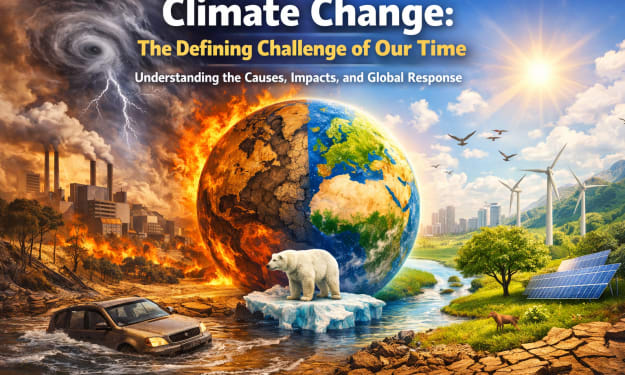
Climate Change: The Defining Challenge of Our Time
Climate change is one of the most pressing issues facing humanity in the 21st century. It refers to long-term changes in Earth’s temperature, weather patterns, and climate systems. While the planet’s climate has naturally changed throughout history, the changes observed today are occurring much faster and are largely caused by human activities. Scientists around the world warn that if these changes continue unchecked, they could have severe consequences for ecosystems, economies, and societies.
By Irshad Abbasi 2 days ago in Earth



Comments
There are no comments for this story
Be the first to respond and start the conversation.