
Amazing Animals Guinea-Bissau
Wildlife of West Africa

Guinea-Bissau is bordered by Senegal to the north, Guinea to the east and south and the Atlantic Ocean to the west.
National Bird

Black-Crowned Crane
African buffalo have heavy, ridged horns that go straight out from the head and curve downward, then up. They are widely regarded as dangerous. These buffalo live in a wide range of habitats so long as there is plenty of access to water and grass. They are known to gather in herds of thousands.
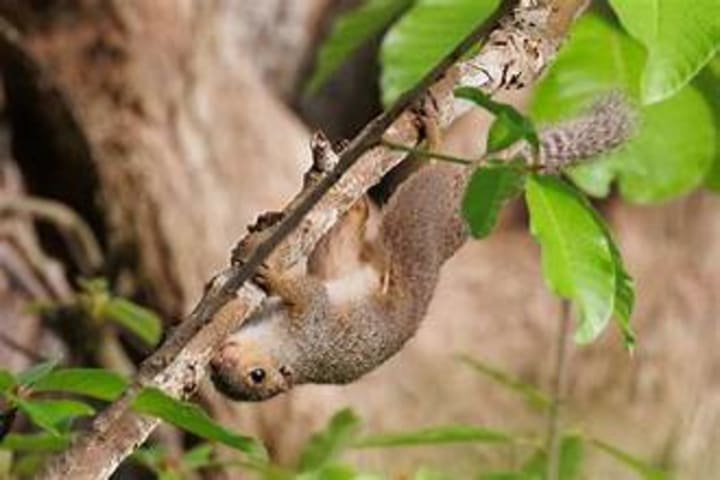
Gambian sun squirrels are arboreal animals spending most of their time in the upper branches of trees in dense woodland savannas. They will feed on nearly anything they can, including insects, seeds, fruit, acacia pods, lizards, geckos, young birds, small mammals, and palm nuts. These are solitary animals.

Honey badgers have stocky bodies, large heads, small eyes, strong, wide forefeet, small hind feet with short claws, muscular necks and shoulders, and thick, loose skin. They feed on snakes, birds, eggs, frogs, and small rodents. These animals will also seek out bee hives to eat the larvae and honey inside.
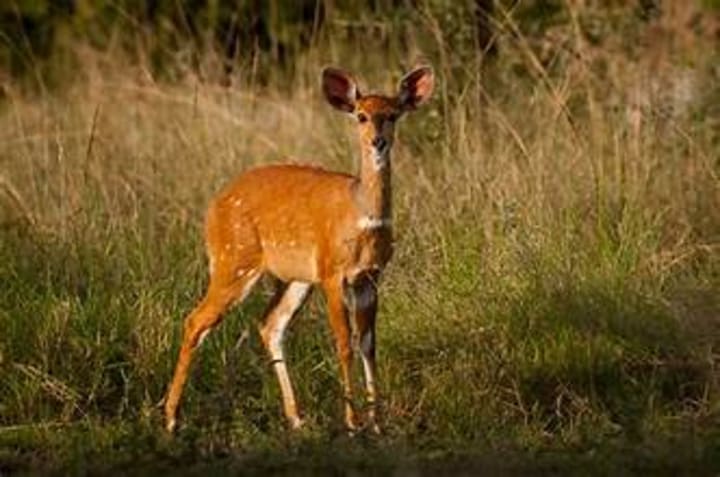
Northern bushbucks are reddish, yellow-brown or light brown with white spots and stripes. Adult males have parallel horns. They inhabit wooded areas staying on forest edges and in brush areas with river and streams. They are good swimmers and can cross rivers.

Red-legged sun squirrels have large eyes and tails and small rounded ears. They live in areas with large trees including plantations, primary and secondary forests, and patches of trees in savannas and gardens. These squirrels eat fruit and seeds but can also feed on vegetation and insects. They are usually found alone or in pairs.
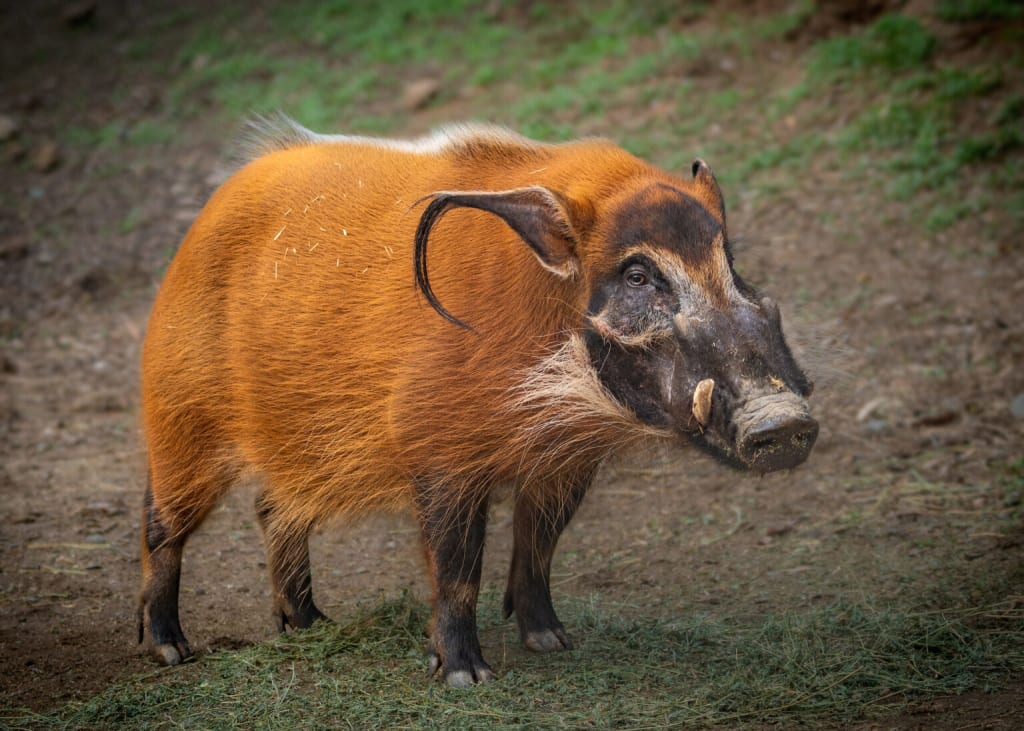
Red river hogs (pictured above) are reddish with a white stripe down their backs. Both sexes have tusks. They inhabit places with thick vegetation and don’t venture far from the rainforest. Red River Hogs are social creatures that usually live in groups called “sounders.” These groups typically consist of one male and 2 to 15 females and their young.

Straw-colored fruit bats are the second largest species of fruit bat in Africa. They are referred to as flying foxes due to their size, There are social animals that live in large colonies of 100,000 to 10,000,000. These bats mostly feed at night searching for food in nearby forests.

Rock hyraxes have short snouts, stout legs, and fleshy soles on their feet, They are brownish-gray with creamy undersides, These are small animals but are not rodents they closest living relatives are elephants and manatees. Rock hyraxes inhabit rocky, scrub-covered areas. Their feet also have a depression in the center that acts a bit like a suction cup so they are good rock climbers. These animals usually live in colonies called “kopjes,” ranging from 5 to 60 individuals. Usually, these groups are made of a male, several females, and their young.

Stripped ground squirrels have brown to reddish or yellowish fur and white or buff stripes down each side. These squirrels don’t climb trees their claws are suited for digging and running along the ground. Female Striped Ground Squirrels tend to be highly social and often live in groups of 6 to 10.

Warthogs have thick protective “warts” on the sides of their heads and two upper tusks that protrude from their snouts. Sparse bristles cover their bodies and there are tufts of long hair at the end of their tails. Their habitats include wooded savannas, grass steppes, and semi-deserts. They use their strong, blunt snouts and tusks to dig up and eat tubers, bulbs, and roots.
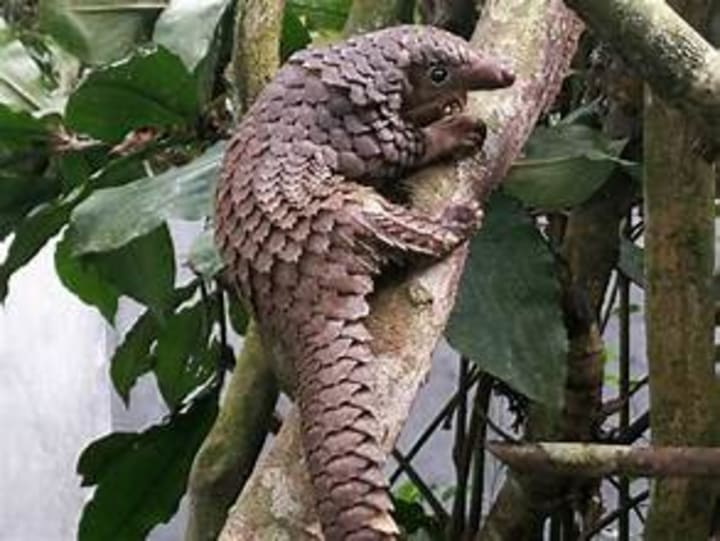
White-bellied pangolins are unusual animals and their bodies are covered by keratin scales. They have small pointed heads, long tongues, large curved claws, and prehensile tails. They live in tropical, moist, lowland forests and feed exclusively on ants, ant eggs, termites, and termite eggs.
Birds
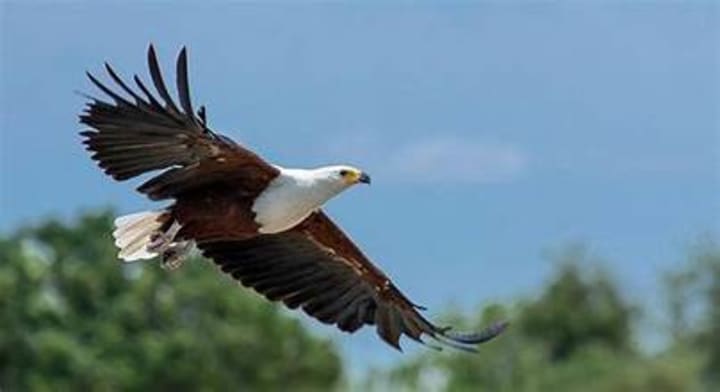
African fish eagles with their striking appearance and distinctive calls.
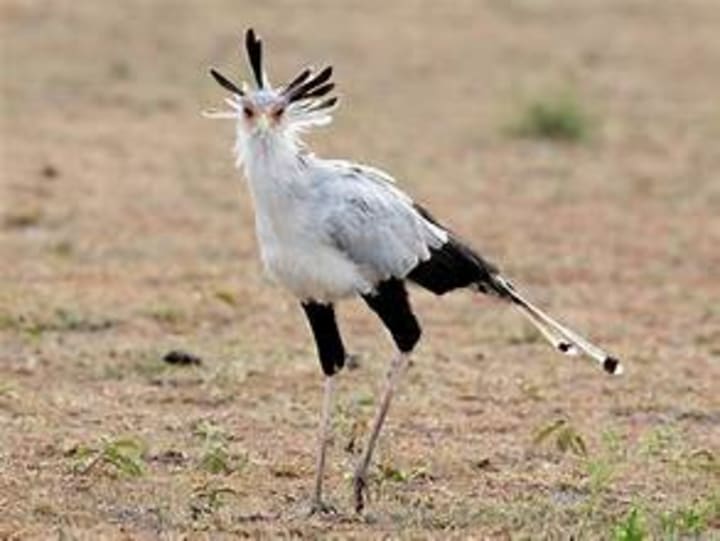
Secretary birds with long legs and stunning black feather crest on the back of their heads.
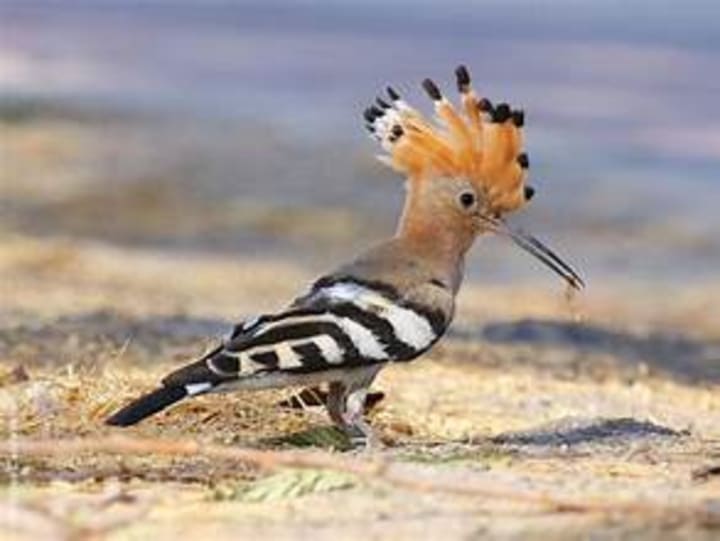
Eurasian hoopoes with their muscular bodies.
About the Creator
Rasma Raisters
My passions are writing and creating poetry. I write for several sites online and have four themed blogs on Wordpress. Please follow me on Twitter.
Keep reading
More stories from Rasma Raisters and writers in Earth and other communities.
Amazing Animals Ghana
The African country of Ghana has 221 amphibian and reptile species, 724 bird species, and 225 mammals. Ghana is an African country located in the western part of the continent, below the Sahara. It boasts a wide variety of biomes, from coastal savannas to tropical rainforests, and it used to be a British colony.
By Rasma Raisters6 months ago in Earth
Man Shot and Killed During Minneapolis Immigration Crackdown Graduated from Preble High School
A man shot and killed during an immigration enforcement operation in Minneapolis has been identified as a graduate of Preble High School, a detail that has added a deeply personal dimension to an already controversial crackdown. As authorities continue to investigate the circumstances surrounding the fatal shooting, community members, former classmates, and civil rights advocates are demanding transparency, accountability, and a broader review of how immigration enforcement actions are being carried out.
By Salaar Jamaliabout 16 hours ago in Earth
God Is Truly the Provider
I was sitting in Haji Sahib’s spacious drawing room, waiting for him to arrive. As I looked around, I noticed expensive decorative items, a fine globe, a large colorful television, a beautiful telephone, and artificial vines attached to the walls. The furniture was of high quality, and the sofas were so soft that one almost sank into them.
By Sudais Zakwan2 days ago in Earth



Comments
There are no comments for this story
Be the first to respond and start the conversation.