
A New Super-Earth: Chinese-Led Team Discovers Promising Planet in Habitable Zone
Scientists discover super-Earth planet in Sun-like star's habitable zone

A New Super-Earth: Chinese-Led Team Discovers Promising Planet in Habitable Zone
The question "Are we alone in the universe?" has been pondered by humanity. for many generations. For a very long time, scientists have wanted to find another Earth, a planet where life could exist. We may be one step closer to finding out thanks to a significant breakthrough made by Chinese researchers in collaboration with German institutions. The Promising Super-Earth Kepler-725c An international team led by the Yunnan Observatories of the Chinese Academy of Sciences discovered a new super-Earth in the habitable zone of a sun-like star. This newly detected planet, Kepler-725c, orbits a star nearly 2,472 light-years from Earth and holds exciting potential for life.
If you want to know more : Read this
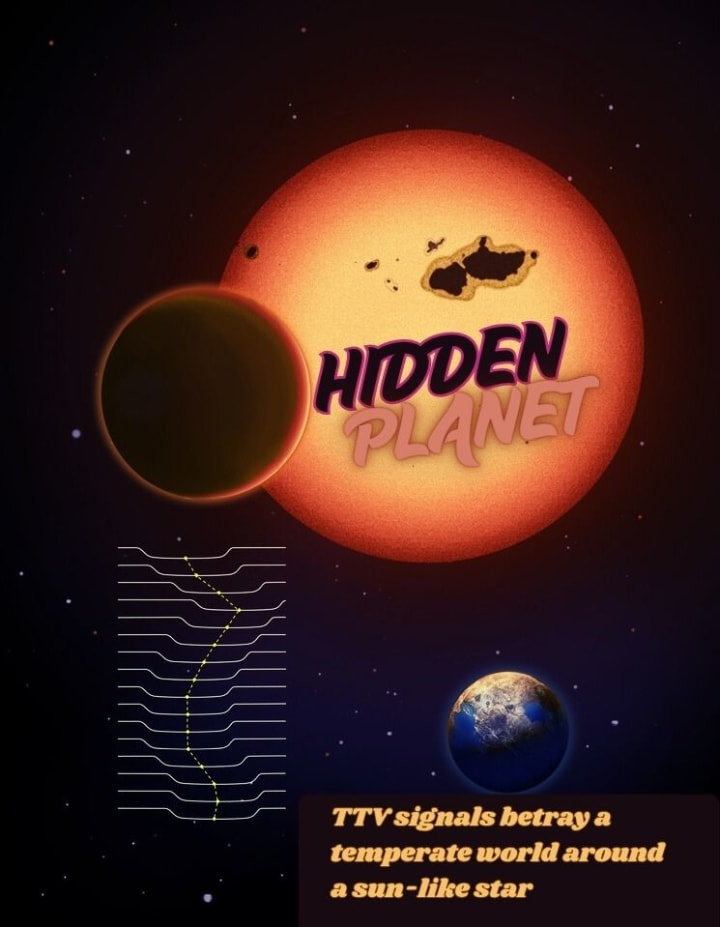
What makes this discovery especially groundbreaking is the method used: Transit Timing Variation (TTV). This represents a significant advancement in the search for extraterrestrial worlds because it is the first time that TTV has been utilized to successfully identify an exoplanet that might be habitable.
What does "Super-Earth" mean?
A "super-Earth" is a planet that is larger and more massive than Earth but smaller than gas giants like Neptune. Kepler-725c is massive enough to be classified as a super-Earth but still a possibility for Earth-like conditions due to its estimated mass of around ten times that of Earth. Most importantly, Kepler-725c is in its star's habitable zone, which is the orbital region where liquid water, a necessary component of life as we know it, can thrive in the right conditions.
The Magic Behind the Discovery: Transit Timing Variation (TTV)
The TTV method, in contrast to conventional approaches like transit photometry and radial velocity, which call for either direct observation of a planet passing in front of its star or measurement of the planet's gravitational "wobble," focuses on something more nuanced: variations in the timing of a planet's known orbit. In this instance, the gas giant Kepler-725b, which orbits its star every 39.64 days, was closely studied by astronomers. Slight deviations in the timing of its orbit suggested that another, unseen planet was gravitationally influencing it. That planet turned out to be Kepler-725c.
The study's first and co-corresponding author, Sun Leilei, explained: “The TTV method allows us to uncover invisible planets that do not transit their host stars or cause detectable radial velocity signals. It opens a new pathway to explore potentially habitable worlds.”
The Importance of This The successful application of TTV provides a "new, powerful tool" for the search for planets with low masses and long periods, particularly those that orbit sun-like stars in the habitable zone. It also helps compensate for the limitations of other detection methods, especially when a planet doesn’t pass directly in front of its star from our viewpoint.
"This is a crucial step in answering the age-old question: Are we alone in the A Leap for Chinese Space Science
This discovery not only marks a significant turning point in China's expanding role in space exploration, but it is also a victory for planetary science. Several institutions carried out the research, including: Yunnan Observatories of the Chinese Academy of Sciences
"Xiaotong University and Liverpool University" Nanjing Institute of Astronomical Optics and Technology Hamburg Observatory (Germany)
More excitingly, the findings will inform and support future Chinese missions, including the China Space Station Telescope (CSST) and the ambitious Earth 2.0 (ET) Project.
These initiatives are expected to further enhance our ability to locate and analyze exoplanets — possibly even confirming which ones are truly capable of sustaining life.
The Next Big Questions
Scientists are quick to point out that even though Kepler-725c's location in the habitable zone makes it a tempting candidate, more research is required. The planet’s actual atmosphere, surface conditions, and composition remain unknown. Future missions may use techniques like:
Exoplanet transmission spectroscopy
Spectroscopy of emissions "Direct imaging"
These methods will help determine whether Kepler-725c has liquid water, a stable atmosphere, and perhaps even signs of life.
As "Gu Shenghong", team leader from Yunnan Observatories, noted:
"It requires further investigation to assess whether the discovered planet truly possesses conditions suitable for Earth-like life."
A New Era in the Search for Life
The discovery of Kepler-725c represents more than just another exoplanet. It's a "symbol of human curiosity and technological advancement" and a sign that our ability to answer some of the most fundamental questions about the universe is getting better. With more advanced telescopes on the way — from both China and international missions like PLATO and ARIEL — the search for a second Earth is entering an exciting new chapter.
“This is just the beginning,” Sun Leilei said. The TTV method "could assist us in uncovering many additional worlds that could one day reshape our understanding of universe life."
About the Creator
Keep reading
More stories from ARJU RAHMAN and writers in Earth and other communities.
Erin Patterson murder trial
After overindulging in dessert, an Australian woman on trial for murder claims that she threw up the poisonous mushroom meal that killed her relatives. In connection with the beef Wellington lunch that was served at Erin Patterson's regional Victorian home in July 2023, she has pleaded not guilty to four charges, three of which involve murder and one of attempted murder. Prosecutors allege Ms Patterson deliberately served toxic death cap mushrooms, but only to her guests. The contaminated meal, according to her defense team, was a tragic accident that had also made their client sick. Ms Patterson told the court she had only eaten a small part of lunch but later consumed two-thirds of a cake, before becoming "over-full" and vomiting.
By ARJU RAHMAN 8 months ago in Criminal
Without Democracy, Donald Trump’s Venezuelan Oil Quest Will Fail
Donald Trump’s renewed interest in Venezuelan oil may seem, on the surface, like a hard-nosed geopolitical calculation. Venezuela holds the world’s largest proven oil reserves, and amid global energy uncertainty, access to those resources is undeniably tempting. But history, economics, and politics all point to the same conclusion: without democratic reform in Venezuela, any attempt by a Trump-led US administration to secure reliable Venezuelan oil will ultimately fail.
By Aarif Lashari5 days ago in Earth
So You Decided To Become a Nurse Practitioner:
So you decided to become an "Advanced Practice" nurse. Congratulations!... is what I would say if this was a good idea. Grad school? In this economy? What were you thinking? Likely it was something along the lines of either 1) “I've seen these other chucklefucks do it— Why can't I?” or even 2) “I've got a nice career, I should shake it up. I miss feeling like I have no clue what I'm doing.”
By Sandor Szabo2 days ago in Fiction




Comments (1)
This discovery is huge! Using TTV to find a potentially habitable super-Earth is a game-changer. Can't wait to learn more.