
A Day Without Water: The Cost of Climate Change in Daily Life
Water scarcity isn’t the future—it’s now, and this is how it feels.

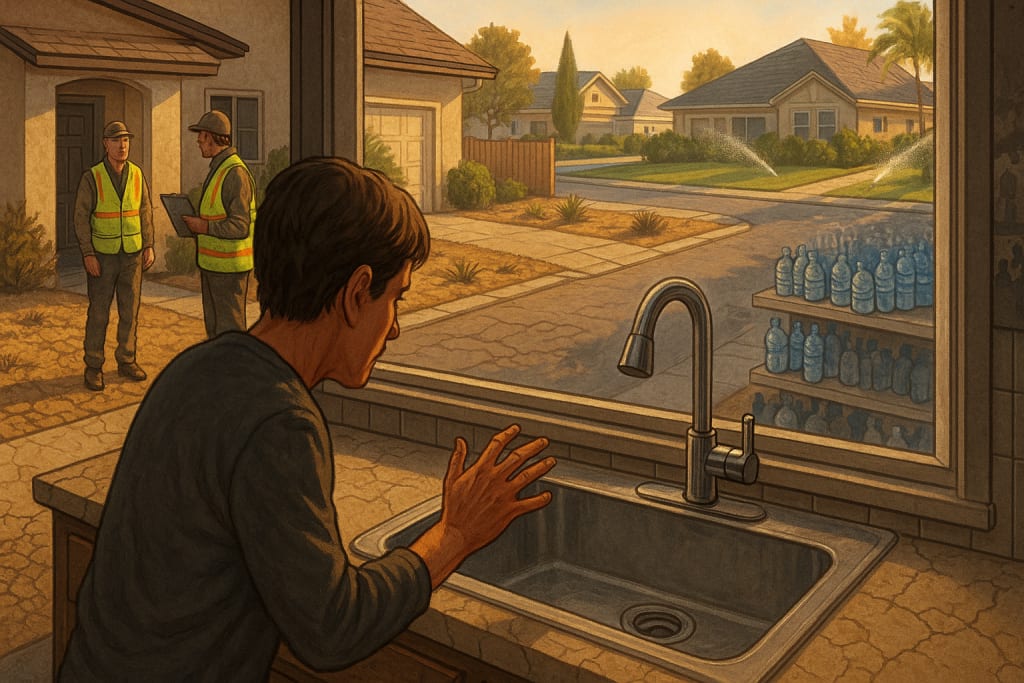
It started with a knock on the door at 6:15 a.m.
A local official in a reflective vest stood outside, clipboard in hand, eyes tired. “We’re shutting off the water for 24 hours,” he said. “Possibly longer. The reservoir’s below critical. Please conserve what you have.”
I blinked, half-awake. “No water at all?”
He nodded. “Not a drop.”
I live in a town outside Bakersfield, California. We’re in what's officially called a “severe drought zone”—but the language doesn’t do it justice. The rivers are dry, the soil cracks like a broken plate, and summer brings heat that feels like standing inside an oven. That day, our taps went dry. And suddenly, water—a resource I had always taken for granted—became a luxury.
When the Faucets Fail
The first thing you notice in a day without water is just how many times you instinctively reach for it.
To brush your teeth. To boil water for coffee. To flush the toilet. To wash your hands, especially after the pandemic drilled that habit deep into us.
By 9 a.m., I had already reached for the faucet seven times. Each time, silence answered back.
Our local grocery store was mobbed by mid-morning. The water aisle was stripped bare. People walked out with carts stacked high with plastic gallons. One woman cried in the parking lot because she couldn’t find any for her newborn’s formula.
This wasn’t a movie plot. This was a Tuesday.
A Growing Global Problem
According to the World Health Organization, over 2 billion people already live in water-stressed countries. And climate change is making it worse. Longer droughts. Shrinking glaciers. Unreliable rainfall.
Closer to home, the American West is facing what researchers now call a “megadrought”—a once-in-a-thousand-year event, worsened by rising global temperatures. A 2022 study published in Nature Climate Change found that the period between 2000 and 2021 was the driest in the region in over 1,200 years.
Water isn’t disappearing—it’s being redistributed unevenly, hoarded by dry heat, evaporated by extremes.
Life on Rationed Time
By midday, I’d begun rationing the three bottles I had. Half a bottle for cooking, a few sips to stay hydrated, a splash for wiping my hands with a towel.
I skipped lunch to avoid needing water for cleanup. I didn’t shower. I flushed once. That was it.
By sunset, it wasn’t just physical discomfort—it was a creeping panic. What if this lasted longer than a day? What if this became the new normal?
I thought of Cape Town, South Africa, which nearly hit “Day Zero” in 2018, when taps would have been turned off citywide. Only extreme conservation measures helped them avoid full shutdown. But even now, Capetonians live with water limits—50 liters (about 13 gallons) per person, per day.
In contrast, the average American uses about 82 gallons daily.
The Inequity of the Water Crisis
During our outage, I noticed something else: some houses still had water.
Upscale developments nearby had private wells. Their sprinklers still clicked on at dusk. Their lawns glowed green, while our yards turned to dust.
That’s the unspoken reality of the climate crisis—those with the least suffer the most. In developing nations, entire villages walk hours for drinking water. In cities like Flint, Michigan or Jackson, Mississippi, unsafe water is a daily threat.
Drought doesn’t just dry up rivers—it exposes injustice.
Hope in Conservation
But it’s not all bleak. Solutions exist.
Places like Singapore have implemented high-tech recycling systems that reuse wastewater for drinking. Israel uses drip irrigation to grow crops with minimal waste. Cities like Las Vegas pay homeowners to rip out lawns and install desert landscaping, conserving millions of gallons each year.
Even small actions help: turning off taps while brushing, fixing leaks, collecting rainwater, and rethinking water-intensive habits.
We can’t control the rain—but we can change our behavior.
The Last Drop
At 6:42 a.m. the next day, the water returned with a gurgle. I stood over the sink and watched it pour—cool, clear, endless.
I let it run for a full minute before I stopped myself. Guilt trickled in.
Because now, I knew what it meant to live without it.
Not just to miss it—but to fear its absence. To count every drop like currency. To see how fragile “normal” can be.
We need to stop asking what climate change will do in the future—
We need to ask who’s living through it right now.
And more importantly—what are we doing about it?
About the Creator
majid ali
I am very hard working give me support
The Ongoing Search for Water on Mars
For decades, scientists have been fascinated by the possibility of water on Mars. Known for its dry, dusty landscape and reddish appearance, Mars was once thought to be a completely barren world. However, modern discoveries have revealed that the planet may have once had abundant water—and scientists are still searching for evidence of it today.
By Irshad Abbasi 5 days ago in Earth


Comments
There are no comments for this story
Be the first to respond and start the conversation.