
6 Minutes of Darkness: Get Ready for the Longest Eclipse of the Century That Will Turn Day Into Night
A rare total solar eclipse will plunge parts of Earth into nearly six minutes of totality — an extraordinary celestial event that promises breathtaking skies, dramatic temperature drops, and a once-in-a-lifetime cosmic experience.
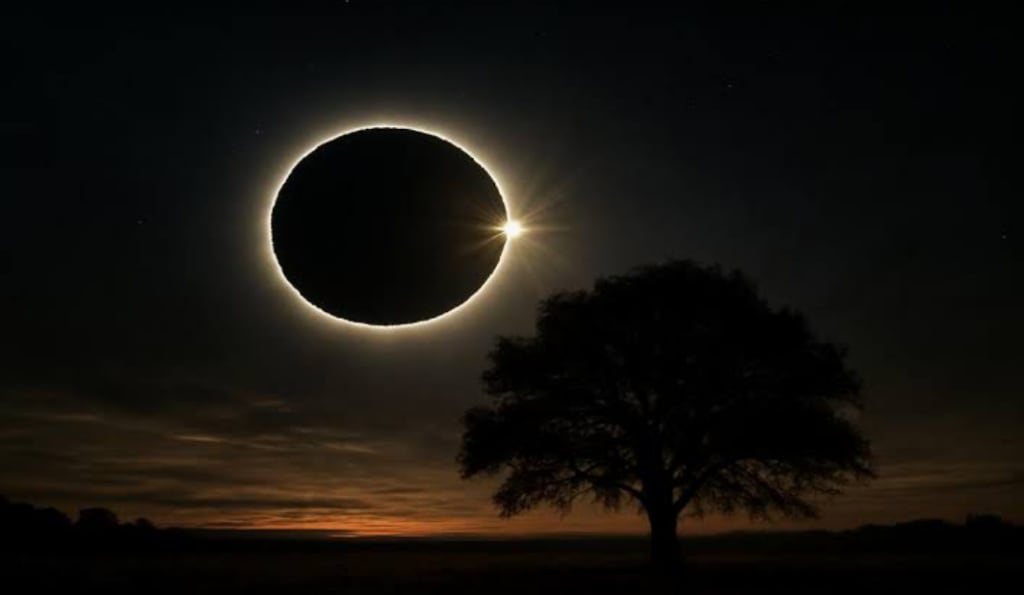
There are few moments in life when the world seems to pause entirely. The longest eclipse of the century promises to be one of those moments — six unforgettable minutes of darkness in the middle of the day, when the Moon will completely block the Sun and turn daylight into an eerie twilight.
For skywatchers, scientists, and curious minds alike, this is more than just another astronomical event. It is a rare cosmic alignment that will remind us how small we are in the vast universe — and how extraordinary our view from Earth can be.
What Is a Total Solar Eclipse?
A total solar eclipse occurs when the Moon passes directly between the Earth and the Sun, casting its shadow onto Earth’s surface. For observers located within the narrow “path of totality,” the Moon completely covers the Sun’s bright disk.
During those precious moments, daylight fades dramatically. The sky darkens. Stars may appear. The Sun’s glowing outer atmosphere — called the corona — becomes visible, forming a shimmering halo around the black silhouette of the Moon.
Most total solar eclipses last only two to three minutes at any given location. However, this upcoming event is expected to last close to six minutes in some areas, making it one of the longest eclipse experiences of the 21st century.
Why Will This Be the Longest Eclipse of the Century?
The duration of a total solar eclipse depends on several astronomical factors aligning perfectly.
First, the Moon must be relatively close to Earth in its elliptical orbit, making it appear slightly larger in our sky. At the same time, Earth must be slightly farther from the Sun, which makes the Sun appear marginally smaller. When these two conditions occur together, the Moon can cover the Sun more completely and for a longer period.
Additionally, the eclipse path must cross regions near Earth’s equator, where the planet’s rotational speed is greatest. This subtle detail allows the Moon’s shadow to linger just a bit longer over certain locations.
When all these cosmic variables align, the result is an extended totality — and in this case, nearly six full minutes of darkness that will turn day into night.
What Happens During the Six Minutes of Darkness?
As the eclipse approaches totality, the world begins to transform.
Shadows sharpen and curve into crescent shapes. The light takes on a strange metallic tone. Temperatures can drop several degrees within minutes. Birds may fall silent or return to their nests. Some animals behave as though night has arrived unexpectedly.
Seconds before totality, a dazzling flash known as the “diamond ring effect” appears — a final burst of sunlight peeking around the Moon’s edge. Then, suddenly, the Sun disappears.
For six surreal minutes:
The sky resembles deep twilight.
Bright planets such as Venus or Jupiter may become visible.
The Sun’s corona glows in delicate, silver-white strands.
A 360-degree sunset effect circles the horizon.
It is not complete darkness like midnight, but rather an otherworldly dimness that feels suspended in time.
Then, just as abruptly as it began, a thin beam of sunlight reemerges. The diamond ring flashes again. Daylight returns, and life resumes its normal rhythm.
Where Will Day Turn Into Night?
Only those within the path of totality will experience the full six minutes of darkness. This path is typically narrow, stretching across select regions of continents and oceans.
Outside the path, observers will see only a partial eclipse, where the Moon covers part of the Sun but never fully blocks it. While still impressive, a partial eclipse does not produce the dramatic transformation that totality delivers.
For those eager to witness the longest eclipse of the century, early planning is essential. Major eclipses often draw travelers from around the globe, filling hotels and creating heavy traffic along the path of totality.
For many, it is worth the journey.
The Science Behind the Spectacle
One of the most fascinating aspects of a total solar eclipse is the cosmic coincidence that makes it possible. The Sun is about 400 times larger than the Moon — but it is also roughly 400 times farther away from Earth. This proportional balance causes both objects to appear nearly the same size in our sky.
Because of this rare alignment of size and distance, the Moon can perfectly cover the Sun’s bright surface, revealing the faint corona that is otherwise invisible.
Scientists use long eclipses to study the Sun’s outer atmosphere, solar flares, and magnetic fields. Even in an age of advanced satellites and space telescopes, total solar eclipses still offer unique research opportunities.
Beyond the science, however, lies the human experience — one that words often struggle to fully capture.
A Shared Global Moment
Throughout history, solar eclipses have inspired awe, fear, and wonder. Ancient civilizations often viewed them as omens or divine messages. Today, we understand the precise mechanics behind them, yet the emotional impact remains just as powerful.
There is something profoundly humbling about watching the Sun — the source of all life on Earth — temporarily vanish.
For six minutes, millions of people may look upward together. Strangers may cheer. Some may cry. Others may stand in silent reflection. In a world filled with constant motion and noise, a total solar eclipse forces us to pause.
It reminds us that we are all part of the same cosmic dance.
How to View the Eclipse Safely
While totality is safe to view with the naked eye, every other stage of the eclipse requires proper eye protection. Looking directly at the Sun without certified eclipse glasses can cause permanent eye damage.
To stay safe:
Use ISO-certified eclipse glasses.
Never rely on regular sunglasses.
Ensure cameras, telescopes, and binoculars have approved solar filters.
Remove glasses only during totality, and replace them immediately when sunlight returns.
Preparation ensures that the experience remains both unforgettable and safe.
Why You Shouldn’t Miss It
The longest eclipse of the century is not just another date on the calendar. It is a once-in-a-generation opportunity to witness the universe in motion.
Six minutes may not seem long in everyday life. But when the Sun disappears and the sky darkens in the middle of the afternoon, those six minutes stretch into something extraordinary.
It is a reminder of the beauty of science.
A demonstration of celestial precision.
A shared human experience under one sky.
When day turns into night, even briefly, the world feels different.
And for six remarkable minutes of darkness, we will stand together beneath the Moon’s shadow — watching history unfold above us.
About the Creator
Keep reading
More stories from Aqib Hussain and writers in Earth and other communities.
Global Economy Must Move Beyond GDP to Prevent Planetary Disaster
When we hear about the global economy, one number usually dominates the conversation: GDP, or gross domestic product. For decades, it has been the gold standard for measuring economic success. But according to United Nations Secretary-General António Guterres, this single-minded focus on GDP is not only outdated—it’s dangerous.
By Aqib Hussain2 days ago in Earth
“Train of Two Storms” Signals a Major Shift in Bay Area Weather
After weeks of relatively dry and stable conditions, the Bay Area is preparing for a noticeable change in weather. Meteorologists are tracking what they describe as a “train of two storms,” a back-to-back weather pattern that could reshape the region’s forecast over the coming days.
By Adil Ali Khan3 days ago in Earth
Foot Bindings
I asked my grandmother how she knew she'd fallen in love. I am not sure I ever did love him, she said. This was before I met my husband. I was naive, a naked spring, a raw nerve of a thing. That cannot ever be me, I knew. Sadness swept in gently like a Moscow thaw. It is no simple thing, looking into a woman's vast soul and seeing its foot bindings. Now, in Italy divorced with my skin singed off, when I say I don't love him mean: I have succeeded at feeling nothing most days and it mostly works. Do you want the comfort of Nothing? Do you want Nothing, too? Be warned: you'll never be free, even when you are nothing. Here is what doesn't work: Accepting the stages of grief. Talking about it. Sitting with the feeling. Missing him—no, the person you were when you believed in death do us part. Writing poetry. That, too. When I say I don't love him I mean: I feel capsized in an endless, starved tide. What sometimes works: selective memory. You must forget ripe tomatoes and his beard and feeling perfectly sheltered in a big blue world. Forget coffee in bed, laughter watching TV, blowing out the candles on the birthday cake and the quiet all-encompassing knowledge that you are chosen. Remember only how love turned to a banal everyday survival act, a trapeze act unsure whether he will catch you, how the warmth stagnated and became sour, remember the foot bindings and remember the resentment boiling in your veins as you stick it out for the kids. Six-hour Netflix binges help, too. A man's fingers tracing your spine. Frozen pizza at 2 a.m. Random trips to the museum just to stand near things that last a while. The realization that crying won’t change anything. Seeing that life is just a dream, and refusing to participate in your own suffering. Bite your fist. Walk on eggshells around joy. When I say I don't love him, I mean he didn’t break my heart, he just stopped touching it and it forgot how to beat right.
By Ella Bogdanova4 days ago in Poets



Comments
There are no comments for this story
Be the first to respond and start the conversation.