
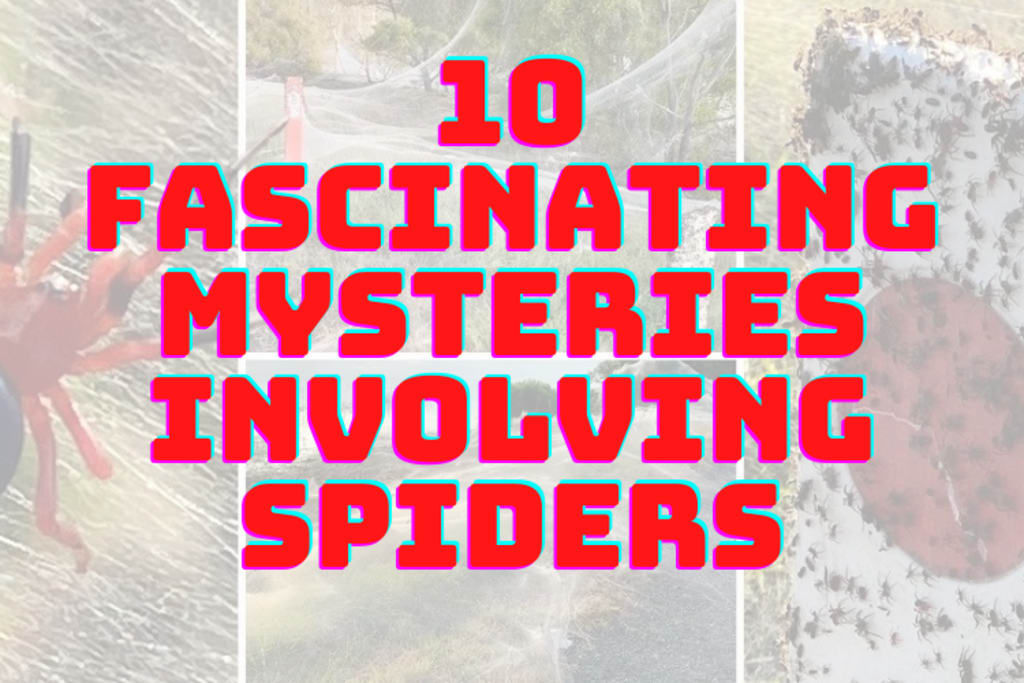
10 Fascinating Mysteries Involving Spiders
One of the most intriguing animals in the natural realm is the spider. Sadly, they are also the most feared and misunderstood. Many of the mysteries surrounding these arachnids have been answered with the aid of science. However, several questions have never been fully clarified.

10 Blue Tarantulas
There are more than 850 known species of tarantulas worldwide. Some can shoot excrement as a form of defense, while others can grow to be as large as a human face. Then there are those that are bright blue in color for no apparent reason. Experts believe that the hue blue has a significant function. They "do not yet know what that [particular] role is," though. The most likely theory relates to sexual selection. Scientists hypothesize that the tarantulas' bright hue aids in luring prospective mates. However, Bor-Kai Hsiung of the University of Akron argues that this theory is unlikely to be accurate because tarantulas have extremely weak eyesight despite having eight eyes.
9 Bizarre Web Formations In The Amazon
Troy Alexander found a number of enigmatic webs in the Tambopata Research Center in Peru in 2013. A little sphere in the middle of each web was encircled by a circle-shaped fence. The specialists he questioned were unable to identify the structures. A few months later, he returned to Peru, determined to solve the riddle. When he saw that the sphere within the fence was an egg sac holding a spiderling, he realized that his perseverance had finally paid off.
Scientists are still unsure of what species is responsible for the strange webs, though. They haven't yet figured out the fence's precise function either. However, they have two theories. One is that the fence serves as some sort of protection against ants, guarding the egg sacs. The other is that after the spiderlings hatch, they can eat the termites it has captured.
8 The Humongous Size Of Antarctica’s Sea Spiders
The enormous sea spider, which is 100 times larger than its counterparts, is one of the strange and unsettling organisms that can be found in Antarctica. Due to the extremely freezing temperatures, this spider species experiences polar gigantism, which causes animals to grow larger than their counterparts in warmer regions of the Earth.
Sea spiders typically measure 2 to 3 millimeters (0.08 to 0.12 in) in diameter in Europe and America. They can, however, reach a diameter of 30 to 35 centimeters (12 to 14 inches) in the Antarctic region.
Although experts do not yet know how or why the sea spiders of Antarctica have grown to such enormous sizes, they are putting one compelling theory to the test. According to Bret Tobalske of the University of Montana, the sea spiders' huge growth was caused by the Antarctica's subfreezing temperatures, which allowed them to reduce "their metabolism to the point where they scarcely need oxygen."
7 Ability To Not Get Trapped In Their Own Webs
Why spiders don't get entangled in their own webs is a mystery to scientists, although there are several theories. The main issue is that there isn't much evidence to support it. French scientist Jean-Henri Fabre proposed one compelling theory that appears to partially resolve the enigma in 1905. He deduced that spiders create an oily covering to shield them from their own sticky webs after seeing that they "often dragged their legs across their mouth parts." In 2011, a group of Swiss researchers replicated Fabre's experiment, confirming this notion.
The tiny barbs on spiders' feet and the angle of their legs, among other strategies, allow them to escape becoming impaled in the sticky goop of their webs, according to a 2012 study by Costa Rican experts. This implies that a number of defense mechanisms are employed to shield spiders from their own death traps.
6 Origins Of Spider Venom
Scientists are still perplexed by the genesis of spider venom, which is a scientific enigma. The venom of spiders originated from a variety of sources, as opposed to the venom of lizards and snakes, which can be traced back to a single species.
Understanding the origins of spider venom and its complex mechanics is crucial for both academic and medical reasons. Innovative medications and new kinds of insecticides can be made using spider venom. In fact, it is being researched as a possible treatment for breast cancer.
Many scientists think that non-toxic hormones with a specific function were the precursors to spider venom. These hormones "grew more and more militarized" through time, eventually developing into the dangerous spider venom we are familiar with today. However, they acknowledged that it is quite challenging to figure out how those hormones changed from being safe to hazardous.
5 Orb Spiders Of Madagascar
The Madagascar orb spiders are renowned for their extraordinary capacity to spin enormous webs. Their huge webs may completely encircle a Volkswagen Beetle. Orb spiders are smaller than the typical adult's thumb, despite this.
The orb spiders of Madagascar are exceptional for two reasons. First, compared to other species' silk, theirs is stronger. Second, and this amazes experts, they construct their webs above flowing water, like as rivers and streams. No concrete evidence exists to support any one theory on how they are able to achieve this.
Scientists are also baffled as to why orb spiders create such enormous webs. Does this imply that the size of their prey is similarly enormous?
4 Ability To Crawl Pretty Much Anywhere
For our benefit, scientists have already solved this riddle. The little hairs on the ends of spider legs allow them to move on practically any surface. These tens of thousands of hairs are bendable and stretchy. The spider's ability to cling to the surface is improved because they "provide several contact points between the spider and the surface."
Spiders only briefly cling to surfaces, as opposed to barnacles, which cling to items permanently. This special talent, also known as dynamic attachment, is comparable to Post-it notes. Simply put, barnacles are like superglue and spiders are like Post-it notes.
We won't be donning Spider-Man outfits any time soon, despite the fact that scientists have finally figured out the science underlying spiders' remarkable capacity to move almost everywhere. Simply put, we "are too hefty for [them] to work."
3 Spider Rain In Goulburn, Australia
In 2015, the occupants of Goulburn, Australia, encountered a baffling peculiarity that made them keep thinking about whether they were being attacked by bugs. It really came down bugs. Short-term, numerous region of the city got canvassed in networks and a large number of child bugs. Fortunately, the insects were innocuous.
However, the secret didn't keep going long. Martyn Robinson, a naturalist from the Australian Museum, quickly gave a logical clarification. As indicated by him, the occupants of Goulburn had encountered swelling, a dispersal procedure that insects use to relocate.
This unique capacity to outfit wind and a decoration of silk is the motivation behind why all mainlands, even Antarctica, have insects. In any case, because of the outrageous temperatures of the Frozen Continent, the bugs that end up there ultimately pass on.
2 How Spiders Create Silk
Spider silk is amazingly lightweight and elastic while yet being sturdy. Spidrons, a kind of silk protein, which are kept in specific glands by spiders, are used to make it. Scientists have been unable to determine how spiders convert the gel-like spidroins into solid silk for many years. But only lately was the enigma solved by a team of Swedish experts.
The researchers found that a shift in acidity is what causes the transition from a gel-like to a solid state. An enzyme known as carbonic anhydrase causes the pH to gradually change from neutral 7.6 to acidic 5.7. It happens as the spideroins pass through its glands.
1 Do Tarantulas Shoot Silk From Their Legs?
According to a research published in 2006 by scientist Stanislav Gorb, zebra tarantulas may shoot silk strands from their foot to aid in climbing a glass wall. Gorb's assertion was refuted by entomologist Fernando Perez-Miles in 2009. He repeated Gorb's experiment, but this time he imprisoned the tarantulas' spinnerets (the glands that release silk). He carried out the experiment but discovered no silk traces on the glass wall.
Interestingly, he found that as the tarantulas scaled the wall, they would "rub their rear legs against the open spinnerets." This suggested that rather than the tarantulas' legs, the spinnerets produced the silk that Gorb had discovered.
The narrative didn't end there, though. According to an experiment done in 2011 by Claire Rind of Newcastle University, tarantulas would shoot silk from their foot "as a lifeline to save themselves."
Do tarantulas actually spew silk from their legs? Before this riddle is fully solved, further research has to be done.
About the Creator
indika sampath
hello world
my name is indika sampath so I'm a article writer. you also can learn by reading somethings that important things.
thank you so much for visiting my profile
Keep reading
More stories from indika sampath and writers in Earth and other communities.
The Death of Lenny Lance on Christmas Day
It was a cold and snowy Christmas Day in the small town of Mapleville when the news of Lenny Lance's death spread like wildfire. Lenny, a beloved member of the community, had passed away unexpectedly in his sleep at the age of 47.
By indika sampath3 years ago in Earth



Comments
There are no comments for this story
Be the first to respond and start the conversation.